

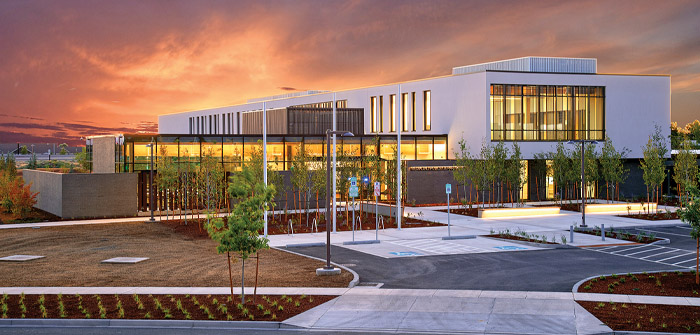
(Photo courtesy of Pence Contractors)
A ribbon-cutting ceremony, held August 12, heralded completion of the new 42,000-square-foot, state-of-the-art Redmond Public Safety Facility (RPSF), designed to give the City’s police department the necessary tools to better meet the current and future needs of the fast-growing Central Oregon hub.
Following the event, the public was invited to tour the $49 million two-story facility at 111 NW Teak Avenue alongside Highway 97, before it is slated to become the official new full-time home of the Redmond Police Department by August 25.
The new building is a marked improvement on the previous cramped 13,000 sq. ft. downtown headquarters, built in 1998, which the department had long since outgrown, and features more privacy for crime victims to meet with officers, high visibility locations for custody exchanges and marketplace transactions, and modern technology to help with policework and investigations.
The City estimated the Deschutes Avenue location was also costing nearly $30,000 in maintenance and repairs each year. Currently, the future of the building being vacated is to be determined.
The majority of the funding for the relocation project came from a 2022 voter-approved $40 million Bond issue, with the balance coming from 2021 American Rescue Plan Act (ARPA) funds, the City of Redmond and other sources.
Redmond Mayor Ed Fitch said, “On behalf of the City of Redmond, I would like to emphasize how grateful we are to our citizens for supporting construction of this superb new facility. It was their approval of the $40 million bond issue that made this vision possible.
“Everyone did a great job on the project, which came in on time and under budget.
“It is going to be a great facility for the police department going forward for many decades to come, and we were really happy that the community sees its police department as an integral part of their livelihood.
“I think everyone agrees that the police department does a great job here, and that was really evident during the National Night Out (the annual community-building campaign that promotes police-community partnerships and neighborhood camaraderie).
“The City of Redmond is blessed to have an outstanding police department. This marks the realization of a facility that matches the quality and commitment of our officers.”
The RPSF building is a welcome new home for the Redmond PD, as the former facility became too small to accommodate a growing staff and call volume, with its systems failing, according to the City.
Redmond Police Chief Devin Lewis said the new facility was crucially needed to keep up with the city’s significant population growth and increased community needs.
Redmond has experienced rapid growth since the former police station was built in 1998. The population has increased by nearly 41% since the 2010 census, and that facility was not built to keep up with such rapidly expanding and evolving community needs.
Redmond is acknowledged as one of the fastest-growing communities in Oregon, with a growth rate of over 25% since 2016. As a result, Redmond PD needed a significantly larger facility to accommodate the growth in staff to support their expanding population and community needs.
The facility was designed by FFA Architecture and Interiors, Inc. and built by Pence Contractors, with Bend-based Cumming Group, led by Project Management Director Wayne Powderly, serving as owner representative.
Construction was aligned to meet LEED (Leadership in Energy and Environmental Design) specifications, including electrical vehicle charging stations in the extensive visitor and staff parking areas, and an array of solar panels on the roof.
Redmond ARPA funds were used for acquisition of the eight-acre site, with a surplus area of approximately 1.5 acres anticipated to be developed over the next few years.
Chief Lewis added, “We are grateful for the support we have received from the community to make this project possible; it is a testament to our City’s leadership and the respect garnered by the dedicated men and women who serve Redmond.”
He said the project includes an emergency operations center, as needed, which doubles as a training room which can be utilized by the public as a multi-use space for group events.
Pre-design community interactions included attendees participating in image and word visioning exercises, shaping the design inspiration for the new facility; as well as engaging directly with the design team regarding the building program and site.
The FFA Architecture + Interior (FFA) team has honed a reputation for civic work, including in the public safety realm, and notably designed the 2017 reconstruction and revitalization of the 100+ year old historic Redmond Union High School building, which now serves as Redmond’s City Hall.
Architect/Associate with FFA Rachel Zanetti said, “Early on in the process we held community meetings for public feedback, and group sessions with Redmond PD, including input from departmental user groups as design progressed.
“We also conducted 3-D virtual reality walkthroughs and cost estimates to help with the funding application process, and tours of other public safety facilities in the state to identify best current practices.
“Throughout the project, we aimed to maximize local landscape vistas through view corridors in open shared spaces — without compromising safety — to emphasize that connection with the surrounding environment.
“In shadowing LEED standards, mechanical systems were designed in alignment with sustainable practices, with other elements including a full roof of solar panels, with infrastructure for additional modules in the future.
“The increasingly popular mass timber construction style employed utilizes large, prefabricated wood panels, beams, and columns to create strong, durable, and sustainable structures. It’s a viable alternative to concrete and steel, offering benefits like faster construction times, reduced environmental impact, inherent fire resistance and enhanced aesthetics.
“We had a great collaborative project team, alongside the City as exceptional partners in the process of creating a facility the community can be proud of and providing an enduring legacy.”
Throughout the project’s development, the design team focused on where people gathered in the facility and how those spaces could relate to the natural environment, whether through direct connection to landscape or through views of the surrounding mountains and Smith Rock.
The team worked to balance these direct and visual connections with concerns of security. These gathering spaces were also positioned to maximize chance interactions between staff members, aiming to strengthen relationships and team dynamics throughout the entire organization.
Community spaces were also carefully considered relative to the natural environment and privacy, including an entry path leading to a vestibule that separates the lobby from the community room. This gives more privacy to the lobby, which looks out into landscaped courtyards, with the connection to nature a key component of “trauma informed” design.
The landscape of Central Oregon was a key reference in the expression of the architecture. The use of mass timber and a heavy masonry base echoes the local environment and volcanic rock found on site, and weaves around captured exterior spaces.
The white stucco volume floats above the walls, contrasting the warm colors of the group plane and connecting to the snow-capped mountains in the distance.
In addition to FFA, the project team included civil and structural engineer KPFF, landscape architect Knot Studio, mechanical, electrical and plumbing contractor PAE, as well as general contractor Pence Contractors.
FFA facilitated workshops with 60-plus city staffers to ensure the new building met their needs. Ian Gelbrich, an FFA partner and design lead for the project, added, “There was careful consideration for the flow of staff through the building, and how to provide natural views without compromising security.”
Along with officer space, evidence rooms and storage, the new public safety base includes community benefits the former building couldn’t provide, like privacy for crime victims to meet with officers, abundant parking, and a facility built to leverage modern technology.
Wayne Powderly, project management director for Bend-based building consultant Cumming Group, said, “The old building is outdated and staff were squeezed in there like a sardine can. The new facility is a modern police station with the latest technology, which also offers room for potential expansion projects.”
Chief Lewis said the new lobby offers separate entrances for people accessing different services, to provide privacy, which is lacking at the current building.
He said, “Unfortunately, we previously have had people in there that are victims of crime trying to report a crime; and at the same time, we’ve had somebody who’s there trying to do their annual registration as a sex offender. Both of those people deserve auditory and visual privacy.
“There’s also more parking for employees and the public at the new site. Tied into that, there is a safe exchange area of two spots under 24/7 video surveillance, well-lit, right in the front of the police department, offering a safe place for custody exchanges or to pick up an item bought online.”
Other new amenities include holding cells, a sally port (a secure entryway, that allows for controlled access and egress for the safe transfer of individuals in custody), fitness rooms, wellness rooms, expanded locker rooms, increased evidence storage, separate spaces for each function within the department, a patrol room, break room, conference rooms, police dog kennels and a washing area. Protective glass and sound-proofed interview rooms are additional improvements.
Chief Lewis said, “The team visited other public safety facilities in the state including in Oregon City, Salem and Beaverton, to gain insights into best practices from each.
“When fully staffed the new facility will accommodate 70 people, while the previous one was designed for 36, and we outgrew it fairly rapidly.
“This is a big investment from the community and built to last, while also allowing for further growth as the population expands.
“The open concourse is key in offering opportunities for interaction and enhancing the family culture feeling.”
There are also improvements regarding weapon storage, a bull pen area for patrol sergeants and separate lieutenants and detective/investigators areas, as well as more evidence processing tools.
The new building incorporates garage space for CERT (Central Oregon Emergency Response Team) tactical vehicles — the squad being our version of SWAT, comprised of tri-county specially trained officers from various agencies, including Redmond, Bend, Jefferson County, Crook County and Prineville — as well as a separate loading dock, and a warehouse area able to process regional response vehicles, complete with biohazard decontamination ability, and an exhaust system.
Lewis added, “We didn’t even have space to house canines previously, and now we have kennels with a dog run and washing station.
“We will be operating out of both locations until the transition is complete, as it is a big process moving evidence and so forth.
“The whole team worked wonderfully along with the City to provide a legacy facility we can all be proud of — as well as being great for staff morale, recruitment and retention.”
Redmond Public Safety Facility
111 NW Teak Ave., Redmond, OR 97756
Property Owner/Developer: City of Redmond
Owners Representative: Cumming Group – Wayne Powderly, Director Project Management
Contractor: Pence Contactors
Project Cost: Construction cost $38 million; total project cost $49 million
Sitework Start: May 2024
Completion: July 2025
Square Footage: 43,000 sq. ft.
Amenities: Modern and state-of-the-art with admin offices and training/multipurpose public space, two-story, mass timber facility balances secure police operations with inviting public space, daylight-filled corridors and preserved view corridors to Mount Jefferson, the Sisters and Smith Rock. Welcoming entry plaza and EV charging stations available and more. Exposed cross-laminated timber ceilings and wall panels offer biophilic benefits and reduce the building’s embodied carbon, 70kW photovoltaic solar panel array on roof with potential of additional future infrastructure.
Financing: Public Approved Bond
Project Manager: Dan VanBrabant, Pence Contactors
Superintendent: Ben Hoover, Pence Contactors
Assistant Superintendent: Brad Lauziere, Pence Contactors
Project Engineer: Grace Ray, Pence Contactors
Architect: FFA Architecture + Interiors
Principal-in-Charge Architect: Richard Grace, FFA Architecture + Interiors
Principal Designer: Ian Gelbrich, FFA Architecture + Interiors
Project Architect: Rachel Zanetti, FFA Architecture + Interiors
Project Designer: Phil Lopez, FFA Architecture + Interiors
Project Manager: John Pete, FFA Architecture + Interiors
Structural Engineer: KPFF Consulting Engineers
Civil Engineer: KPFF Civil
Mechanical Engineer: PAE Engineers
Electrical Engineer: PAE Engineers
Geotechnical Engineer: Wallace Group
Landscape Architect: Knot Studio
Subcontractors and Suppliers: Alliant Systems, Aqua Construction Cleaning, BECO, Bell Hardware, Bend Commercial Glass, Bryker Enterprises, Building Material Specialties, Carpentry Plus, Ceniga’s Masonry, Central Oregon Garage Door, Consurco Inc., Contech Services, Corrections Technology, Cosco Fire, Deschutes Painting, Eagle Roofing, Eagle Striping, EC Company, Fabulous Floors, Flynn BEC LP, General Sheet Metal Works, Green Thumb, H.A. McCoy Engineering & Surveying, High Desert Paving, Mark Latham Excavation, Michaels Precast, Mid-Valley Commercial Contraction, Mountain Sky, PBS Supply Co., Pence Contractors, Pence Kelly Concrete, Roedel Tile, Salem Wood, SteelFab Oregon Inc., Steelport, Sunlight Solar, Sunset Stucco & Exteriors, TK Elevator, Wilson Curb