

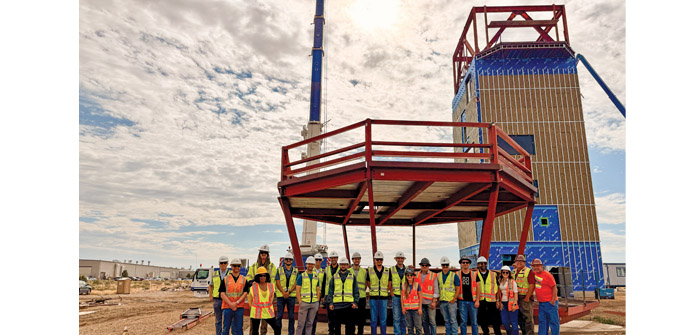
(The Bend Air Traffic Control Tower project team gathered in July 2025 for a photo before the cab (which sits on top of the tower) was raised and set into its final resting place | Photo courtesy of Morrison-Maierle)
Our community has added another impressive feature to its skyline — the new Bend Air Traffic Control Tower. Engineered with efficiency, safety, and sustainability in mind, this tower is more than just a structure; it’s a testament to thoughtful design and collaboration.
With around 140,000 annual operations, Bend is the third busiest airport in Oregon. Its high traffic comes from private (general aviation or GA) service and training flights. That’s why an air traffic control tower was needed in the first place.
From our team of structural, civil, mechanical, electrical, plumbing, fire protection, and ICT engineers, here are six things you need to know about this project.
1. Stormwater management is underground
The Bend Air Traffic Control Tower site utilizes a unique dry well system for stormwater management. With no existing, available storm sewer infrastructure nearby and a need to avoid surface water (which attracts birds and risks airport safety), we designed underground storage basins where water infiltrates through drain rock, tailored to Central Oregon’s soil and climate. In wetter climates, such as Portland, this wouldn’t be possible due to soil saturation.
2. Funding came from five separate grants
Airport Manager Tracy Williams secured $17.5 million from five separate grants to make this project possible. Four of the grants were provided through the FAA, and another by Oregon DOT.
3. The top of the tower was designed for maximum visibility
The tower, which has a 25’ x 25’ footprint, is located on the east side of the runway and has a glass octagon-shaped cab. The height of the cab was determined using a siting study to maximize visibility by taking into account the local topography, existing buildings, and future buildout of the airport grounds.
The cab floor is situated at 81 feet, with an 85-foot eye height, and provides the sightlines as required by the FAA. The tower has eight stories and 139 steps (each seven inches high), but the elevator only reaches the seventh floor. To access the cab, controllers must use stairs to preserve the 360-degree view. This guideline is also mandated by the FAA.
5. All details were designed to prevent glare and static
All cab interior elements, including walls, flooring, and air flow (HVAC) grills, are finished in black to minimize light reflection and prevent static electricity. In typical buildings, most HVAC components exposed in interiors are typically white or light-colored to match the ceilings and walls. Architectural features such as finishes and material selections also followed this directive.
Additionally, special films and angled glass were selected to ensure the safety of both controllers and pilots.
6. The tower is built to withstand extreme events
The new air traffic control tower rising at Bend Municipal Airport isn’t just tall — it’s classified as an essential facility, meaning it’s engineered to stay operational after major events like earthquakes, wildfires, or severe storms. Unlike most towers made from precast concrete, Bend’s tower uses a special steel structural system designed for high seismic resilience. Its “Yield-Link” braces act like shock absorbers, protecting the tower by deforming during an earthquake while keeping the main structure intact.
To ensure continued operation, the tower includes high-rise–level fire protection features such as a pressurized stairwell and a generator-backed fire pump. A sophisticated lightning protection and grounding network shields sensitive electronics, while redundant mechanical systems keep controllers working even if equipment fails. Together, these systems make the tower one of the most resilient and technologically advanced buildings in Central Oregon.
There’s always more than meets the eye when it comes to several projects we help create at Morrison-Maierle. This couldn’t be truer on the Bend Air Traffic Control Tower project.
From its underground stormwater system to its earthquake-resistant frame, every detail of the tower was connected to performance, safety, and maximizing the use of a small space with a very important job to do.