

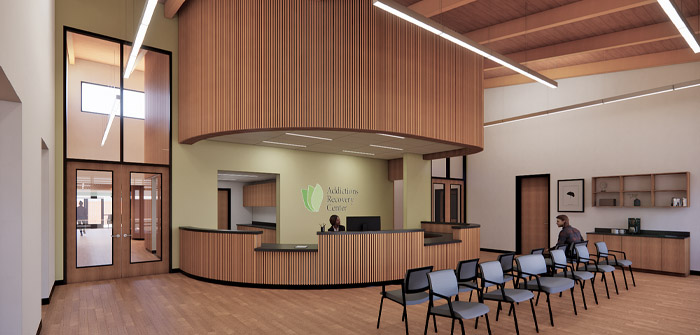
(Addictions Recovery Center | Rendering courtesy of ORW Architecture)
With the current high cost of construction and financing, many organizations — both private and public — are wondering whether building a new facility, or expanding their current building are viable options. How can an owner determine whether or not their project will pencil out? Furthermore, how can they generate early support for the project, whether it is from internal stakeholders or external funding sources, without breaking the bank?
For many of our clients, engaging in a limited conceptual design effort is the answer. Developing a conceptual design package allows both public- and private-sector clients to get a handle on their project by providing salient information on building size, site constraints, construction complexity, approximate cost, and land-use approval issues. Typically, this limited design exercise can be done at a fraction of the cost of full architectural and engineering design services.
The result of the conceptual design effort is a preliminary site plan, floor plans, and 3D imagery showing interior and exterior materials. These drawings often include “scope notes” that address specific areas of concern – whether it’s the need for new utility connections, construction phasing issues, or special code requirements based on the building’s use. These conceptual drawings are then used to develop a high-level cost estimate that includes both hard costs (for construction) and soft costs (for permits, system development charges, fees, equipment, etc.).
These preliminary drawings and cost estimates provide our clients with a powerful tool they can use to generate financial support for the project — whether it’s bank financing for the private sector, grant applications and donor requests in the nonprofit arena, or development of long-term capital budgets in the government realm.
Our firm recently completed a conceptual design study for a residential treatment center serving individuals with substance use disorder. On this project, we were able to highlight the value of conceptual design, both in terms of confirming the approximate space needs and cost of the project, and in generating early support from both internal stakeholders and external funders.
The client’s vision for a co-located men’s and women’s facility, sharing staff and resources while maintaining separation of treatment programs and cohorts, highlighted the value of a focused conceptual design effort as a strategic tool for early planning and decision-making. This is distinct from the more time- and cost-intensive phases of schematic design and design development.
The project site, located within an urban residential neighborhood, presented significant constraints. Working at a conceptual level allowed the team and client to quickly test responses to these challenges, establishing approximate space needs, massing strategies, and staffing patterns without prematurely committing to detailed architectural solutions.
A central challenge was replacing the existing men’s facility with an expanded program while introducing a new, co-located women’s residential facility. This dual-gender, shared-resource model is relatively uncommon in residential treatment settings and required iterative testing of staff workflows and operational efficiencies. Equally critical was maintaining clear physical and visual separation between men’s and women’s areas to support therapeutic standards regarding gender separation and restriction of relationships. Conceptual studies enabled rapid evaluation of alternative layouts and strategies, allowing the client to understand tradeoffs and refine priorities in a way that would have been difficult and costly within a more rigid, documentation-driven process.
Importantly, the conceptual design established credible cost projections and compelling visual imagery. These tools proved essential in building consensus and communicating the project’s vision to funding partners, laying a strong foundation for future fundraising, phased implementation, and eventual progression into more detailed design.
David Wilkerson is principal of ORW Architecture, a design firm with offices in Bend and Medford, Oregon.