

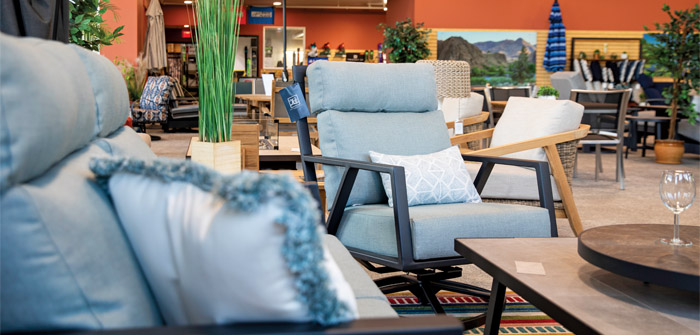
(Photo by Cheryl McIntosh Photography)
When Eric Holmer talks about outdoor living, he is not selling furniture. He is making an argument grounded in decades of experience and a passion for helping people connect with their homes and nature.
Holmer is the owner of Patio World, the Bend showroom his father founded before passing it to the next generation. The business has been around long enough to weather a pandemic that nearly leveled the industry, and to witness a quiet but meaningful shift in how Central Oregonians think about the space beyond their back door. When COVID-19 shut down travel and pushed people home in 2020, demand for outdoor furniture surged. Supply did not keep up, and the industry spent the better part of two years digging out. What emerged on the other side was a customer base that thinks differently about their relationship with the outdoors.
The Lounge Revolution
Walk into Patio World and roughly 70 percent of what you see is lounge furniture such as sectionals, fire pit groupings, and chairs built for settling in. That ratio was closer to 50-50 before 2020, split evenly between dining and lounge.
“After the pandemic, more people decided they’d rather have appetizers and drinks around a fire pit and go inside for the actual meal,” Holmer says. Patios, decks, and other outdoor spaces are now used more often as a place to decompress than as an extension of the dining room.
Plan It Like a Room
“If more architects, engineers, and construction companies had outdoor living space on the forefront as they design everything, it would be better for the outcome of the structure down the road,” he says. “The outdoor space shouldn’t be an afterthought.”
Consider window heights relative to deck railings, or furniture scale relative to view corridors. These are design decisions that become expensive to undo after the concrete is poured.
Holmer offers best practices for builders and clients alike. A 48-inch round dining table with four chairs requires a minimum 12-by-12-foot area. A deck only eight feet deep cannot comfortably fit a dining set. Ten feet is the bare minimum. Twelve is where it starts to feel right. And as a general principle, a custom-built home of 5,000 square feet should have a deck that is at least 20 percent of that footprint.
The same logic applies to utilities. Running conduit for future electrical or roughing in a natural gas line costs a fraction during construction of what it costs to retrofit later. “You lump that into the mortgage, it’s five dollars a month,” Holmer says. “Versus dropping three or four thousand dollars to run wire after the fact.”
He speaks from experience. When Holmer built his own home in 2015, he deliberately over-engineered the deck, reinforcing one corner he suspected might someday hold a hot tub. Seven years later, the hot tub arrived. The infrastructure was already there.
Quality as a Long-Term Investment
Holmer is direct about the core difference between what Patio World carries and what customers find at a big-box retailer. The gap comes down to frame construction, multiple layers of powder coating, and enduring fabric. Most of Patio World’s upholstered pieces use Sunbrella, an outdoor fabric that has set the industry standard for UV resistance and durability. One brand Holmer carries applies seven layers of powder coating to ensure every seam is sealed against moisture and wear.
The numbers tell the story. A premium piece, properly maintained, can last 15 years or more. Holmer has six metal dining chairs on his own deck purchased in 2006 that are still in use.
“If you leave everything outside uncovered, it’s going to be fully functional for five-plus years,” he says. “If you take care of the fabrics, you’re looking at 10 to 15 years.”
Furniture that fades and cracks after two seasons is a recurring cost. “With the quality of our products, they’re not going into the landfill every couple of years,” he says. “We don’t try to compete with the big box stores on price, because our pieces are an investment in long-term comfort and durability.” For customers who want something tailored, most custom orders arrive within six weeks.
Asked what he most wants builders, architects, and homeowners to take away, Holmer doesn’t hesitate.
“Everyone focuses so much on how the front of the house looks, and the kitchen and living room,” he says. “But what are you envisioning for the next five, ten years? Don’t sell yourself short on the outdoor living aspect of the house.”
Zone it deliberately. Build in the infrastructure. Size the deck to match the house. Think about what you’ll want in a decade, not just this summer.
“It’s part of a homeowner’s living space,” he says. “It should be stewarded with the same care.”
Patio World is located at 665 SW Columbia Street, overlooking Riverbend Park in Bend.