

Let’s start with areas of broad agreement:
- Roadways serve both motor vehicles and bicycles. While there is a strong bicycle advocacy community in Bend, the city’s geography and roadway layout make extensive bike pathways challenging to implement effectively.
- Bikes are impractical for transportation during four to six months of winter each year.
- Vehicle travel has become increasingly difficult as the city has grown and
- In an ideal scenario, traffic engineers would prioritize efficient vehicle movement while balancing the needs of cyclists and pedestrians for safety and flow. Choke points should be analyzed with accurate user counts (vehicles, bikes, and pedestrians) to implement targeted solutions.
Shifting Priorities and Spending
In 2020, voters approved the Go Bond program. Figure 1 illustrates the budgeted allocations, with the two largest categories being Bike-Ped safety and East-West traffic mitigation. Figure 2 shows actual spending to date.
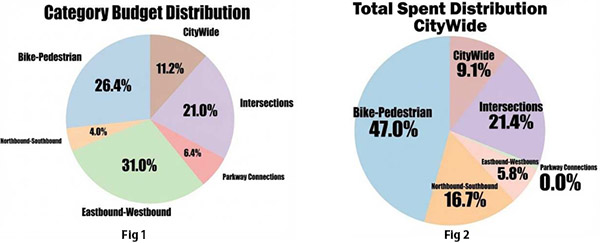
Nearly 50% of funds have gone to Bike-Ped safety projects, while only 5.8% has been allocated to East-West traffic mitigation. Vehicle traffic flow improvements often take a back seat, with measures like traffic calming islands, street closures, and restricted turns exacerbating congestion and creating circuitous routes. For instance, the Franklin Ave project in the area from Harrington to 3rd street will result in islands preventing through traffic at Harrington and left turns on 2nd street. This does not help vehicle traffic at all. There is really nothing being to done to help vehicle traffic. The main purpose of this project is strictly bike related.
A major concern is Reed Market Road, a key East-West corridor serving the rapidly growing southeast area. While a railroad bridge will provide some relief, the primary bottleneck remains at Third Street, where westbound traffic already backs up to American Lane. Trains are a periodic nuisance, while the west-bound backup is constant during daylight hours.
Despite these issues, the City Council is proceeding with the $32 million Hawthorne Overcrossing project (with expected cost escalations of 20-35% based on national trends. This will also close the Hawthorne on/off-ramp access to downtown. Pushing more traffic to remaining offramps and requiring needless rerouting of vehicles to get back to the downtown center.
They have not adequately presented to the public methods and data used to make the radical changes to traffic patterns, rather the constant phrase appears to be, “after reaching out to all stakeholders we are moving ahead…” However the average driver does not appear to be one of the stakeholders contacted.
What This Means
Empirically, the data from the 2020 Go Bond program reveals a clear prioritization by the City Council: substantial investments in bicycle and pedestrian infrastructure at the expense of critical vehicle traffic improvements. With nearly 50% of funds directed toward Bike-Ped safety compared to just 5.8% for East-West traffic mitigation, the spending patterns suggest a strong ideological commitment to creating a bike-centric city, even as practical realities—such as harsh winter conditions and challenging geography—limit its broad applicability.
While promoting active transportation and safety is commendable and aligns with many modern urban planning goals, this approach appears to undervalue the daily frustrations of the majority of Bend residents who rely on motor vehicles as their primary mode of transportation. As the city continues to grow rapidly, inadequate attention to major corridors like Reed Market Road and projects like the Hawthorne Overcrossing (with its associated ramp closures and significant cost overruns) risk worsening congestion, increasing commute times, harming local businesses, and diminishing overall quality of life.
Long-term, this imbalance may lead to inefficient use of taxpayer dollars, strained infrastructure, and growing public discontent. A more balanced strategy—grounded in comprehensive traffic studies, accurate multi-modal user counts, and equitable investment across all transportation needs—would better serve the entire community. The City Council should revisit these priorities to ensure infrastructure spending reflects the actual needs and usage patterns of Bend’s residents rather than a singular vision of mobility.