

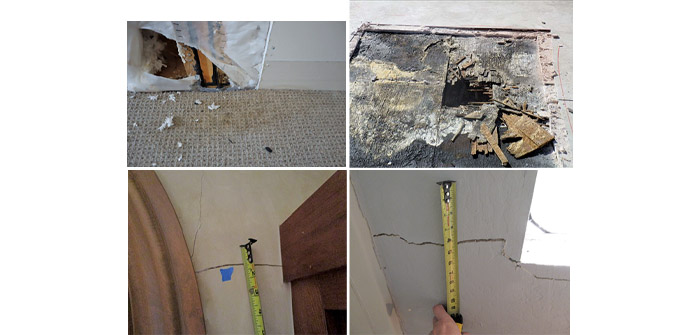
((L-R, T-B) Window water leaks resulted in damage to drywall and carpet. Damaged roof sheathing caused by inadequate insulation. Drywall crack at window corner caused by foundation movement. Interior finish damage caused by foundation movement | Photos courtesy of Ashley & Vance Engineering)
Markets across the country, including Central Oregon, are experiencing a boom in development, reshaping cities and neighborhoods at a rapid pace. However, once the construction is done, a complex reality can emerge. When buildings don’t perform as expected, the consequences are both immediate and on-going. Between unexpected repair costs and property value declines, the relationships between developers, contractors, design professionals, and owners break down. In these high-stakes disputes, legal teams often turn to forensic engineers to clarify the technically complex issues involved.
Whether retained on behalf of a developer, a general contractor, an insurance company, or a property owner, a forensic engineer’s role is to investigate the facts and determine the root cause of damage. They must provide accurate information regarding the cause of a failure after investigating the facts and evaluating the evidence, not serve as an advocate for either side in a dispute. In fact, engineering codes of ethics published by the American Society of Civil Engineers and National Society of Professional Engineers require engineers to be objective, truthful, and act with integrity. Their role is to dispassionately gather, review, and analyze the evidence and provide clients with objective opinions regardless of whether those opinions are “good” or “bad” for a party involved.
The Anatomy of a Defect
Construction defects generally fall into two categories: visible (patent) or hidden (latent). Patent defects are immediately obvious, such as damaged drywall or jammed windows. Latent defects are often hidden behind finishes or inside wall cavities and can include structural framing, waterproofing, or site drainage issues. These conditions often do not reveal themselves for months or even years after construction is done. For example, consider a common issue: water leaking through a window during a rainstorm. While the water leak is a patent symptom, the root cause may be a latent defect behind the finishes such as damaged flashing or a defective window unit. A knee-jerk reaction might be to blame the window installer. Instead of speculating, forensic engineers rely on methodical observations and testing to identify leak locations, removing finishes or disassembling the window as needed to establish their findings in the physical evidence.
Additionally, a forensic investigation can determine whether a failure occurred because of an unprecedented event. With the leaking window example, a forensic investigation would also consider the nature of the event itself. Perhaps the leak occurred shortly after severe weather where falling tree limbs caused damage. While most construction defects do not require a historic storm to reveal themselves, a neutral approach to determining the cause of a failure provides reliable answers during a dispute. When a failure occurs, blame can spread rapidly across architects, engineers, general contractors, and material suppliers, often devolving into costly, multi-party blame games. This is exactly where forensic engineers can be called on to provide objective analysis.
Following the Data, Not the Dispute
The methodology of a forensic investigation mimics that of detectives investigating a crime scene, spanning both the structure and the surrounding site. Through thorough observation, forensic engineers seek to evaluate the property as a whole. Engineers may probe into walls to check exterior waterproofing, perform structural calculations, or perform elevation surveys to evaluate grading. From there, they compare what was built to the original construction plans, the building code, and manufacturer’s instructions. Forensic engineers seek to answer two questions: why is the property performing as it is, and did the design and construction meet the minimum code and industry standards. The forensic engineer’s goal is to understand the truth about how and why a building is responding to the site conditions based on observations and measurements. Ultimately, assigning legal blame is the job of judges, juries, or arbitrators. The role of the forensic engineer is to help these people make informed decisions based on the facts.
Resolution and Progress
The majority of construction defect disputes do not end up in a court room but are resolved through alternative dispute resolution methods such as mediation. In either case, the properly founded opinions of forensic engineers help cut through the elevated emotions of those involved. When the parties are presented with detailed analysis backed by physical evidence explaining why a failure actually occurred, it bridges the gap between technical complexity and the legal dispute. This can help the disputing parties stop arguing about what happened and start working toward determining reasonable and cost-conscious repair strategies.
By prioritizing the facts and physical evidence, forensic engineers do not just help resolve construction disputes. They uphold the standard of care that keeps the engineering and construction industries moving forward.