
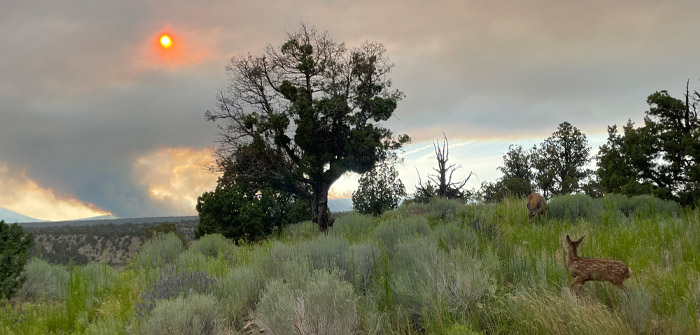
(Akawa Butte fire, Crooked River Ranch | Photo by Amanda Cardenas, Think Wild Board Director)
As summer heats up, wildfire season is back in Central Oregon, with wildfires throughout the state causing evacuations, poor air quality, and concerns around life and property. At Think Wild, Central Oregon’s wildlife hospital and conservation center, nearby fires including the Akawa Butte and Brewer Fires along the Jefferson-Deschutes County line, and the Rowe Creek Complex to the north, and associated poor air quality have renewed questions around how wildfires affect Oregon wildlife and how people can help.
Fortunately, Oregon’s native species are adapted to forest fires, but that doesn’t mean that many won’t suffer or lose their lives. Wildfires cause immediate habitat loss and potential die-offs, and they change ecosystem structure for years to come. Some species that depend on mature forests — tree cavity-nesting owls, for example — may experience population reductions while those that thrive in young forests, like songbirds and burrowing mammals, may increase.
In the short term, with the severity and scale of the current wildfires, wildlife may be more likely to enter urban areas and exhibit unusual behavior while fleeing smoke and fire over the next few weeks. They will also be in search of food resources, which will be significantly depleted in the immediate aftermath of the fire.
“It’s mid-July, which means we’re right in the middle of nesting and baby season. Our hospital is admitting new baby birds and mammals every single day,” said Sally Compton, Think Wild executive director. “That makes this an especially vulnerable time for wildlife to face fire. Nestlings, fledglings, and young mammals are less able to flee smoke and flames than adults, and a fire moving through nesting habitat can separate or orphan young animals very quickly. On top of that, fires diminish territories and available habitat, making resources more scarce and increasing competition, which is especially hard on young wildlife still learning to hunt or forage.”
Heat, wildfire, and poor air quality can also have similar effects on wildlife that we experience ourselves. “During times of extreme heat or poor air quality, animals may experience dehydration, heat exhaustion, general disorientation, and respiratory issues,” said Think Wild’s interim director of Wildlife Rehabilitation, Savanna Scheiner. She advises people to “watch for wildlife traveling through your property and along roadways fleeing fire, seeking shelter and looking for food and water. Drive slowly, and do not panic or approach these animals. If necessary, monitor at a safe distance. If you notice wildlife exhibiting odd behaviors or come across a nest or young animal that appears abandoned or injured, please contact your local wildlife rehabilitation center before intervening.”
As wildfire seasons become longer and more severe, healthy riparian ecosystems are increasingly important for protecting wildlife and reducing the impacts of fire across the landscape. Through Think Wild’s Beaver Works Oregon program, we restore these critical waterways by installing Beaver Dam Analogs (BDAs) and planting native vegetation to support beaver population recovery and the natural processes that create more fire-resilient habitats. BDAs, along with natural beaver dams, slow water flow and increase water retention in creek systems, creating wetter floodplains that are less susceptible to wildfire. These restored wetlands also provide critical refuge for wildlife fleeing fires in drier upland habitats, offering food, cover, and water when surrounding landscapes are burning.
“Restoring riparian habitat, so beavers can move in and take over, is one of the most effective things we can do for fire resilience,” said Dr. Maureen Thompson, Think Wild’s Beaver Works Oregon program manager. “More late-season water impoundments (AKA beaver dams) mean more fire resilience for everyone who lives nearby, human and wildlife alike.”
This work has never been more important. In fact, this week Think Wild was forced to cancel an in-stream restoration project because an active wildfire near the project area created unsafe conditions for volunteers. As fire seasons become longer and more severe, restoring these natural, fire-resilient ecosystems is becoming both more urgent and more challenging.
Here are some ways that you can support native wildlife during fire season:
- Do not feed wildlife. Human food can cause harm and encourage animals to remain in urban areas where they’re more likely to come into conflict with humans. If you maintain a bird feeder, clean it regularly to help prevent the spread of disease.
- Provide clean water. A shallow dish or bird bath placed away from your home can provide a much-needed drinking source during hot, dry weather. Refresh the water frequently to keep it clean and reduce mosquito breeding.
- Make backyard water features wildlife-friendly. If you have a pond, trough, or other water feature, ensure wildlife can safely climb out by adding rocks, branches, logs, or wildlife escape ramps.
- Protect your pets and wildlife. Keep cats indoors and dogs leashed or supervised, especially during periods of poor air quality and when wildlife may be displaced by wildfire. This protects both your pets and vulnerable wildlife seeking refuge.
- Give wildlife space. Never approach or attempt to care for wild animals yourself. If you find injured or orphaned wildlife, discover a nest of baby birds or mammals, or observe wildlife behaving unusually, contact your local wildlife rehabilitation center for guidance.
- If you find a burned animal, do not feed or give water unless directed by a wildlife rehabilitator or veterinarian. Instead, gently place the animal in a ventilated box lined with a soft 100% cotton towel or cloth, keep it in a dark, quiet location, and contact a licensed wildlife rehabilitator immediately.
- Use water wisely. Conserving water during drought and wildfire season helps maintain streamflows and wetlands that wildlife depend on for survival.
- Help prevent wildfires. Follow all local fire restrictions, properly extinguish campfires, avoid parking vehicles on dry grass, and stay aware of conditions, as even small sparks can quickly become large wildfires.
- Volunteer to restore wildlife habitat. Healthy riparian areas and wetlands are more resilient to wildfire and provide critical refuge for wildlife. Consider joining a local habitat restoration project to improve habitat before the next fire season.
- Support your local wildlife hospital. Wildlife rehabilitation centers, including Think Wild, receive little to no government funding and rely on community support. During baby season and wildfire season, donations of supplies such as formula, heating pads, enrichment items, and cash gifts help ensure injured and orphaned wildlife receive the care they need.
This list is non-exhaustive, but we hope that you find it helpful. If you ever have questions, Think Wild’s wildlife hotline, 541-241-8680, is available seven days a week from 8am-5pm. Think Wild is a 501(c)(3) nonprofit organization, and tax-deductible donations can be made at thinkwildco.org/donate or mailed to PO Box 5093, Bend, OR 97708.
About Think Wild:
Think Wild is a 501(c)3 nonprofit organization located in Bend. Our mission is to inspire the high desert community to care for and protect native wildlife through education, conservation, rescue, and rehabilitation. We provide veterinary treatment and care at the wildlife hospital, staffed by expert wildlife rehabilitation staff, animal husbandry volunteers, and our staff veterinarian. We also provide wildlife habitat installations, native plantings, and wildlife education programming for youth and the community, and can help with conflicts with wildlife. Wildlife injuries can be reported to our Wildlife Hotline at 541-241-8680, which is monitored seven days a week from 8am-6pm.
thinkwildco.org • Instagram & Facebook @thinkwildco • info@thinkwildco.org