
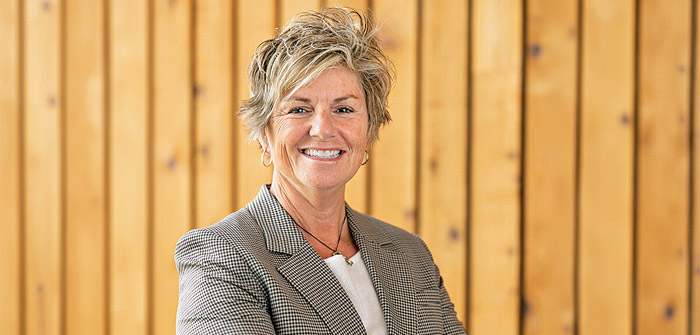
(Dr. Christine Pollard)
When Dr. Christine Pollard arrived at OSU-Cascades in 2011, there was no biomechanics laboratory, no Doctor of Physical Therapy program and only seven students enrolled in the kinesiology program she had been hired to launch.
At that time, OSU-Cascades, founded in 2001, was still operating as a two-plus-two institution on the Central Oregon Community College (COCC) campus, serving juniors and seniors who had completed their first two years of post-high school work at COCC.
Fifteen years later, Dr. Pollard finds herself leading one of Oregon’s fastest-evolving public universities as interim Chancellor and Dean, overseeing an institution poised for transformation. She took on the top role in early May during a time of executive leadership transition.
A national search is currently underway for the permanent Chancellor and Dean spot. During a recent interview, Dr. Pollard shared her plans to apply, as well as a leadership philosophy shaped by a career building new programs, forging key partnerships and steadily expanding opportunities for students.
“I found my love for bringing groups of people together and what you can get accomplished with collaboration here,” Dr. Pollard said during a wide-ranging conversation at her second-floor office, which overlooks the OSU-Cascades Student Success Center and future site of a health and recreation building.
For Dr. Pollard, the journey to OSU-Cascades began long before her first day on campus. Raised in Eugene and a first-generation college attendee, she left Oregon to play basketball at a small Southern California college before earning a master’s degree in physical therapy at Pacific University.
She completed her doctorate in biomechanics at the University of Massachusetts Amherst, followed by a postdoctoral fellowship and faculty position at the University of Southern California (USC), where her research focused on biomechanics and ACL injury prevention.
Family ultimately drew her back to Oregon. While vacationing in Bend, Dr. Pollard learned about OSU-Cascades. After dropping off a resume, she eventually received an unexpected phone call asking whether she would be interested in creating OSU-Cascades’ first kinesiology program.
“It was just me and seven students,” Dr. Pollard recalled. “ A lot of people thought I was taking a huge risk by coming to OSU-Cascades, but I saw the opportunity to help build something from the ground up.”
Building from the Ground Up
Launching the kinesiology program required far more than just developing and teaching courses. To earn tenure, Dr. Pollard needed a biomechanics laboratory capable of supporting competitive research. The challenge was significant. Such a facility required specialized equipment and customized infrastructure that at the time did not exist in Central Oregon. To make it happen, Pollard began building partnerships.
Working alongside The Center (today the Saint Charles Center for Orthopedics and Neurosurgery), the Center Foundation, and Therapeutic Associates Bend, she helped establish a biomechanics laboratory while securing university funding for equipment and community support for the facility itself.
The collaboration gave students access to research opportunities rarely available at a young branch campus. The Functional Orthopedic Research Center of Excellence (FORCE) lab became a place for nationally recognized research. Dr. Pollard’s early career research centered on ACL injuries in young athletes, including participation in a multi-million-dollar National Institutes of Health (NIH) study during her time at USC.
Once established in Bend, she led biomechanic studies, leading some of the earliest published research examining highly cushioned running shoes, including independent research focused on the physical impact of “super shoes” (such as HOKAs). Those studies attracted national attention, including 2020 coverage in The New York Times.
One of the most important aspects of research for Dr. Pollard has been creating opportunities for students to participate in groundbreaking studies alongside faculty. Both as a scientist and an administrator, putting student success at the forefront is a critical pillar for her.
“I am a fierce advocate and supporter of our students, and to be able to do that in this role is something I take really seriously,” she said. “When you come to a smaller campus, that’s something that’s very different. Students should know their faculty. They should know their leaders and be able to engage.”
As a Research 1 institution with a small student body, OSU-Cascades can combine high-level research with close faculty interaction and personalized educational experiences that are often difficult to replicate at larger universities.
Creating Oregon’s First Public Doctor of Physical Therapy Program
Even before earning tenure, Dr. Pollard had identified what she believed was a major gap in Oregon’s higher education system. During her OSU faculty interview, she asked why Oregon lacked a public Doctor of Physical Therapy (DPT) program. The response from university leadership was simple: earn tenure first, then build it. Pollard did exactly that.
“I asked why we didn’t have a public university DPT program in the state of Oregon,” Dr. Pollard said. “The response was, ‘Get tenure, and we’ll talk about it.’”
Years of planning followed. Support from then-Vice President Dr. Becky Johnson, combined with construction of the current campus and specialized instructional facilities, including a cadaver laboratory and dedicated treatment spaces, created the infrastructure needed to launch the program.
The inaugural OSU-Cascades DPT cohort began in 2021. Due to the pandemic, faculty were selected via initial virtual interviews and subsequent vetting. Today, the three-year doctoral program enrolls around 44 students per class and has already graduated three cohorts. Alumni are serving communities across Oregon, including rural areas like Eastern Oregon, where physical therapists are in high demand.
“If you look at this side of the Cascades, the need for physical therapists is very high,” Dr. Pollard noted. Our DPT program requires that each student does one of their clinical rotations in a rural area and our program includes considerable coursework and training dedicated to rural physical therapy. “When our students go out and do their clinical rotation in those rural areas, it’s a great opportunity for them to experience cross-disciplinary patient situations. They treat a little bit of everything,”
The work prepares graduates to serve areas where healthcare professionals are often difficult to recruit, and many choose rural postings for later employment. For Dr. Pollard, the program reflects OSU’s land grant commitment and is one of OSU-Cascades’ broader responsibilities: helping solve workforce shortages while expanding educational access across the state.
A Passion for Leadership
Dr. Pollard built her reputation as a researcher, fundraiser and program founder, but high-level academic leadership gradually became her professional calling. She became OSU-Cascades’ Senior Associate Dean in late 2023, overseeing academic affairs, faculty development, enrollment strategy and institutional planning.
One of her major initiatives involved reorganizing the campus’ academic leadership structure to better position the campus for continued growth. Creating improved organizational frameworks while building strong relationships across campus, in the Central Oregon community and within the greater OSU system continues to be a priority in her current role.
“As a postdoc, I found my love for bringing groups of people together and seeing what you can accomplish. In my current role, it’s been energizing to care so much about this campus, contribute valuable historical knowledge and represent the campus in the Central Oregon community and beyond,” she said.
“What I’ve loved about this role is being in a position to advocate for OSU-Cascades. There’s so many great things happening here that need to be highlighted, and many opportunities for the community to be involved and supportive of the campus.”
Dr. Pollard’s leadership style has left a lasting impression on colleagues who have worked alongside her for years. Dr. JJ Hannigan, now a faculty member at OSU-Cascades who first joined the campus as Pollard’s postdoctoral researcher, describes her as a consensus builder who actively seeks input before making decisions.
“Even if she ends up making a decision that you might not have agreed with, you always feel heard,” he said, adding that Dr. Pollard’s ability to listen while still moving initiatives forward has earned widespread respect across campus.
Beyond her administrative abilities, Dr. Hannigan said Dr. Pollard has built a culture of genuine connection throughout the university. “I think what makes her such a good leader is the fact that she listens and she truly cares,” he said.
Looking Toward the Next 25 Years
As OSU-Cascades celebrates its 25th anniversary this year, Dr. Pollard believes the institution is entering a vibrant new phase. In the next decade, she sees an opportunity to expand and celebrate what makes OSU-Cascades uniquely Central Oregon, including partnering with regional businesses to benefit both students and employers.
“Innovation doesn’t happen in isolation. Some of the most exciting opportunities for Central Oregon will come from researchers, students and business leaders working side-by-side to turn ideas into practical solutions,” Dr. Pollard said.
One of the most significant new campus initiatives is the development of the Innovation District, where university researchers, students and private industry will work side-by-side. (See sidebar for more details.)
For local businesses, Dr. Pollard sees tremendous potential. Rather than waiting until students near graduation, OSU-Cascades increasingly aims to integrate employers directly into coursework through real-world projects, mentoring opportunities and internships beginning as early as freshman year.
Health professions, engineering, outdoor products, business and applied research all play significant roles in Central Oregon’s economy and on current and future campus programming.
The university’s accessible size, she believes, is an advantage for meaningful local business collaboration. Enrollment currently sits at approximately 1,400 students, with long-term planning focused on maintaining the close-knit campus atmosphere.
Campus built environment expansion is also continuing. Dr. Pollard highlighted the recently approved $42 million in state funding towards an $84 million project which includes 24 acres of land remediation plus the construction of a Student Health and Recreation Center, expected to open around 2030. At roughly the same time, the first Innovation District buildings are expected to be ready, ushering in an exciting new chapter.
As OSU-Cascades prepares for its next phase, Dr. Pollard hopes the university will continue its rise as a nationally recognized institution uniquely positioned to educate students, fuel innovation and strengthen Central Oregon for decades to come.
“The next 25 years are about expanding our impact through partnerships, innovation, research and student success in ways that benefit the entire region. The future of OSU-Cascades is inseparable from the future of Central Oregon,” said Dr. Pollard.
Innovation District on the Horizon
OSU-Cascades’ forthcoming 24-acre Innovation District is envisioned as a catalyst for economic growth, bringing together businesses, entrepreneurs, researchers and students in a collaborative environment where ideas can move more quickly from concept to commercialization.
Rather than separating academia from industry, the district is designed to create shared spaces where companies can establish laboratories, project work areas and meeting places alongside university researchers, giving students access to real-world projects while helping businesses develop the next generation of talent. An initial focus for industries involved is the biotech, outdoor products and energy sectors.
“We’re really doing a great job at having much more of what we call work integrated learning,” said Interim Chancellor Dr. Christine Pollard. “We’re trying to get students from the first year doing some sort of real-life experience really early on” rather than wait until they near the end of their undergraduate experience.
The goal is for industry partners to work directly with students through classroom projects, internships and collaborative research, creating a win-win relationship that benefits employers, faculty and students alike.
The first phase of the Innovation District is already moving forward. Environmental remediation has been completed on the initial eight acres, infrastructure construction is underway and the university is preparing to partner with a master developer. The company awarded the contract is expected to be announced soon.
Plans call for a mixed-use 60,000 sf commercial building where industry partners can work alongside OSU-Cascades faculty and students, complemented by residential development of on-campus multifamily housing.
The district will also become home to initiatives such as the recently announced Energy Innovation Center, which focuses on advancing energy storage, carbon capture and other emerging technologies.
The ultimate goal is a vibrant hub where education, research and private industry converge to drive entrepreneurship, workforce development and innovation. The approach speaks to Central Oregon’s longstanding reputation for cross-industry collaboration, heralded by many business leaders as a characteristic that makes the region unique.