
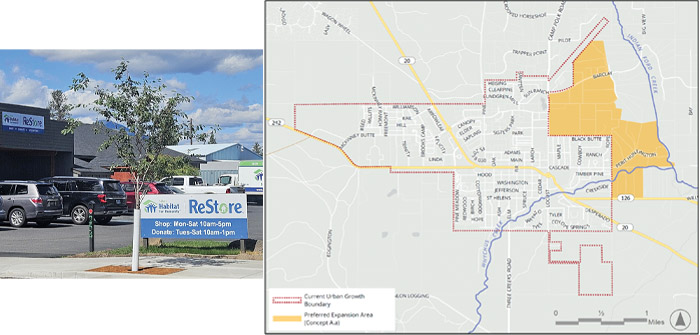
((Left) The local Habitat for Humanity is observing its 35th anniversary and completion of its 100th home. Shown is the ReStore on E Cascade | Photo by Andrea Hine (Right) Rendering shows the current UGB boundary for Sisters (dotted line), as well as the preferred expansion area (yellow) | Map courtesy of City of Sisters)
“We’re up against a deadline to obtain approval for our UGB expansion application,” said Scott Woodford, after some 32 months of effort on Sisters’ part (and an “almost nonstop engagement in the process” — not counting all the background work entailed).
As he explained, from his vantage point as Community Development Director, “If approval for the UGB expansion application isn’t secured by the Deschutes County Planning Commission and its Board of Commissioners by the end of 2026, the city will be forced to redo significant portions of its planning work — including housing needs assessments, and possible master plan updates — which would set the timeline back. “The County is aware of our impending deadline, and City of Sisters staff is watching the clock,” Woodford said.
(Urban Growth Boundary is a planning tool used in Oregon to ensure communities have enough space for growth over the next 20 years.) As Woodford noted, the population of Sisters is projected to approximately double during that time, “and we have to make sure there is sufficient land to meet our identified future needs for housing, employment opportunities — including retail and light industrial — and parks and schools.”
Woodford predicted “ebbs and flows in the population over the next two decades, kind of a zigzag. And if population exceeds estimates, we’ll adjust our land needs over time. It may also be less than predicted, in which case the expansion land will remain undeveloped. It’s like trying to create a perfect crystal ball, knowing that many factors are beyond our control.”
Affordable Housing
UGB efforts are inextricably tied to the continuing need for affordable housing in Sisters, where the median single-family home price has reached $833k (as of the June 2026 Beacon Report) — compared to $728k in Bend and $515k in Redmond — while median household income is approximately $95,000, according to recent census data estimates.
“There is no doubt a discrepancy exists between income and housing costs in Sisters,” Woodford said, “providing another reason to expand the town’s boundaries, as the additional acreage will provide an opportunity for more housing choices, and opportunities for our workforce to live and work in the area. It’s one of the City Council’s highest priorities, which has been backed by the city’s continuing financial support for several affordable housing projects.”
Among them are the 40-unit Trinity Place Apartments, and the 26-home Larch Street Commons — both currently under construction. The latter is being built by the local Habitat for Humanity, which is observing its 35th anniversary, and the completion of its 100th house.
“We are building more than just houses,” said Peter Hoover, executive director of the Sisters affiliate. “We are building the infrastructure of a sustainable community, ensuring that Sisters remains a place where everyone who contributes to our vibrant life here can afford to stay.”
Audit of City’s Development Code
On another front involving the Community Development Department that Woodford directs, “Sisters has received a grant to hire planning consultants to perform an audit of the city’s development code compliance with laws passed by the state,” he said. “The audit contains 35 pages of line items, which are recommendations, rather than requirements.”
To elaborate, “The audit is intended to provide more flexibility in adding to existing housing stock, particularly affordable units — rather than opening up new areas for development,” Woodford noted.
Dark Sky Designation
Joining Oregon’s Sunriver and Antelope, Sisters has been recognized as an official dark sky community for its work in “preserving and protecting its night sky from artificial light pollution — through responsible outdoor lighting policies and public education — to ensure future generations can still see the stars,” according to the International Dark Skies Program (IDSP).
“We’re working on implementation of these standards,” Woodford said, “primarily through community outreach and education, which is a big undertaking. Efforts include swapping out non-compliant lighting, and the city is offering a lighting rebate program to encourage participation.”
Planning for Future Growth
“While many in the community might prefer to maintain the town as it is,” Woodford said, “we must plan for, and accommodate, projected future growth. Not only because we are required to do by the State, but because it is smart to be proactive and plan properly so growth doesn’t overwhelm us. Instead, we’ll be able to work toward meeting identified community needs — such as building homes for our workforce, and setting land aside for future parks and open spaces — to help maintain the small town feel that we know and love.”