

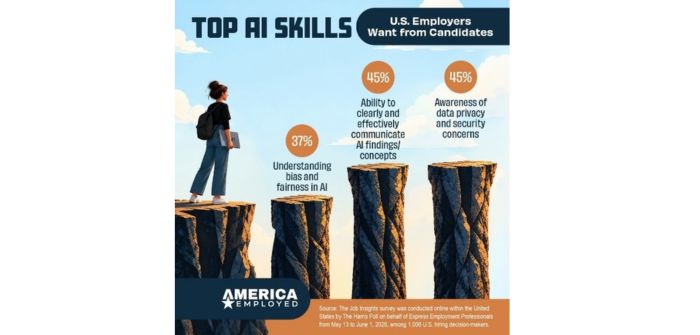
(Graphic courtesy of America Employed)
Nearly every job seeker believes they are AI-ready, but many may be underestimating what companies now expect, according to a recent Express Employment Professionals-Harris Poll survey.
That confidence is nearly universal, with 93 percent of job seekers saying they have the AI skills employers want. However, only 35 percent of job seekers believe companies are looking for advanced or expert AI capabilities, while 41 percent of hiring managers say candidates need them.
AI proficiency isn’t reserved for highly technical candidates, either. Nine in 10 hiring managers look for at least basic AI skills, and more than half (54 percent) consider AI proficiency very important or absolutely essential when evaluating applicants.
AI Joins Traditional Hiring Priorities
Even as AI skills become a factor in hiring, job seekers believe employers still place the greatest value on long-standing workplace qualities. When asked which attributes companies consider absolutely essential in applicants, they ranked dependability, work ethic and communication skills ahead of technical and AI capabilities:
- Dependability: 47 percent, down from 52 percent in the fall of 2023
- Work ethic: 47 percent, compared with 48 percent in the fall of 2024
- Communication skills: 45 percent, unchanged from the fall of 2024
- Technical skills: 29 percent, compared with 25 percent in the fall of 2024
- AI skills: 19 percent
What Employers Mean by AI-Ready
While job seekers may rank traditional qualities higher, hiring managers are looking for specific AI capabilities:
- Awareness of data privacy and security concerns: 45 percent
- Ability to communicate AI findings or concepts clearly and effectively: 45 percent
- Understanding bias and fairness in AI: 37 percent
Job seekers’ assessments of their own abilities, however, vary widely. More than half of millennials (55 percent) and half of Gen Z job seekers (50 percent) describe their AI skills as advanced or expert, compared with 31 percent of Gen X and 12 percent of baby boomers and seniors. Men are also more likely to anticipate that higher bar, with 42 percent expecting advanced or expert proficiency compared with 28 percent of women.
The generational divide is just as clear in what job seekers think employers want. Forty-three percent of Gen Z and millennials believe companies expect advanced or expert AI skills, compared with 25 percent of Gen X and 10 percent of baby boomers and seniors. A similar gap emerges between men and women, with 42 percent of men expecting companies to seek that level of proficiency compared with 28 percent of women.
ExpressPros.com/Newsroom