
(Photo courtesy of E2 Solar)
In Redmond, rooftop solar is not only generating electricity locally, but it’s lowering operating costs for public facilities, helping nonprofit housing organizations have a greater impact, and decreasing utility bills for local households.
Having installed hundreds of solar systems in Redmond since our company’s inception, E2 Solar’s work locally includes residential projects as well as affordable housing and public facilities. Most recently, installations at Deschutes County Fair & Expo Center, the Redmond Airport and Habitat for Humanity homes all demonstrate how local rooftops can serve the community and its energy needs.
Measurable Savings and Environmental Benefits at Public Buildings
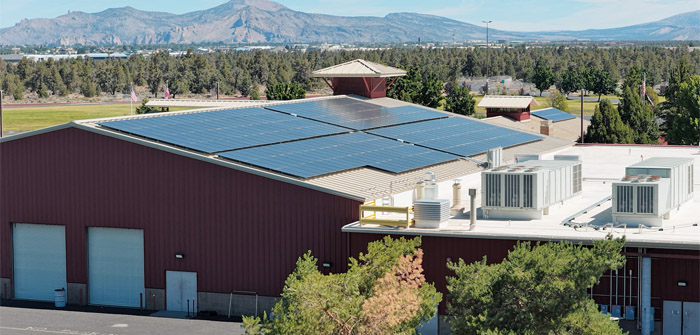
At the Deschutes County Fair & Expo Center, E2 Solar recently completed a massive installation of 796 solar panels on three buildings. Together, these solar arrays are projected to generate approximately 446 megawatt-hours of electricity annually (equivalent to 446,000 kilowatt-hours). These systems are also expected to deliver $61,000 in electricity-bill savings each year. As of late October 2026, production was well on track, reaching approximately 390 megawatt-hours, with savings already at over $53,000.
E2’s financial projections place the facility’s break-even point for these systems at approximately the end of year six, after accounting for federal elective-pay benefits and Energy Trust of Oregon incentives. Additionally, Deschutes County is expected to save approximately $1.8 million on its electricity bills in the system’s first 25 years of operation (after factoring in the annual escalation rate of energy). Final savings will depend on production, utility rates and other operating conditions. For a public facility like the Deschutes County Fair & Expo Center, this significant reduction in electricity expenses leaves more room in the operating budget for other priorities, while putting existing roof space to use.
In terms of environmental impact, this annual energy generation from Deschutes County avoids approximately 300 metric tons of carbon dioxide emissions, according to the EPA’s Greenhouse Gas Equivalencies Calculator. To visualize this amount, this estimated emissions benefit is equivalent to the carbon sequestered by 300 acres of U.S. forests in a single year.
Solar at the Redmond Airport Terminal Expansion
Another exciting renewable energy project is coming to life at Redmond Airport, where E2 Solar is installing a rooftop solar system as part of its terminal expansion that broke ground in the summer of 2025.
The planned 137.03-kilowatt system includes 315 solar panels and is projected to generate approximately 201 megawatt-hours of electricity annually. Once operational, the system is expected to reduce the airport’s electricity expenses by approximately $27,500 per year. After available incentives, the airport’s break-even point is around year six. Again taking into account the annual escalation rate of energy, the Redmond Airport is expected to save approximately $814,000 on its electricity bills in the system’s first 25 years of operation.
Installation is underway, with the system slated to come online in spring 2027 following utility interconnection. (It’s not uncommon for panels to be installed before a system is connected and authorized to operate.)
Benefits Closer to Home
E2 Solar’s Redmond portfolio also includes installations for Bend-Redmond Habitat for Humanity, at the Cedar Townhomes and most recently at Timber Cottages (13 single-family cottage-style homes in Southwest Redmond). For these projects, our solar proposals connected system design, available incentives and projected production to the needs of both the dwellings and their occupants.
Upon completion, these solar arrays significantly reduce electricity expenses for families that move into the homes — a cost savings that begins on day one of occupancy and continues for decades. For example, after 25 years, an owner of a Cedar Townhome is projected to have saved $155,000 in energy costs.
Prior to homeowners moving in, Energy Trust of Oregon’s Solar Within Reach incentives helped reduce Habitat’s upfront solar costs. These projects illustrate how incentive programs can help bring rooftop solar into income-qualified housing, rather than limiting its benefits to households that are able to fund an installation themselves.
A Local Investment with Long-Term Value
E2 Solar’s work across these projects in Redmond demonstrates how rooftop solar generation can meet electricity needs — and offset energy costs — where people live, work and play.
While the financial benefits differ by property, many public facilities often see improved operating budgets and long-term savings. Nonprofits and housing organizations can often claim significant incentives. And individual homeowners cut electricity costs and gain grid independence by generating their own electricity.
For Redmond and the rest of Central Oregon, the result is a growing community of rooftops that are generating power, reducing projected energy expenses and making solar an important part of the public and residential infrastructure.