

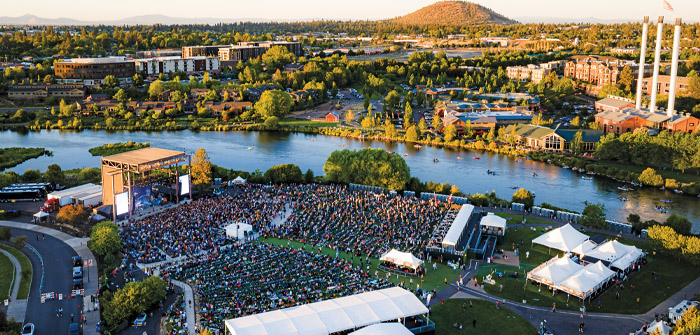
(Aerial view showing the Lord Huron-headlined concert at the Hayden Homes Amphitheater during the venue’s blockbuster 2026 season, which featured 53 shows, and the greater Old Mill District across the Deschutes River, currently celebrating its 25th anniversary as a vibrant Bend hub | Photo by Nate Wyeth Photography)
As Bend’s vibrant riverside mixed-use mecca, the Old Mill District celebrates its 25th anniversary this year; the time is ripe to reflect on a story of dramatic reinvention from a powerhouse of global timber production into the major hub for retail, tourism and community life we see today. The ambitious vision was long held by Bend’s late legendary developer Bill Smith, but the project’s roots stretch deep into a past intertwined with the town’s heritage as a timber capital.
The story starts back in March 1916, when, facing shrinking resources in the Midwest, Minnesota’s Shevlin-Hixon Lumber Company relocated its operations to Bend and opened a giant sawmill on the west bank of the Deschutes River. A month later, fellow North Star State industry adversary Brooks-Scanlon followed suit and launched its Mill A complex across the water.
At their peaks, these titanic timber competitors were two of the largest pine sawmills in the world, straddling the Deschutes and each employing over 2,000 workers in around-the-clock shifts. Each mill eventually produced around 200 million feet of lumber annually, sparking explosive growth as the influx of timber jobs caused Bend’s population to skyrocket from 536 residents in 1910 to 5,414 in 1920.
Shevlin-Hixon famously built a portable logging camp community, known as Shevlin, which acted like a “movable” company town, where homes, a school, a store and a barbershop were jacked up onto railroad flatcars and hauled deeper into the High Desert forest by steam locomotives as local timber stands were cut down.
But an inevitable decline in the logging industry followed and, in the face of dwindling regional timber resources, Shevlin-Hixon sold its holdings to Brooks-Scanlon in 1950. Ultimately, by the early 1990s, changing economic and environmental conditions forced the mills to shutter entirely, leaving behind a heavily polluted, fenced-off industrial wasteland.
In a daring speculative real estate move, in September 1993, developer and former Brooks-Scanlon executive Bill Smith purchased 270 acres of the derelict mill lands, through his newly formed enterprise, William Smith Properties, Inc.
Over the next five years, Smith helmed a Herculean effort to steer the project through painstaking environmental restoration and city zoning. What became known as Bend’s Old Mill District was remediated through a multi-year, private brownfield cleanup led by Smith and his company, alongside state and federal agencies like the U.S. Environmental Protection Agency (EPA) and the Oregon Department of Environmental Quality.
Major elements of the clean-up effort included:
- Contaminated Soil & Hazardous Material Removal: Crews tackled nearly 20 major environmental concerns, excavating and removing contaminated soils and properly addressing asbestos across the entire 270-acre site
- Riverbed & Sawdust Excavation: Massive layers of historical sawdust (up to 15 feet thick) and industrial debris that choked the Deschutes River were dug out
- Riverbank Stabilization & Restoration: The developers stabilized and reshaped the riverbanks, restoring roughly 14,000 linear feet (about 2.5 miles) of riverfront that had been altered and closed to the public for nearly 80 years during active lumber mill operations
- Groundwater Monitoring: Engineers installed monitoring wells to track and manage subsurface conditions
- Habitat Recovery: The cleanup transformed a blighted industrial zone into a healthy riparian ecosystem supporting, among others, native fish, otters and bird species
In recognition of the voluntary brownfield cleanup efforts, the project earned the EPA Phoenix Award in 2002.
With Smith leading the way in a red open-top vintage vehicle, the district finally officially opened its first wave of shops in the summer of 2001, paving the way for the bustling retail, dining and music epicenter that followed.
Now, the district gets more than three million visitors a year and stands as a premier commercial engine for Central Oregon — driving regional economic growth and attracting more than three million annual visitors — including hosting more than 50 shows at the Hayden Homes Amphitheater concert venue.
While the initial adaptive-reuse vision broke ground a quarter-century ago, the district’s sustained market dominance relies heavily on its operational management team, which includes Bill Smith’s wife, Trish Smith, and is now led by their son, Matt Smith, and daughter, Marney Smith. Tasked with managing a complex ecosystem that balances national retail anchors with local independent brands, the team navigates intense seasonal foot-traffic fluctuations, a high-profile entertainment venue and environmental river stewardship, as part of a mission to keep the Old Mill District feeling uniquely “Bend.”
“We’ve actually seen 3.5 million visitors to the district over the past 12 months, with 75 percent being from Central Oregon,” Old Mill District Marketing Manager Beau Eastes said. “A big part of that is making sure our tenant mix is always evolving and growing with what resonates with the community — we have to be relevant and exciting to the local community.”
Original charter tenants like Regal Cinemas, Ben & Jerry’s, Gap, Banana Republic, Sunglass Hut and Bath & Body Works have been at the complex since the beginning, illustrating Old Mill District leadership strategies that have kept such legacy and local independent businesses anchored here amidst rapid growth.
“We’re always looking for “’best in class,’” Eastes added. “This past year’s been a great example of that. Dudley’s Bookshop, REVOLVR, Stacks Dinner and Delicatessen — all of those local operators are the best at what they do. But so is Madewell.”
William Smith Properties Vice President Peter McCaffrey reiterated the area-centric approach, saying, “Most of our peer retail developers and landlords have multiple projects in a variety of different cities and markets. They spread central management team members over their portfolio of projects so they can gain economies of scale and repeat their tenant-mix recipe over and over.
“We are very much an anomaly in that this is our only mixed-use project. We take pride in the fact that we walk on-project every day. This has allowed us to embrace more local tenant businesses when the conventional choice is to lease to the national-brand equivalent. Over 60 percent of our ground-floor businesses are Oregon-owned. This is a major differentiator from similar lifestyle centers across the country whose locally owned businesses typically comprise just ten percent of the tenant mix. By staying focused locally, we are able to keep the Old Mill District a distinctly Bend experience.”
Meanwhile, the Hayden Homes Amphitheater continues its meteoric rise — staging 53 shows in the 2026 season, including the free Old Mill District 25th Anniversary Dance Party. “What I think our tenants and businesses throughout town really benefited from is 12 shows in September and October, which really extended the summer season for folks a month past Labor Day,” Eastes said. “I think the diversity in genres might be the most impressive thing about the season. Comedy, country, jam bands, bluegrass, EDM, pop, indie rock — it felt like the 2026 season touched a lot of bases.”
In terms of how the district has adapted its public spaces and riverfront access to keep the area inclusive and walkable as Bend’s population has boomed over the last two and a half decades, Eastes said “generosity of space” has always been one of the guiding principles. “What makes the Old Mill District so special is the Deschutes River and the various ways to enjoy and discover it. That was true when we first broke ground on the district and even more so now as higher density projects become more of the norm in Bend.
“We also take a lot of pride in being a sustainability leader in Central Oregon,” Eastes continued. “We’re still crunching the numbers for the 2026 season, but in 2025 the amphitheater diverted 93 percent of its waste from Knott Landfill through our recycling, composting and upcycling efforts. We’re taking what we’ve learned on the west side of the river and have begun plastic recycling and can recycling on the shops’ side of the district.”
As Bend’s demographics and population have shifted rapidly over the last 25 years, the Old Mill community event strategy — from art series to family festivals — has similarly evolved in an effort to make sure the space remains inclusive for both lifelong locals and newcomers. “I think those core memory-making, family-friendly free events we do will always be part of our DNA — events like our Halloween block party and Santa flying in on an AirLink helicopter,” Eastes observed. “We’ve also reinvested in our First Friday Art Walk and really emphasize the art at the event, even though we do offer free wine and snacks.
“And I think what’s so great about the evolution of the amphitheater is that world-class entertainers are regularly coming to Bend in the summer now. That’s pretty special for a community our size.
“We also are really proud of the efforts we take to ensure locals have the best shot at getting tickets to shows at the amphitheater,” Eastes continued. “Our “Locals’ Deal” at the Ticket Mill, where we secure handfuls of tickets for each show for in-person purchases, is pretty unique.”
As far as what lies ahead, as housing costs, infrastructure demands and local commerce shift in Central Oregon, the next major chapter for the Old Mill District includes adding three new buildings on its north end, on the east side of the river. The plans to revitalize the Old Mill District layout and expand its footprint include infrastructure work being undertaken to relocate massive water mainlines and private irrigation systems, as part of groundwork to prepare the area for the future building footprints.
Architectural plans drafted by TVA Architects reveal a major North End Expansion development phase consisting of three brand-new structures:
Building X: Designed with open, flexible indoor/outdoor spaces, massive outdoor patios and a rooftop terrace. This structure is earmarked for a premium riverfront food and entertainment venue situated right on the Deschutes trail
Building Y: A specialized, multi-tenant retail building situated directly alongside the historic “Hot Pond”
Building Z: Positioned right at the main entrance, the two-story building will be an iconic entrance and a vibrant anchor to the Old Mill District’s north end
Construction of the new buildings is anticipated to progress sequentially as developers hit critical pre-leasing benchmarks with prospective incoming retail and restaurant tenants.
Eastes added, “Two of those buildings we expect to break ground on in March — and we still have developable riverfront land on the west side of the Deschutes that we’re starting to plan for — so the future is bright!”