

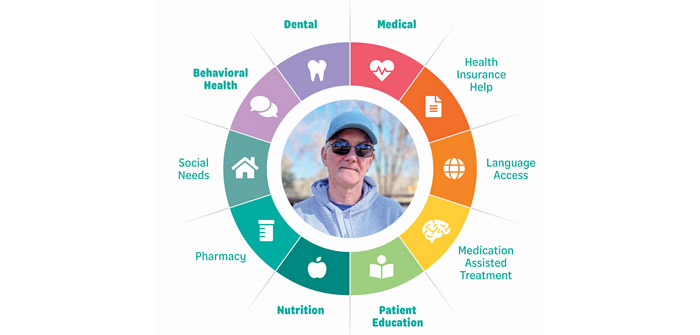
(Dustin’s care plan involved multiple services through Mosaic as part of the team-based care model | Graphic courtesy of Mosaic Community Health)
When Dustin Harris moved back to his hometown of Prineville after working as a plumber in Texas, he had just finished a stay in rehab. He was on a path to recovery from alcoholism and trying to build a healthier life with help from his family. But then he suffered a different health setback: his blood sugar was dangerously high and he ended up in the Emergency Room (ER). That’s where he found out he had diabetes.
After getting signed up for the Oregon Health Plan (Oregon’s version of Medicaid) while in the ER, Dustin was sent to Mosaic’s Prineville Health Center. There, he received care from a whole team: a primary care provider, a pharmacist, a nutritionist and a mental health specialist. They helped him understand his conditions, change his diet and work through the emotional parts of recovery. “I was so ignorant of all that was going on that it actually brought me to tears,” said Dustin. “Addiction is a hard thing… it’s a really, really hard thing. Without people to help you along the way, it’s difficult to do it all yourself.”
What is Team-Based Care?
Nearly half of adults in the U.S. have two or more long-term health problems, like diabetes and alcohol use disorder, which often require several different types of healthcare. That’s why “team-based care” — where medical professionals work together across specialties all in one building — is so important. Team-based care is especially effective in community health centers like Mosaic, where many patients face complex needs and barriers to care.
Studies show that team-based care helps people stay healthier, lowers costs, increases satisfaction and helps patients manage chronic conditions like diabetes successfully. They’re also less likely to need to go to the emergency room or be hospitalized, avoiding costly medical bills and financial strain on the system.
How Team-Based Care Helps People Heal
Instead of just treating symptoms, the care teams at Mosaic help people deal with the deeper causes of their health problems and make changes that last. This includes screening for housing and food insecurity, mental health, dental needs, health insurance issues, language barriers, substance use disorders, medication needs and financial issues.
The goal is to remove as many barriers as possible. For people on a low income, for example, Mosaic offers a sliding scale payment plan and has in-house enrollment specialists who can get patients signed up for Medicaid and other programs. Community Health Workers help connect patients to resources, whether it’s food or housing opportunities or simple health tools to support at-home care.
Dustin’s treatment plan included seeing a primary care provider to review his overall health, explain his diagnoses and coordinate care with other specialists. Dustin met with a clinical pharmacist to educate him on how to properly use his medications. He worked with a nutritionist to learn how to make sustainable changes to his diet and manage his glucose levels. He also saw a behavioral health specialist to process the emotional and psychological foundations of his illnesses.
For Dustin, having a long-term, inclusive care plan made a big difference. After a few months, his A1C — a key number that measures how much sugar is in the blood — dropped by more than half. “I control my diabetes with a prescription, diet and exercise, and I stick to it religiously,” Dustin said. He gives credit to the team at Mosaic for his progress. “They have walked with me along this journey and have made it so much better than I thought it could ever be.”
Healing is Possible — But It’s Harder Alone
“I’m convinced that without Mosaic — there’s no way I could be at the level of wellness I am now,” Dustin said. “[They] gave me this ray of hope that there’s a way we could actually beat this and manage this.”
He’s not just managing diabetes, either. He’s quitting smoking through Mosaic’s tobacco cessation program and finally getting the dental care he needs. He’s working toward full-body health and feels thankful for this second chance. “I did so many things to try to kill myself for so long,” said Dustin. “I thought: if I could do that, then why couldn’t I put that much effort into reversing it all? I had to start brand new and build myself back up.”
And Dustin’s transformation goes beyond his physical health. He’s also rekindled his Christian faith and is returning to his plumbing career. He wants to be of service to others — whether through his profession or by sharing his journey to inspire others facing similar struggles. “Hopefully they can hear and read what’s happened to me and relate it to their own life,” said Dustin, adding that he’s thankful for the new “sense of hope that most people in their lives don’t get.”

