

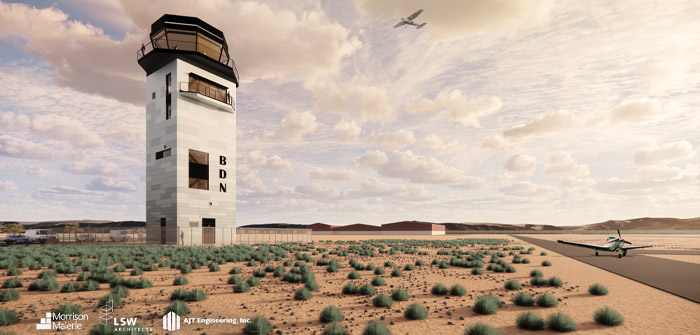
(The new first-class, state-of-the-art control tower will rank as Bend’s tallest building | Rendering courtesy of Bend Municipal Airport)
Despite being Oregon’s third busiest airport in terms of aircraft takeoffs and landings — with 140k annually, or 380 a day — Bend Municipal is the only public airport among the top five that doesn’t have an air traffic control tower (ATCT). As a result, the facility still operates in an “uncontrolled airport airspace” that requires pilots to communicate directly with each other to coordinate who’s next to arrive and depart, which fosters “an extremely difficult operating environment,” according to air traffic specialists.
Fortunately, a “first-class, state-of-the-art facility,” standing at 115 feet and ranking as Bend’s tallest structure, is now in the final stages of construction, said Tracy Williams, the airport’s general manager.
With the new tower, as Williams explained, air traffic controllers will orchestrate safe separation of aircraft and proper sequencing from a perch about 85 feet above the single, 5,200-foot runway that gives them a 360-degree view around the airport without blind spots or no visual coverage. “It’s all about safety, safety, safety,” she said. “The pilots have anxiously anticipated this long-overdue improvement.”
According to the City of Bend (which owns and operates the airport), the ATCT comes with another plus: it will minimize airspace conflicts with nearby airports in Redmond, Prineville and Madras. “During the hours that the tower is open, all aircraft taking off or landing will be required to be in two-way radio communication with air traffic controllers,” noted Williams, an accredited airport executive for 30-plus years.
Construction crews began building the tower in August 2024, and according to Williams, it is about 90% complete. She expects construction will be completed by the end of April 2026.
The pace of construction, Williams explained, “has been affected to a certain extent by factors beyond local control — such as cold weather conditions (e.g., trenching to lay fiber cannot take place when the ground is covered with feet of snow), asphalt plant shutdowns, labor shortages, supply-chain issues, and the recent 43-day government shutdown. For the most part, however, we didn’t stop working.”
Describing the project’s exterior and interior design elements as “relatively straightforward, with only minor hiccups as would be expected with any construction project,” Williams said that “getting others to embrace my vision in the early stages,” (discussions about the need for a control tower had been underway since 2008), “was perhaps the most challenging aspect. I even addressed the issue when interviewing for my position,” she said, and was convinced that “I can accomplish this.”
Calling this “my legacy project” and the “most ambitious” of her career (which has included executive positions at airports throughout the U.S., including Reno-Tahoe International Airport, and Lihue Airport on Kauai), Williams said that “Of the $15M required to make the air traffic control tower a reality, local out-of-pocket costs total approximately five percent, and these are for amenity upgrades such as installing remote-control window shades instead of the originally proposed venetian blinds, and additions in the break room kitchen.”
“The ATCT is being built in anticipation of future growth,” she said. “It’s very forward thinking.” (A five-year aviation activity forecast for the Bend Municipal Airport predicts two- to three-percent growth year over year.) “There is even a room in the eight-story tower to accommodate additional personnel when growth dictates it.”
Williams emphasized that “Collaboration has been integral to the project from its earliest pre-funding days — an example being the initial site selection study that involved some 45 professionals. Everyone had an opportunity to weigh in.”
“Since then, constant collaboration, transparency, and open communication — which foster more efficient problem-solving — have been key to our success.” (Among the partners are Morrison-Maierle, LSW Architects, and AGT Engineering.)
“In fact,” Williams said, “The Bend Municipal Airport’s ATCT will be used as a model for the FAA’s tower modernization efforts. Although not realizing it at the time, we were trailblazers.”
Williams pointed out that there are no plans to bring commercial flights to Bend. “There’s no reason to compete with Redmond, especially since Bend is heavily used for general aviation and business by about 300 aircraft, and its runway isn’t long enough to accommodate commercial jets. This is how we distinguish between the two airports, which service entirely different markets.”
Nor is the control tower project designed to attract other larger aircraft. “All of our planes meet the criteria of having a 79-foot-wide wing span, and a 30,000-pound, single-wheel, weight-bearing capacity,” Williams said. “While the new tower might change the mix of aircraft and air traffic flow organization, there are still limitations on who can come in to optimize operating efficiencies.”
As she watches the ATCT take shape from her office window, Williams does not minimize her key role each step of the way. “Someone had to champion the project, and I knew that I couldn’t drop the ball.”
And, she adds, “I’m so fortunate to have City of Bend leadership as advocates, as well as strong support from elected officials at all state and federal levels who continually ask, ‘How can we help?’ They tell our story with energy and enthusiasm.”
Comparing the project to “flying a plane while it’s being built,” Williams shares an attribute with those officials and other ATCT advocates. “I take pride in making a difference for the communities I serve.”


