

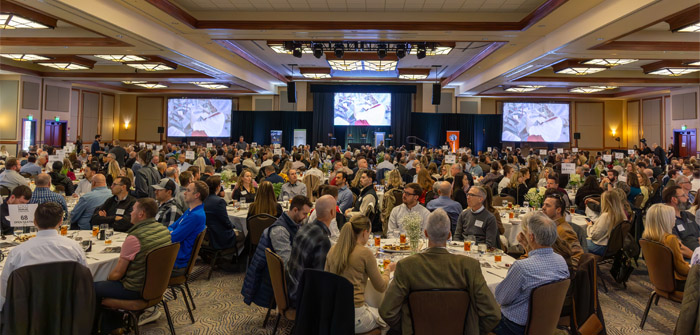
(EDCO CEO Jon Stark updates 2026 Luncheon on recent economic activity | Photo courtesy of EDCO)
Key EDCO Event Hears Insights from Executive Panel and Brand Visionary
A crowd of some 750 business and community leaders thronged Bend’s Riverhouse Convention Center recently for the sold-out 2026 Economic Development for Central Oregon (EDCO) Annual Luncheon, featuring keynote speaker and business transformation expert Michelle Stacy.
Stacy, a former President of Keurig, where she led the brand’s explosive growth from $200 million to $2.5 billion, has 35+ years in executive leadership at Keurig, Gillette and P&G, and shared insights from her journey building billion-dollar brands and shaping market-defining innovations.
The EDCO event – which analyses economic trends and best practices for today’s business community – was billed as “Embracing Innovation in Central Oregon: Where Barriers Spark Breakthroughs” and also featured a dynamic panel discussion, exploring how Central Oregon companies are transforming challenges into opportunities for growth and long-term success.
Moderated by Roger Lee, VP Business Client Advisor with Summit Bank, the panel brought together executive leaders from top local companies like i3DMFG, CV International, Serán Bioscience, and Deschutes Brewery, to share real-world insights on innovation and leadership.
Proceedings began with EDCO CEO Jon Stark — leading the group’s mission to create a diversified local economy and a strong base of middle-class jobs in Central Oregon — giving an update of recent accomplishments spearheaded by the organization over the last year.
Stark said the EDCO team met with more than 600 *traded sector companies in 2026 and assisted over 800 businesses across the region.
*Traded sector companies are businesses that export goods and services outside their local region, driving economic growth by bringing in external revenue and creating a multiplier effect for local jobs.
He added, “Over the last three years, that work resulted in 750 jobs created and $200 million in capital investment. Those are real projects and real jobs in our communities.
“That work is also being recognized nationally. Once again, the Bend Metropolitan Statistical Area (MSA) was ranked number four Best Performing Small City by the Milken Institute.
“That ranking reflects consistency. It reflects collaboration across the region. And it reflects an economy that continues to perform, even in a challenging environment.
“We are also competing at scale. The new Amazon regional distribution center reflects the infrastructure, workforce, and logistics capacity that companies at that level require.
“We continue to see expansion activity across the region. To support this growth, we are focused on industrial readiness and on building opportunities for growth across the region.”
Stark said the Central Oregon Innovation Hub, now under EDCO’s leadership with Rita Hansen at the helm, would be a key element of this strategy, “through better connecting founders, resources, and capital, improving the founder experience and supporting innovation-based enterprises in a new way in our region.”
He added, “This, when paired with the Innovation District from OSU-Cascades, will further support the innovation-based economy of today and tomorrow.”
Peter Skrbek, CEO of Deschutes Brewery, said the craft brew market sprang from a cottage industry which grew to 9700 craft breweries by 2014, all fighting for just 20 percent of the overall beer market.
He said, “There was something of a retail overreact followed by changing consumer behaviors.
“Over the last four years, Deschutes Brewery has re-established our identity as a beverage company brand.
“We have always been at the forefront of technology and adaptation. We were ahead of the curve in developing NA beers, and on the commercial front we have tried a different strategy and collaborated with other brands matching what we have here in Central Oregon.
“We also went into a national partnership with Patagonia, and a joint venture with Costco, where now you can get a 12 pack including the Kirkland logo for the incredible deal of $12.99.
“As trends have changed, in the “beyond beverage” category, for example, hard seltzer makers Truly and White Claw, aimed at ‘Gen-Z’ consumers, has a bigger share than the entire craft brew market.
“To reflect such changing tastes we have co-created an exciting new product aimed at the 21-27 market, called “Party Bomb” featuring real fruit, real sugar, flavored alcohol. We are pushing technological boundaries and taking fans and customers to the next level.
“Once again, we are finding value in taking an underserved market and making it better. The cornucopia of Earth’s bounty is our palate!”
Sam Zumbrunnen, president of Bend-based Cv International, Inc. which provides complex aircraft maintenance platforms, primarily for military and commercial aircraft, said his company is inclined to “never say no” and display strength in quality and customer service in finding the right solution for any desired application.
i3DMFG is a 3D metal additive manufacturing company, based in Redmond, specializing in aerospace and defense disruptive product and engineering, utilizing the latest laser printer technology to manufacture custom-designed parts for everything from high-end bicycle equipment to satellites and aerospace rocketry.
It employs metal powders that are layered one upon each other together with high-powered lasers into the requested design. Civil and mechanical engineers and support staff program the printers to create the pieces.
The finished products are lightweight, resilient to stress and create efficiencies in their use. For example, NASA has been using such products for years and is always on the hunt to find parts for its rocketry that will reduce weight, help operate the engines more efficiently, thus reduce fuel usages.
Stephanie Bonfiglio, VP of Integration and Quality Excellences at i3D, said, “We pioneer complex systems and are always looking to push the envelope including printing faster and better.
“This company was founded in 2013 to prove disruptive technology’s value in finding solutions for customers – from prototyping to production to innovations.
“We had 15 employees two years ago and have now grown to 54. We also work with Redmond High School and COCC in taking on and training interns.”
Dan Smithey, PhD, is president, CEO and founder of Serán Bioscience, providing clients with integrated drug product development, formulation, and manufacturing solutions.
He said, “The pharmaceutical industry is typically risk averse. The average timeframe is 10-12 years and $1.8bn to develop a new therapy. That is not sustainable
“We saw the wave and knew that development processes etc. had to change to deliver medicines more equitably and try to provide drug solutions faster.
“People ask why we locate in Bend and the answer is the quality of life it offers our employees. You really can innovate anywhere.”
Seran’s latest growth step includes a $200 million strategic investment from Bain Capital Life Sciences and Vivo Capital to support the construction of a new 100,000 commercial-scale drug manufacturing facility in Bend set to open later this year.
Lee concurred that innovation takes a whole community and part of Central Oregon’s ‘secret sauce’ was that it was not a dog eat dog environment, but a tight-knit, collegiate style helpful community.
Smithey added that Seran was embracing AI technology, especially in streamlining somewhat mundane regulatory tasks, and was looking at how applications may also aid the manufacturing process.
Stacy currently serves on the boards of iRobot, Skullcandy and Milton’s Bakery, and has held leadership roles across several high-growth companies.
As featured speaker, she shared boardroom-tested strategies to drive innovation, lead with engagement and build high-performance teams that thrive in complexity and accelerate growth.
She stressed that one of the secrets of transformational innovation was to create a culture of innovation where leaders stay engaged.
Redefining your category could also help companies grow.
She said, “Gillette used to be about how many razors you could put in a bag and the discussion was on how to lower costs.
“But we changed the paradigm to compete on technology, which started the journey toward precision engineered razors such as the Sensor.”
Launched in 1990 after a decade of development, the Gillette Sensor was a revolutionary shaving system featuring twin blades individually mounted on highly responsive springs, designed to adjust to facial contours. It significantly improved shaving closeness and comfort, marking a major innovation in shaving technology that cemented Gillette’s market leadership.
The company also expanded its grooming products range as part of the “Best a Man Can Get” campaign.
Stacy said it was important to emotionally engage with customers, citing the passion of Keurig “super consumers” as an example.
She added, “The biggest waste in an organization is disengaged talent – people are the only asset that can create and we should prioritize the positive intent of the individual.
“Part of what keeps people engaged is being heard and it is vital to allow different points of view to be heard through full engagement.
“When we let our light shine, we let others shine.”


