

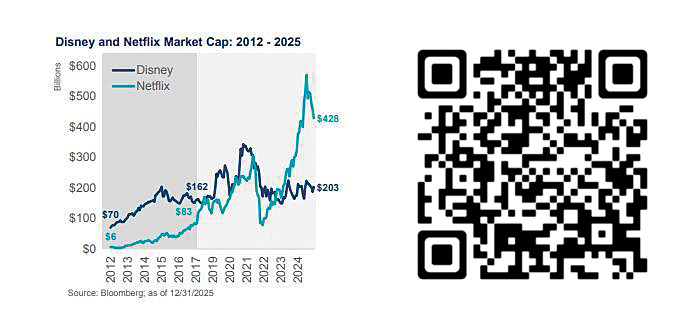
(Graph courtesy of Heritage Wealth Advisors)
Families flocked to theaters this holiday season to see Zootopia 2, which grossed $556 million globally its opening weekend. Some, though, will wait for it to come to streaming. Today, that means Disney+; but it was not long ago that Netflix was the streaming home for films like Zootopia 2. From 2012 to 2017, Disney licensed movies out to Netflix for a fee, allowing Netflix to use the films to attract new subscribers.
In hindsight, the decision was a colossal error by Disney. Movie studios historically reached customers through movie theaters, video rentals, and home video sales. To Disney, Netflix was another distribution channel to reach customers. When the partnership began in 2012, Disney had a market cap about 20x larger than Netflix. But streaming became the more lucrative business by taking market share from movie theater attendance, video rentals, and home video sales. Both firms benefited during the partnership, with each growing their market cap by roughly $80 billion. In 2017, Disney course-corrected and broke away from Netflix to start their own streaming service, Disney+.
Open borders with Disney were key to the success of Netflix. The Disney library gave them time to build a self-sustaining model that generated almost double Disney’s net income in 2024. Early hits House of Cards and Orange is the New Black were a proof of concept that enabled future triumphs like Stranger Things. Disney’s focus on short-term profits missed the broader shift occurring in content consumption. Since the breakup in 2017, Disney’s market cap has increased just $41 billion, while Netflix has grown $345 billion.
As we look out at the global economic landscape, we see the patterns of a similar story unfolding. Following the collapse of the Soviet Union in the 90’s, the U.S. turned to less developed nations such as China, in much the same way that Disney partnered with Netflix. U.S. companies sought to boost short-term profits by moving manufacturing overseas to access cheap labor. The increased trade between the two countries linked them together and led to prosperity for both economies. GDP per capita in the U.S. grew by 1.7% a year from 1991 to 2024,¹ while Chinese GDP per capita grew at a staggering 8.1% rate.²
U.S. companies, though, failed to recognize the Chinese economy as a threat, just like Disney overlooked Netflix. The period of open borders offered China a generational influx of capital. They invested excess back into the country’s infrastructure and built a more self-sustaining economy. This led to advancements in key technological industries such as artificial intelligence (AI), electric vehicles, and renewable energy.
While globalization started declining a decade ago, “Liberation Day” represented a clear shift in this trend. Just as Disney pivoted to a self-sustaining streaming service, the U.S. is reducing foreign dependencies and seeking greater autonomy. The hope is that these tariffs will bring more production back to the U.S. to further develop domestic infrastructure and preserve technological advantages.
The decoupling of Disney and Netflix showed an example of how these decisions can lead to diverging outcomes. We cannot know for certain if the U.S. or China will come to lead the global economy. Both economies face challenges in the years to come — aging demographics, rising U.S. debt levels, and a substantial real estate slowdown in China, to name a few. What seems clear is that the reduced reliance on each other has increased risk to both countries, in our view. As nations become less ingrained in the global economy, it is possible that greater dispersion between winners and losers will arise. Investors should not rely on rising tides lifting all boats in the global economy, making diversification critical in the decades ahead.
What follows is our outlook on the short-term economic future and long-term trends we believe investors should consider when positioning their retirement assets. To access the full HWA 2026 Economic & Market Outlook white paper on our website.
¹World Bank. (2025, December 17). Constant GDP per capita for the United States, retrieved from FRED
²World Bank. (2025, July 2). Constant GDP per capita for China, retrieved from FRED


