

Redmond, Oregon’s “Hub” reference stems from its early role as a central hub for agriculture, trade, and transportation in Central Oregon, established with the arrival of the railroad in 1911. This identity, promoted by groups like the railroad and irrigation district, solidified as the city grew into a key commercial center with access to highways and its own municipal airport by the 1930s and 1940s.
Redmond maintains its statewide recognition as the “Hub”, especially for industrial development that has seen substantial growth since the initial “COVID Crash” in 2020, driven by population influx, e-commerce expansion and availability of resources including land, power, water and workforce.
As a reminder, 2020 began an economic slowdown where Global GDP fell by 3.4%, amounting to over $2 trillion in lost output and marked the start of widespread business shutdowns, with nonessential businesses closed and millions of jobs lost. The economy entered a deep but short recession, with output falling as much as 20% in a single quarter in some regions.
Central Oregon Impact and Recovery
There are continuing reports of businesses closing because they never really recovered. However, most have seen strong rebounds evidenced by the following statistics:
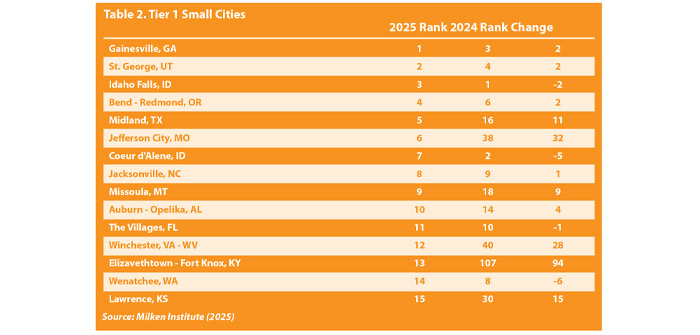
The Milken Institute’s report, “2025 Best Performing Cities,” lists the Bend-Redmond metro service area as the fourth best performer and that is up from sixth position last year. Most of that performance came from growth in Redmond.
Milken Institute’s Best Performing Cities 2025
Components of the best performing cities index includes analysis of ability to provide well-paying jobs, the growth of key industries employing STEM workers and the area’s ability to retain and grow its workforce.
Heartland Forward Institute’s report, “Most Dynamic Metros, 2024,” indicates that “Post Pandemic, Metros like Bend-Redmond (No. 8), leveraged quality-of life amenities and outdoor recreation to attract new residents and visitors, driving economic momentum. During the pandemic some people moved out of dense urban areas seeking quality of place and quality of life in smaller communities. Many who came as tourists decided to relocate. This trend has driven strong performance by these destination metros.”
For various reasons, our Tri County region’s economic growth continues to outpace other regions in Oregon. This growth places pressure on resources including commercial spaces for growing businesses.
Lease Rate Growth Overview (2020–2025)
- Pre-COVID (2019–2020): Industrial lease rates in Redmond averaged around $0.65–$0.75 per square foot, not including NNN (insurance, taxes and maintenance) charges.
- Mid-2023: Rates climbed to $0.85–$1.00 per square foot, reflecting tight vacancy and strong demand for small-bay and flex industrial space.
- 2025 through third quarter: Current asking rates range from $1.10 to $1.25 per square foot, depending on location, building age and amenities.
That’s a 60-90% increase over five years, with the steepest rise occurring between 2021 and 2023 as businesses scrambled for mostly basic manufacturing and distribution facilities.
- Low vacancy: Redmond’s industrial vacancy rate has been locked in at around 3.5% for at least the last two years.
- Limited speculative development: Over 90% of new industrial space is pre-leased with spec builders waiting for lower interest rates and materials costs.
- Local user growth: Most of the growth in leasing can be attributed to Central Oregon-based firms needing more space or additional amenities including more office space, fenced outdoor storage and large indoor work areas.
What to expect in the near future
- Redmond’s vacancy rate has seen a slight increase recently. If vacancy continues to rise, it could moderate lease rate growth and lease rates for larger buildings could see a slight decrease to incentivize occupancy. Some tenants are already seeing offers of free rent or first year lease rate reductions.
- .. The recent impact of tariffs, labor shortages, and local regulatory hurdles continue to have an impact on development costs that must then be passed on in the lease rates for new construction.
- Any new tax measures (like Oregon’s proposed Measure 118) could dramatically increase costs for development which will be passed on to tenants.
Another impact of State tax structures will eventually affect demand. According to the Tax Foundation’s “2025 State Tax Competitiveness Index,” Oregon is about in the middle for overall tax burden on business but is #49 in favorable Corporate Tax rates. This has been given as the major reason for several high-profile Oregon companies recently moving their headquarters out of state.
2025 State Tax Competitiveness Index
| State | Overall Rank | Corporate Tax Rank | Individual Income Tax Rank | Sales Tax Rank | Property Tax Rank | Unemployment Insurance Tax Rank |
| Oregon | 30 | 49 | 40 | 4 | 31 | 41 |
Tax Foundation’s 2025 State Tax Competitiveness Report
- Redmond’s industrial land supply is constrained in key areas, especially near the airport and logistics corridors. As level, ready to build parcels with accessible utilities become scarcer, the cost of development escalates and makes it more difficult for developers to recover those expenses at a competitive lease rate.
Economic changes affecting long-term lease rates
Long-term industrial lease rates in Redmond will be shaped by a dynamic mix of local growth trends, national economic shifts, and policy decisions. Here’s how the key forces are expected to play out:
Redmond’s industrial base is diversifying beyond traditional manufacturing into food products, aviation, medical supplies, distribution and services. A more diverse mix of businesses means more resilience for the local economy and that translates to less volatility in lease rates, even during national downturns.
Redmond’s efforts to increase resources such as vacant industrial zoned land, water and power will provide long term advantages.
Maintaining a favorable business climate should be a priority and State regulators and politicians must balance the impact of taxes and regulations.
Current lease rates are the result of local economic factors including availability of resources, the cost of construction, interest rates, and demand. With growing pressure on all of these factors, it is expected that industrial lease rates will continue to escalate and users of industrial space will need to make carefully calculated decisions about space requirements that are a major expense line on their business’s profit and loss statement.
Bruce Barrett is a commercial broker with Century 21 Commercial, and Tim Conlon is a Bend business consultant with Conlon Consulting Group.


