

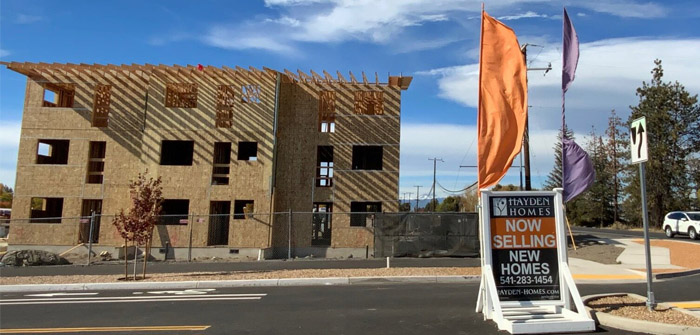
(Parkside Place, now under development by Hayden Homes adjacent to Bend’s Highway 20, promises much-needed affordable housing but has also inspired neighbor traffic concerns | Photo by Leah Etling)
On a recent fall morning in Bend, state and local leaders stood together on a stretch of freshly graded earth along Highway 20 that represents one of Oregon’s most ambitious housing experiments. The forthcoming neighborhood, Parkside Place, is the product of a partnership between the State of Oregon, the City of Bend and developer Hayden Homes, and aims to tackle the region’s housing affordability and availability crisis.
For Oregon Governor Tina Kotek, the moment was symbolic. As House Speaker in 2016, she helped pass House Bill 4079, which allowed Bend and another city to pilot affordable housing projects outside existing urban growth boundaries, a rare flexibility in Oregon’s tightly controlled land-use system. Nearly a decade later, she reflected on the progress and the work still ahead.
“We know the cost of living here in our state is a challenge,” said Kotek, who was in town for the event. “People need affordable housing, and when they don’t have it, we see the consequences; folks living outside, moving away, or workers unable to find a place to live. All those things are bad for our state, but we are making progress here in Oregon.”
She said the Parkside Place project demonstrates how government, business and community groups can work together to make housing happen. “Government can be a great partner and a catalytic investor,” she said. “But we aren’t the ones building the homes, that’s why we need to work with the private sector and get to affordability. What’s happening at Parkside is a significant commitment from our private partners in the development world to do this in a way that lifts up everybody.”
Oregon’s housing shortage is no secret. The state’s Housing Needs Analysis, completed in 2023, found a deficit of roughly 140,000 housing units, the result of decades of under-building, slow permitting processes and soaring construction costs. Kotek has made housing the centerpiece of her governorship, issuing executive orders to accelerate land-use planning, fund infrastructure and create incentives for housing that fills the gap between apartments and single-family homes.
Losing People to High Prices
Bend is the fastest-growing city in Oregon, with home prices and rents that have outpaced nearly every market in the state. According to the city’s latest housing report, the median home price sits well above $700,000, and a household earning the area median income can afford only about half that.
For Bend Mayor Melanie Kebler, that reality defines every policy conversation. Since joining the city council in 2020, she’s urged staff and council members alike to view each decision through the lens of housing.
“Despite our efforts to stabilize rents and home prices, the median home price in Bend is still unaffordable for a family making the area median income,” Kebler said. “We’re losing lower-income earners moving out of the city as higher-income earners move in. What we want are communities like this one, where people of all incomes live together in all types of homes close to amenities.”
That vision, she admitted, has been slow to realize. The Parkside Place project faced “a tough, tough road,” with costly infrastructure hurdles and long permitting delays. “There was infrastructure which is costly,” she said, noting that even a single sewer lift station can cost millions. “Even though we’re on the edge of the city, you still have to get the pipes and roads out here, and that’s a major cost for builders.”
When other developers backed away, Hayden Homes stepped in. “They’re delivering 40 percent deed-restricted affordable housing, instead of 30 percent, and building those first,” Kebler said. “That’s hard to do when you need capital and cash flow, but it shows what’s possible when community-minded builders get involved.”
Parkside Place will ultimately include 108 affordable deed-restricted rental units, 30 affordable deed-restricted homes for sale and 209 market-rate homes, plus more than five acres of open space and a four-acre community park. The affordable portion is expected to serve households earning between 60% and 80% of the area median income: firefighters, teachers, health-care workers and service employees who are increasingly priced out of Central Oregon’s renter or homebuyer market.
Neighbors Weigh In
Neighbors to the west and north edges of Parkside Place are less than enthused with the forthcoming completion of Parkside Place. Despite numerous community meetings prior to groundbreaking, one vocal resident, who has lived adjacent to the project border for 11 years, said she felt unheard during the planning process, where residents addressed quality of life and traffic concerns.
“When I moved here, this was ideal. I looked out my window to 40 acres of wild area, I saw coyotes, a wolf and lots of birds. There were two beautiful seasonal ponds,” said the neighbor, who declined to share her name. “All of that’s gone.”
‘It feels futile. I can’t afford to downsize in Bend,” said the Witherspoon Place resident, age 80 and a Bend resident for the last 55 years. “I believe in affordable housing. But the deception we’ve experienced is truly disheartening.”
The adjoining neighborhood, accessible to Parkside Place via NE Livingston Drive, is already being impacted by through traffic and construction vehicles, she noted. And a promised development exit route from Parkside Place to Bear Creek Road has yet to be completed, though it is planned to be paved later in the development process.
“I see the future traffic issues as a real problem. People won’t always turn right to go to the roundabout at Hamby Road, and that will create hazards for traffic in both directions,” said another neighbor across Highway 20 from the project, a nurse who is concerned about public safety and declined to share her name.
When exiting Parkside Place on Highway 20, drivers must turn right and proceed to the roundabout at Hamby Road to circle back towards Bend, but already, not everyone obeys the signage. “I’ve talked to ODOT, but they say there is nothing they can do,” said the resident, whose home faces the project’s entrance and exit.
David Morman, a resident of the Parkside Place adjacent neighborhood, said neighboring residents expressed their concerns in community meetings before building began, but now are resigned to the impacts.
“As these developments go in, it feels there is no master vision for us as homeowners to know what’s going to come next. As a homeowner in a neighborhood that’s rapidly developing, there’s a big unknown factor: does anybody know what it’s actually going to look like?” Morman asked.
Investment in Infrastructure
For Katie Brooks, Economic Development Officer for the City of Bend, the conversation about housing isn’t just social or political, it’s economic. “If your (staff or employees) can’t afford to live here, you’ve got a problem,” she said. “We view housing as essential infrastructure for our people and for the economy.”
Brooks said Bend has already invested more than $26 million in sewer and transportation infrastructure to unlock the southeast area’s development potential and is seeking $10.7 million more in funding for transportation projects.
Hayden Homes purchased the Stevens Road Tract of 260 acres from the Oregon Department of State Lands in September, with plans for 2,500 homes. Twenty acres of the project will be deed-restricted affordable housing and workforce units, including a focus on local education professionals. The Stevens Road Tract is located east of the 375-acre Stevens Ranch development, where residents are already settled in the first completed blocks of 150 new market-rate homes built by D.R. Horton.
Brooks said that Bend’s southeast area represents the city’s most promising zone for near-term growth. Hundreds of acres of open space in the area, now mostly sagebrush, lava rocks and juniper trees, could eventually house up to 20,000 residents in a total of 7,500 homes.
“This is about long-term economic vitality,” Brooks said. “If employers can’t attract workers because of housing, our entire regional economy suffers.”
Another forthcoming project highlighted by officials was Caldera Ranch, located across Knott Road from Caldera High School and part of the urban growth boundary expansion authorized by Senate Bill 1537 in 2024. Land added to the city under the bill is required to be developed with 30 percent of housing units at affordable levels.
Caldera Ranch is expected to include 716 homes on 91 acres, about half detached single-family and the other half townhomes and multifamily. More than one-third of the total are planned to be deed-restricted as affordable at different area median income (AMI) levels.
Caldera Ranch will also include nearly two acres of neighborhood-scale commercial development, like offices and retail, and close to ten acres of open space, including a 4.5-acre neighborhood park and multi-use paths for walking and jogging. A new roundabout will be constructed at Brosterhous and Knott Roads to facilitate traffic movement through the area.
“We can’t wait to bring some affordable housing to the city and more housing to this area,’ said Dan Goodrich of Structure Development NW, which will build the project. One of the challenges of expanding beyond the city’s existing infrastructure is obtaining utility services, but Goodrich and consultant AKS Engineering worked with private water provider Avion Water Company to run water lines to the Caldera Ranch site last year.
“Avion has the capacity to serve these developments, and we are ready to do so, as long as the PUC requirements are met,” said Jason Wick, president of the water company.
Community Feedback
The connection between housing and workforce stability is a key point for David Welton, president of Bend’s YIMBY (Yes In My Backyard) chapter, a grassroots group pushing for more housing of all types and income levels. “We think that everybody who works in Bend should be able to live in Bend,” Welton said. “That means building more housing of all shapes and sizes, so everyone has a place to call home.”
He said projects like Parkside Place are vital for workforce sustainability. “If we’re forcing people to drive in from Madras, the carbon emissions from those commutes are huge,” he said. “There’s an environmental reason, a business reason and just a human reason to get housing built.”
Susi Gaylord, a Southeast Bend resident since 2019, offered a counter perspective.
“They’re just jamming everything into Southeast, It’s just not right. This is forever, so make a good plan. What if you add 20,000 people to the southeast, but the roads aren’t meant for it? You have to think about these things,” said Gaylord, who was a vocal opponent of a recent gas station project proposed for Brosterhous and Murphy Roads.
She hopes that area residents can be more involved in the final plans for the forthcoming Southeast Bend projects. “We have smart people here who have vision. People love Bend – take that love and turn it into something positive.”

