
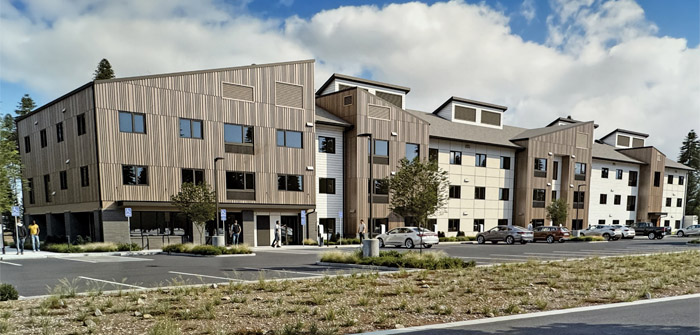
(When completed, the Wickiup Junction project will consist of 100 affordable, high-quality units | Rendering courtesy of Foundation for Affordable Housing)
“I want to thank them very much for helping us reduce and prevent homelessness,” said Deschutes County Commissioner Phil Chang, addressing those assembled at a recent groundbreaking ceremony for the 39-unit apartment building being constructed by the Foundation for Affordable Housing (FFAH) in north La Pine.
Operating nationwide, FFAH — which is dedicated to “enriching the lives of our residents and adding stability to the surrounding community… through construction of safe, comfortable, high-quality, affordable rental homes” — has housed 60,000+ people since its founding in 1988.
The charitable organization’s latest project, on Drafter Road in the Wickiup Junction area, is targeted at individuals and families making 30 to 60 percent of the area income. And why La Pine?
“La Pine has long lagged behind the rest of Deschutes County in indicators of economic health and access to housing,” said FFAH Chief Strategy Officer Tommy Waldron, based on extensive research conducted prior to selecting the community.
“Despite the population growing 178.5% since 2000, and a number of new businesses popping up in recent years, the amount of housing choices is very limited. And rents are going up faster than incomes,” he added.
In seeking financing for the Wickiup Station Apartments project, as Waldron explained, “FFAH started with the state, and — competing against seven other projects — was chosen due to La Pine’s overall need, which is nearly double that of Deschutes County.”
From there, the Foundation hired an architect, LRS Architects Inc., and a civil engineer, subsequently working with Deschutes County, the City of La Pine, and various lenders “to put development plans in place,” Waldron said. “It was a large collective effort to get across the finish line.”
In addition to state monies, financing for the project is coming from NewPoint Real Estate Capital, the National Equity Fund (NET), Umpqua Bank, and the Low-Income Housing Tax Credit program (LIHTC) — which “creates 90 percent of the country’s affordable housing,” according to Waldron.
Construction (by Sun West Builders out of Redmond) will begin this spring, with the building expected to open in late fall of 2026. The 39 units will offer a mix of one-, two- and three-bedroom options to accommodate both individuals and families with rents starting at $600/month (including all utilities). Additionally, ten units will be reserved for veterans, “reflecting the organization’s commitment to supporting those who have served our country.”
“We’re looking for a pretty good mix here,” said Foundation President Deborrah Willard at the groundbreaking.
Waldron noted that “a full-time service coordinator will be on-site to help residents gain access to various community organizations (such as job resources), and help stabilize their lives.”
The property will also feature a range of amenities, including a large community room, game rooms, a fitness area, and a common deck. The grounds will also include a playground, raised bed gardens, covered bike storage and natural areas.
“The building for which we’re breaking ground is Phase 1 of what will eventually consist of 100 units,” Waldron said. “The Foundation for Affordable Housing already owns the property, and has applied for tax-credit funding for Phase 2. If awarded, we envision two years until completion, allocating 14 months for construction.”
In the second phase, “we’ll also be increasing sewer capacity, which will affect not just our project but the Wickiup Junction area overall. Thirty to 50 contractors, all of them from Deschutes County, will be involved during peak construction — thereby providing job stability in the area,” he noted.
In terms of sustainability, and in recognition that development can be disruptive to wildlife and the environment, FFAH is working with Moffet Energy Modeling and other expert consultants. The property “Wickiup Station” will be Earth Advantage certified, and as an organizational goal, FFAH will replant ten times the number of trees removed on the site with an Oregon organization.”
As Waldron emphasized, “This is the best example of what we’re doing in Central Oregon.”