

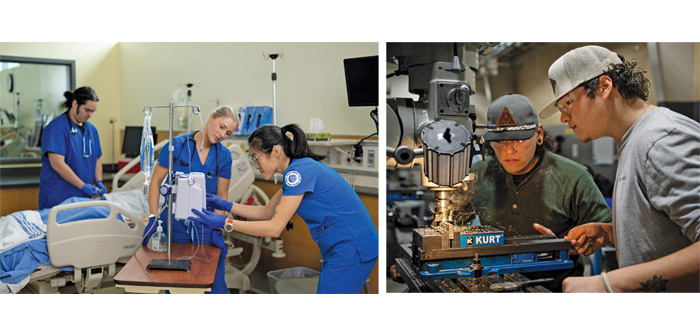
((Left) COCC Nursing Program (RIGHT) Redmond Campus Manufacturing Program | Photos courtesy of COCC)
Central Oregon Community College is a pillar of furthering opportunities for the region, and has been since they opened up their doors and first started offering classes in 1949. Since that time, the college has grown into a force for economic development, helping develop a highly-trained workforce, higher average wages for graduates, and programs that directly support the creation of jobs in the region.
According to COCC President Dr. Greg Pereira, this development of the workforce through career-focused education is paramount to the modern college. “As employers face labor shortages in healthcare, skilled trades, technology, and public service, COCC has expanded career and technical education (CTE), workforce training, and partnerships with regional employers to better align academic programs with Central Oregon’s economic needs,” he said. “This positions the college as both an educational institution and an economic development partner. We do this while continuing to serve and grow our traditional transfer degree programs that are also vital to Central Oregon.”
Another major trend Pereira mentioned is all about increasing accessibility for students, and helping spread the college’s overall reach. “Today’s college students are increasingly adult learners, working professionals, parents, or part-time students who need more flexible options,” he said. “COCC has responded by expanding online learning, increasing noncredit and continuing education offerings, and strengthening services at its regional campuses in Redmond, Madras, and Prineville. The college’s strategic plan specifically prioritizes expanding access, increasing participation among underserved populations, and making education more equitable and student-centered.”
One way COCC is looking to increase accessibility and help all students work their way towards that final degree is called Guided Pathways, which has been under development at COCC for several years and will fully launch this fall term. “Instead of presenting students with the list of all 103 majors we offer, you shrink that into broad interest areas and allow them to gradually explore those areas,” explained Alicia Moore, vice president of student affairs. “It’s about helping students make academic and career connections early in their time with us,” she added, with boosted retention and graduation rates as measurable outcomes.
In communities outside of Bend, the college has been expanding operations in recent years to meet community needs. In Redmond, “The Manufacturing Technology program has been working on improving and updating curriculum for both the machining and welding pathways for several years,” said Amy Ward, Redmond Campus Director. “In 2024, the program changed the instruction model from a self-paced, open-lab format to scheduled instruction. This change has increased opportunities for formative assessment, so faculty can make sure students are prepared to enter the local workforce. Students are graded on technical skills and employability skills like punctuality, communication, and problem solving. In partnership with local employers, faculty has done extensive updates and rewrites to curriculum.”
In January 2026, the program was awarded a $2.2 million FIPSE grant. Ward says a deliverable of this grant is the creation of an internship program and the development of seven short-term certificates designed to give students the skills they need to quickly enter the local workforce and find living-wage jobs.
The Prineville campus celebrates their 15th anniversary this year, with a continued focus on meeting community needs.
We have completed a comprehensive Workforce Development Needs Assessment, drawing on multiple data sources and direct interviews with employers,” said Prineville Campus Director Suzie Kristensen. “We are launching a Business Essentials Certificate as a direct response to workforce gaps identified in our needs assessment. This certificate can be attained in one academic year and all classes are available on the Prineville campus. We have developed and are implementing a Navigating College noncredit program for our high school students. This program is to support rural students as they build the skills and confidence to succeed in college-level coursework.”
Kristensen said the common themes they identified from the assessment are health care, skilled trades, and business services/entrepreneurship. These themes are directly shaping which credit and noncredit programs the COCC Prineville campus will prioritize next; The campus’s direction is toward being a true workforce and community hub that expands professional development and leadership training, strengthens K-12 partnerships so more Crook County students see college as accessible, and grows student services so geography doesn’t determine opportunity.
In Madras, the expanded campus opened this past January. The story of combining hometown nursing training with hometown nursing careers is suddenly becoming realistic for residents of Madras. That’s also true for the Nursing Assistant and Medical Assistant programs, also newly offered in Madras, and the expanded Early Childhood Education program, which will integrate some of its learning into an on-site child care center for the community. Each program helps address the need for medical careers and training in Madras.
Lastly, COCC’s Small Business Development Center has announced a new director: J.C. Nore. Nore has spent more than 25 years in Central Oregon, much of that working alongside small businesses as an owner, consultant and sales and operations leader. He built and eventually sold his own printing and consulting business, so he understands both the opportunity and the uncertainty that business owners live with. The SBDC was a resource for his business, providing practical, trusted guidance at different inflection points in the growth process.
“My focus is strengthening advising capacity, expanding regional access, and pairing one-on-one advising with practical programming that responds to what business owners actually need,” said Nore. “We’re adding expertise and becoming more deliberate about serving businesses through COCC’s branch campuses rather than expecting everyone to come to Bend. President Greg Pereira has challenged us to make COCC the community’s first-choice college. I see the SBDC as one practical expression of that vision: when Central Oregonians want to start, strengthen, or grow a business, COCC should be one of the first places they turn.”
Our small business community is facing several pressures arriving at once: rising costs, tighter margins, workforce constraints, access to capital, and an increasingly complicated regulatory environment. With challenges rising, the SBDC offers free advice to business owners for practical results.
“If we do this well, the impact will show up in hundreds of better-informed decisions by local business owners,” said Nore. “Some will result in new businesses, financing and jobs; others will help an established business improve its margins, avoid an expensive mistake or successfully navigate growth or transition. I also hope we create a stronger connection between the college, entrepreneurs and the many organizations already supporting economic development throughout Central Oregon.”