
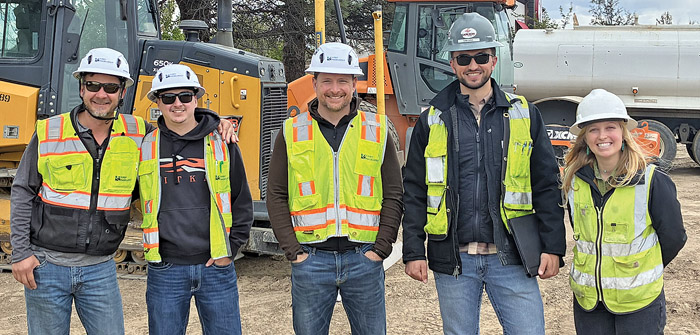
((L-R) Mike Carter (Superintendent KNCC), Carlson Littlefoot (KNCC), Lewis Puller (KNCC), Sam Kane PE (CTI) and Gigi Stetler GIT (CTI) | Photo courtesy of Carlson Testing Inc.)
Carlson Testing Inc. (CTI) operates largely behind the scenes of construction and development, but its work plays a critical role in ensuring that Oregon’s roads, buildings, and infrastructure perform as intended. Founded in 1976 by Doug Leach, the statewide firm provides consulting services centered on construction inspection, materials testing, and geotechnical engineering, which together form the backbone of construction quality assurance.
At its core, CTI acts as an independent verifier. When a new bridge is built, a commercial building rises, or an airport or housing development constructed, Carlson engineers, inspectors and technicians are often on-site or in the lab, confirming that materials meet regulatory standards. This includes everything from testing the compressive strength of concrete cylinders to analyzing soil density and stability before foundations are ever poured.
“You might never see our role in the projects we work on, but that means we’ve done our job correctly,” said Kevin Jordan, a CTI vice president. “Carlson’s role is to make sure that built spaces of all kinds, all across the state of Oregon, are safe and secure for the general public.”
CTI has around 100 employees and offices in Bend, Tigard and Salem. As it celebrates its 50-year milestone, the company is heralding a long history of strong family ties while building toward the future.
A foundation of family and innovation
CTI’s history is rooted in family leadership and long-term industry experience. The company was founded in 1976 by Doug Leach, who established the firm with a focus on quality testing and inspection services at a time when regulatory oversight and formalized materials verification were becoming widespread in the construction industry.
Doug Leach later brought his sons, Brian and Steve, into the business, helping to shape Carlson Testing into a multi-generational company. Brian has since passed away, and today Steve Leach leads the company as president, continuing the family’s direct involvement in day-to-day operations.
Steve Leach’s leadership as the President of CTI reflects decades of hands-on experience across nearly every function within the company, from fieldwork and laboratory testing to executive management. For clients, that translates into leadership that understands the technical realities of projects in the field.
“I’m proud that we’ve reached our 50th year while staying true to our commitment to customer service and quality,” Steve Leach said. “As we’ve transitioned from the first generation to the second and now the third, it would have been easy to lose sight of what matters most — but we’ve remained consistent in upholding our core values.”
The company’s history also includes the contributions of Bend’s Scott Jordan, who spent more than 40 years with CTI before his untimely death in 2024. Beginning his career as a laboratory technician, Jordan rose through the ranks to eventually serve as president. Scott left a legacy of excellence and was a mentor and role model to many. His tenure helped reinforce the company’s reputation for technical rigor and customer service, and his influence continues to shape its culture even after his passing.
That legacy is now reflected in the next generation of the CTI team. Kevin Jordan, Scott’s son, currently serves as a vice president, continuing a pattern of internal development that has long defined the company.
“I have pictures of me as a baby wrapped in a blanket in front of the first Carlson Testing, Inc. office, and I started with the company in an entry-level position and have been able to work my way up throughout my career,” Kevin said. He began his career performing laboratory testing on concrete and soils before advancing into field inspection and project management.
Kevin’s career progression mirrors CTI’s broader emphasis on hands-on expertise. After transferring to the Bend office in 2015, he gained extensive experience in heavy civil construction projects across eastern and southern Oregon. His work has included local highway and airfield projects, along with oversight of mixed design and radiation safety operations — technical areas that require both certification and practical field knowledge.
A focus on employee growth within the firm is CTI’s long-standing approach to workforce development, where many employees have built careers over decades. Looking to the future, CTI is now beginning to attend recruiting fairs at local colleges like OSU with the hopes of continuing to attract talent, particularly in the geotechnical and geological engineering space.
A broad variety of work
The firm’s materials testing division is particularly expansive, covering concrete, masonry, asphalt, and aggregate. In practice, that means technicians may evaluate whether a batch of concrete will hold up under load, determine if masonry, rebar or other materials meet durability requirements, or verify that asphalt mixes can withstand long-term traffic loading. These tests are essential not just for compliance, but for preventing costly structural failures down the line.
Beyond basic materials testing, Carlson Testing also performs “special inspections,” a regulatory requirement for many large-scale construction projects. These inspections ensure that work complies with building codes, engineering plans, and safety standards. The company staffs its projects with certified inspectors and engineers who monitor everything from structural steel installation to reinforced concrete placement, serving as a critical checkpoint between design and execution.
Equally central to the company’s work is geotechnical engineering: the science of understanding how soil and rock behave under structures. Carlson Testing evaluates subsurface conditions through a variety of methods including drilled borings, laboratory testing, and geophysical surveys. Carlson’s team then engineers the soil and rock to meet project design requirements, accounting for challenges like slope instability, expansive soils, and earthquake shaking. These insights inform how buildings are designed and where they can safely be constructed, particularly in complex environments like steep slopes and seismically active terrain.
“Geotechnical engineering provides the foundation for nearly every project that we work on here in Central Oregon. Having a strong understanding of the soils you’re building on allows you to optimize the new structure for cost, safety, and long-term performance,” said Sam Kane, PE, Principal Geotechnical Engineer at CTI.
“The geology of Oregon is very diverse, and different types of soil and rock present different challenges that need to be overcome before a single foundation is poured. Geotechnical engineering often represents less than one percent of overall project costs, yet the problems that can arise without it can easily consume up to twenty percent of project costs. Having the wrong dirt can hurt,” Kane explained.
The company’s capabilities extend into advanced and specialty testing as well. Using tools such as ground-penetrating radar and non-destructive testing methods, technicians can assess structural elements without damaging them. This allows engineers to locate rebar within concrete, detect voids beneath surfaces, or evaluate moisture levels in flooring systems, all while preserving the integrity of the structure.
CTI has played a consistent and visible role in supporting projects across Central and Western Oregon, providing critical materials testing, geotechnical engineering services, and special inspections.
In Central Oregon, their recent work is often part of community-focused development, including projects like the new Bend Central Library, Bend Senior High upgrades, and the new City of Bend Public Works Campus, alongside public-sector investments such as the Bend North Corridor Highway 97 project, the Bend Airport Taxilane Improvements project, and numerous ODOT highway maintenance projects across the state.
In the Portland metro area, CTI’s portfolio expands to include some of the region’s most complex and high-profile developments. From large-scale vertical construction like the Block 216 high-rise and Port of Vancouver Terminal 1 to major public infrastructure such as the Portland International Airport headquarters and the Washington Park Reservoir replacement, the firm has demonstrated its capacity to operate at the highest levels of technical demand.
Additionally, CTI’s full-service concrete, asphalt, and earthen materials laboratory (run by Destry McNeely) holds U.S. Army Corps of Engineers accreditations, which has allowed them to provide testing and inspections on a new fish ladder project at Dexter Dam, outside of Springfield, Oregon. Carlson also recently contributed to Mazama Energy and Quaise Energy’s pilot projects to harness geothermal energy from the Newberry Volcano in Central Oregon. The scope of work is ever-varying and never boring.
To accomplish it all, CTI employs professionals ranging from laboratory technicians to licensed engineers and geologists, reflecting the technical breadth required to support projects of widely varying scale.
“The legacy of the company is reflected in our employees, and in the customer service we deliver for our clients,” Kevin Jordan said. “Our philosophy is that the client comes first. Whether your project is taking place at 5 pm or 1 am, and no matter where it is located in the state of Oregon, our clients know that they can count on us to be there and make sure the testing and inspection job gets done.”