

(Graphics courtesy of State of Oregon Employment Department)
Since 2020, Central Oregon has experienced a booming economy compared to the rest of Oregon. Employment has increased by 10% and population has increased by 5%. Tariffs and reduction in the federal workforce announced earlier in the year threaten economic uncertainty in the near future. In the meantime, Central Oregon’s economy keeps chugging along.
Employment Slightly Increased Broadly in Central Oregon
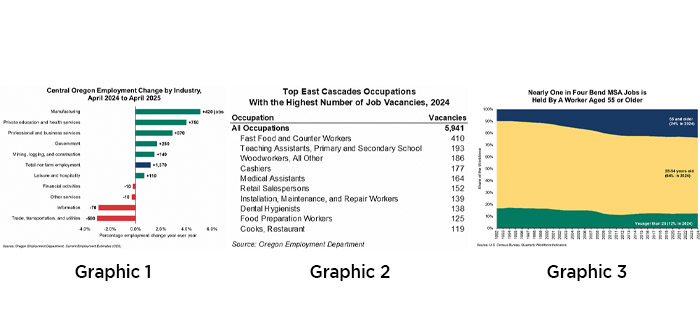
From April 2024 to April 2025, employment in Central Oregon grew 1.2%, adding 1,370 jobs. This is quite high compared to Oregon as Oregon’s total nonfarm payroll employment grew 0.8% over the same time frame.
(See Graphic 1 above.)
Over the year job gains were concentrated within private education and health services (+750 jobs); manufacturing (+420 jobs); professional and business services (+370 jobs); and the public sector (+250 jobs). Other notable gains took place in mining, logging and construction (+140 jobs) and leisure and hospitality (+110 jobs). Over-the-year losses were largest within trade, transportation and utilities (-580 jobs) with 460 jobs lost within the retail trade subsector. Smaller job losses were also recorded in information (-70 jobs), financial activities (-10 jobs) and other services (-10 jobs).
High Job Demand in Health Care and Service Sectors in the East Cascades
Looking more at job demand, we can take a look at job vacancies. Throughout the year, the Oregon Employment Department surveys private employers from all industries and areas of the state to ask about job vacancies they are actively trying to fill.
The Oregon Employment Department estimates that there were 5,941 job vacancies in the East Cascades region at any given time in 2024. The East Cascades region is a ten-county region that includes Gilliam, Hood River, Sherman, Wasco and Wheeler counties in the Columbia Gorge; Crook, Deschutes and Jefferson counties in Central Oregon; and Lake and Klamath counties in South Central Oregon.
Job vacancies in the health care and social assistance industry accounted for 23% of all job vacancies in the East Cascades, the most of any industry in the East Cascades. Leisure and hospitality accounted for 19%, the second most. Manufacturing (16%), retail trade (12%) and construction (10%) round out the top five.
(See Graphic 2 above.)
Average wage across all job openings was $22.68 an hour. The natural resources and mining ($15.59) and the leisure and hospitality ($16.79) industries had the lowest wage offered on average. On the other end, the transportation, warehousing and utilities ($32.25) and professional, scientific and technical services ($30.16) industries had the highest offered wage on average.
Aging Workforce in Central Oregon
Central Oregon’s workforce is aging. The number of workers in the Bend MSA (which is Crook, Deschutes and Jefferson counties) who were ages 55 and over more than tripled in the 30 years from 1994 to 2024, increasing sixfold from 4,000 to over 24,000, according to the U.S. Census Bureau. The share of the workforce 55 and older more than doubled in the same period from 10% to 24%. Driving this trend is that the entire Baby Boomer generation is now 55 and older. Additionally, that generation tends to work for longer in their lives than previous generations. Many of these workers may plan to retire in the next ten years, taking their skills and experience with them.
(See Graphic 3 above.)
With the relatively smaller Gen Z generation entering the workforce, workforce aging is expected to continue in the coming years. Its impacts will be felt industry-wide as there are fewer laborers available to replace retiring workers. It impacts employers, industries and regions to varying degrees. Employers should know the age profile of their own workforce so they can plan accordingly for increased turnover and recruitment efforts due to retirements. At a broader level, workforce planners need to know the demographic profiles of entire industries and regions to help gauge the need for future replacement workers.
The age of the workforce varies by industry. The health care and social assistance industry has the most workers ages 55 and over, with about 3,700. Proportionately, however, this accounts for only a middling 23% of the workforce. The real estate and rental and leasing industry has the largest share of workers 55 and older, accounting for 32% of the industry’s workforce, though it is a relatively smaller industry. Employers in these and in all other industries need to plan for how they are going to attract replacement workers, especially for jobs that require significant training.