
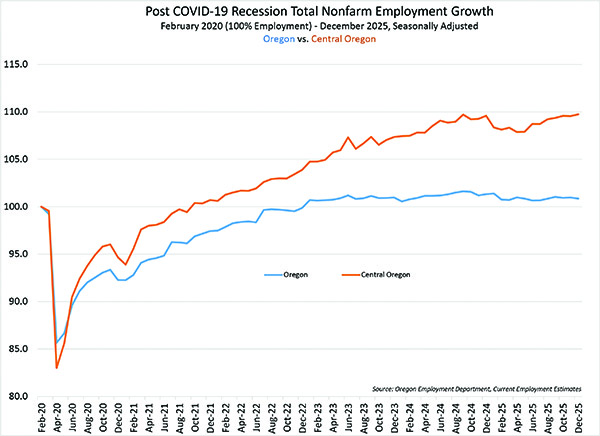
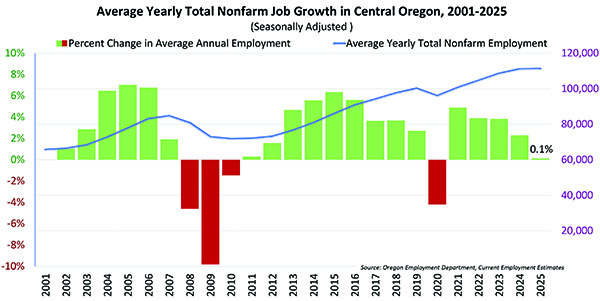
At the beginning of 2025, I wrote an article on 2024 employment noting that total nonfarm employment growth in Central Oregon was slowing but still expanding. Since then, employment in the Bend MSA reached 112,050 in December 2024, the second-highest employment number on record. However, at the start of 2025, total nonfarm growth in the area began to decrease, and by April 2025, employment was 1,750 jobs below its second all-time peak, after which growth resumed, reaching an all-time high of 112,210 by December 2025.
Regional Growth Outpaces State Trend
Compared to the state, Central Oregon is bucking the statewide trend, which began to flatten out or see minimal growth around mid-2023. While there has been some slight movement, for the most part, state-level employment has not changed much, going from 1,985,400 in July 2023 to 1,986,100 this past December (a 0.04% increase). Regionally, however, employment has grown by 3,720 jobs, or by 3.4%, since mid-2023. As we stand now, seasonally adjusted nonfarm employment has continued its upward growth, and as of December 2025, it was at a new peak, while the state has struggled to see any real growth these past few years. Even so, average yearly seasonally adjusted total nonfarm employment growth in Central Oregon is still slowing.
Employment Gains and Losses Across Industries
In 2025, private industry employment growth was concentrated in private education and health services and other services, which both grew by 3.5%. This represents a slower pace for the former compared to 2024, when private education and health services grew by 7.5% and other services by 2.0%. This trend mirrors the state-level pattern, where health care and social assistance have contributed to the majority of total employment growth year-over-year, adding an average of 12,900 jobs in 2025. In fact, health care and social assistance has been a significant driver of Central Oregon’s labor market, growing by over 190% from 2001 to 2025, which equates to nearly 12,900 jobs being added during this time.
In absolute terms, private education and health services still led growth with 670 additional jobs (+3.5%), followed by government with 420 new jobs (+2.9%). Other services added 140 jobs (3.5% growth), and manufacturing gained 130 positions (+1.6%). Mining, logging, and construction saw modest gains of 20 jobs (+0.2%), while total nonfarm employment increased by 520 jobs overall (+0.5%). On the other hand, several sectors experienced losses. Trade, transportation, and utilities lost 380 jobs (- 2.0%), while professional and business services shed 70 positions (-0.6%). Financial activities declined by 40 jobs (-0.7%), and leisure and hospitality saw a minimal gain of just ten jobs (+0.06%).

Rising Unemployment and Labor Force Trends
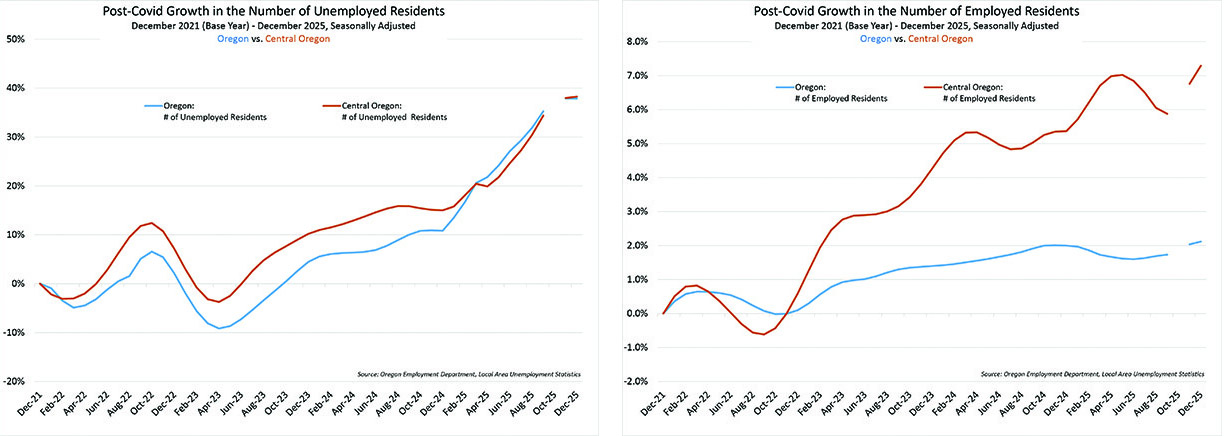
While employment expanded overall, the labor market dynamics shifted in other ways. As of December 2025, Deschutes County reported an unemployment rate of 4.9%, while Jefferson County came in at 5.8%, and Crook County at 5.9%. Notably, the state’s unemployment rate now stands at 5.2%, which means Oregon’s unemployment rate has inverted with Central Oregon’s and is now higher than the region’s rate of 5.0%, a relatively uncommon occurrence.
The labor market is no longer as tight as it was in 2024, with unemployment rates increasing throughout 2025. Compared to December 2024, when unemployment rates were significantly lower (Deschutes at 4.1%, Jefferson at 4.6%, Crook at 5.1%, and Oregon at 4.3%), all areas saw increases of approximately 0.8 to 1.2 percentage points. Interestingly, this rise in unemployment reflects not a loss of employed individuals but rather a faster increase in the number of people entering the labor force who have not yet found employment. In other words, the number of employed individuals is still trending upward, but the number of unemployed is also trending upward at a faster rate. The state has a similar trend, but the number of employed, while still trending up, is doing so at a much smaller rate than Central Oregon’s, while the number of unemployed is increasing at a slightly faster rate comparatively.
Ten-Year Outlook
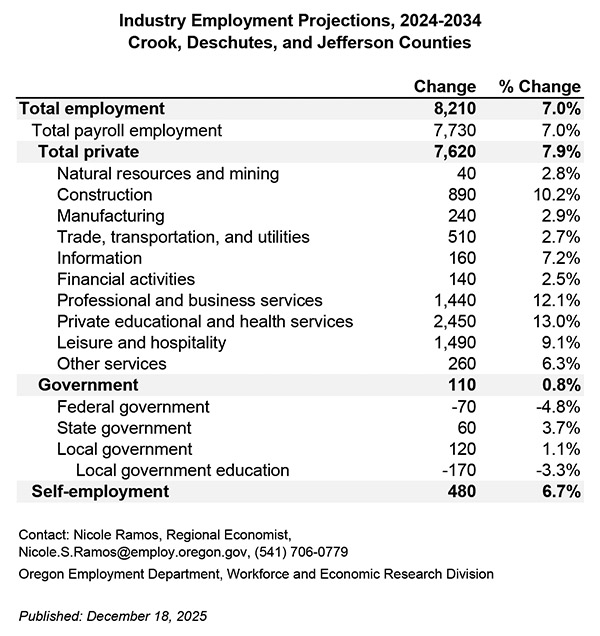
Looking ahead, this year’s ten-year industry forecast indicates that 8,210 jobs will be added to the region by 2034, for a growth rate of 7.0%. The industry expected to see the strongest growth during this time is private education and health services, which is expected to grow by 13%, or 2,450 jobs—slightly lower than the previous ten-year forecast. Within this major industry, health care and social assistance, which makes up around 90 percent of the sector, is expected to grow the fastest. The sector’s expansion (+13.2%) is expected to outpace overall job growth in Central Oregon, accounting for an even larger share of the region’s projected employment than past projections. Professional and business services (+12.1%; +1,440 jobs), construction (+10.2%; +890 jobs), and leisure and hospitality (+9.1%; +1,490 jobs) are also expected to have some of the strongest growth in the region, but all major industries are set to grow over the next ten years. So, while nonfarm employment growth is slowing and the unemployment rate is increasing, here in Central Oregon, we have been faring better and are still experiencing growth that is expected to continue, barring increased uncertainty or economic shock. The question remains whether these trends will persist in the short term or if regional employment growth will slow to match the state’s stagnation and trend.