

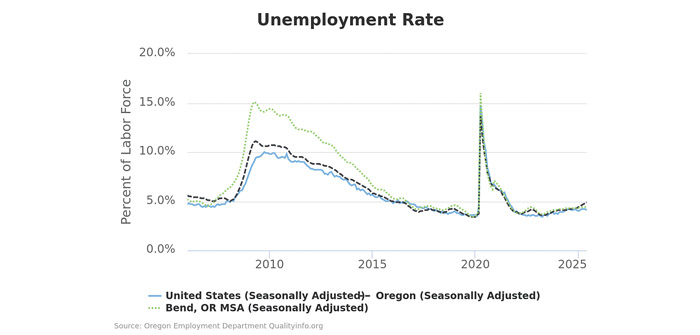
(Graph courtesy of Oregon Employment Department)
Central Oregon’s labor market is currently navigating a delicate balance between growth and emerging caution signals. While the region’s unemployment rate is trending upward, it remains lower than the state average and historically low overall.
“The Central Oregon unemployment rate is trending upward, similar to Oregon overall — but to a lesser degree,” said Nicole Ramos, regional economist with the Oregon Employment Department (OED).
Ramos emphasized that although the region is not immune to statewide economic shifts, “Central Oregon is performing slightly better” compared to Oregon as a whole. According to OED data, Oregon’s unemployment rate hit 4.9% in June, up from 4.8% in May 2025, extending a gradual upward trend over the past year. In June 2024, the statewide rate was 4.1%.
The Bend Metropolitan Statistical Area (MSA), encompassing Crook, Deschutes, and Jefferson counties, continues to show resilience. Ramos noted that the number of employed individuals in Central Oregon “remains historically high,” despite recent signs of softening.
“We still have the largest employment sector in our region’s history, and this is absolutely something to celebrate,” said Matt Ertle, co-owner of Bend employment agency PrideStaff.
The Bend MSA unemployment rate was 4.6% in June, up from 4.4% in May and up 4.3% year-over-year. In Deschutes County, the June unemployment rate rose to 4.5%, from 4.4% in May, and was 1.2 percentage points above its pre-pandemic low of 3.3%. In Crook County, the June unemployment rate was 5.3%, a slight increase over 5.2% in May.
“We’re hearing that businesses continue to remain cautious about additional hiring or growth plans due to uncertainty at the federal levels, and the implications for tariffs on specific industry sectors,“ said Sara Odendahl, interim director of the Bend Chamber of Commerce.
The Bend MSA gained 150 jobs from May to June and total nonfarm employment is now 113,400. Job gains were concentrated in leisure and hospitality, which added 740 jobs – 650 of those were in accommodation and food services. Trade, transportation, utilities, manufacturing, information, and financial activities also saw job increases.
“Unlike in Central Oregon, the number of employed individuals across Oregon has been tapering off for some time,” Ramos said. Locally, this tapering trend is more recent, only emerging in the last few months.
Ramos pointed out that “the number of unemployed individuals has been steadily increasing in both areas, but the increase has been steeper at the state level.” This rising unemployment rate, paired with slowing hiring, raises questions about what lies ahead.
Most of June’s regional job losses occurred in private education and health services, and government employment, each category shedding over 240 roles.
Nonfarm employment, a key indicator of economic vitality, has also provided mixed signals. “This metric has been trending upward in Central Oregon,” Ramos said, but she noted a recent decline of 90 jobs from May to June. While that drop is minor, it mirrors a more prolonged hiring slowdown observed statewide since late 2023.
Looking forward, Ramos posed a key question: “Will the long-term growth trend in Central Oregon continue or begin to mirror the state’s pattern?” For now, the answer remains uncertain. “Business hiring in the area and the number of employed remains historically high,” Ramos concluded. “But the number of unemployed individuals is also rising, which could signal weakness or further loosening in the labor market.”
Employer Perspectives
Regional employment continues to show strength across key industries, including healthcare and hospitality, with many employers reporting steady applicant interest and low turnover. However, challenges such as housing affordability and specialized recruitment remain a reality.
“Attracting and retaining talent continues to be challenging, due to the high cost of living in Bend,” said Odendahl. “Other communities in Central Oregon are not immune to these cost-of-living challenges, as housing prices continue to be a barrier to hiring. As such, we’re hearing that the hiring cycle is often longer and more costly to businesses.”
Ertle celebrated the variety of jobs available locally: “The local Central Oregon job market remains one of the best in our country given our overall size. We are a small market compared to most regions with comparable cost of living, and we have a wide range of diverse positions from seasonal jobs in tourism and firefighting, to technical positions in health care, aviation, construction and engineering. Our public employment sector is also very strong.”
At St. Charles Health System, the region’s largest healthcare provider, hiring remains steady with targeted expansion plans in motion.
“Our vacancy rate remains relatively low, and we’re fortunate that many of our open positions receive strong interest from applicants,” said Paige McAndrews, Director of Talent Acquisition for St. Charles. “As Central Oregon continues to grow, we’re excited to expand access to specialized care in areas like Gastroenterology, Rheumatology and Neurosurgery.”
McAndrews also acknowledged that growth in these specialty departments brings new recruitment demands. “While we do experience some recruitment challenges in these growing departments, particularly for physicians, advanced practice providers and medical assistants, we see these as opportunities to attract top talent and strengthen our teams to meet the evolving needs of our community,” she said.
Ertle noted that salaries are a factor in today’s recruiting game. “The biggest challenge for employers is finding employees in the $42-60k/year range because this income level for the workforce does not support the cost of living in our region,” he said. “This salary range is still the most common for our employers in the region of almost any size.”
In the hospitality sector, Sunriver Resort also reports encouraging hiring trends during the busy tourism season. The resort held two early-season job fairs this spring to help fill available roles for its busiest months of the year.
“I think the Central Oregon job market is strong. Sunriver Resort’s applicant flow was the strongest it has been in years,” said Erika Stohl, Director of Human Resources for the resort.
“Sunriver has a strong employment brand with many perks and benefits resulting in low turnover and associates who return year over year over year,” Stohl said. She also pointed out the strength of employee-driven recruitment, noting, “Our largest referral source is employee referral, which also speaks to our strong brand and competitive wages and benefits.”