

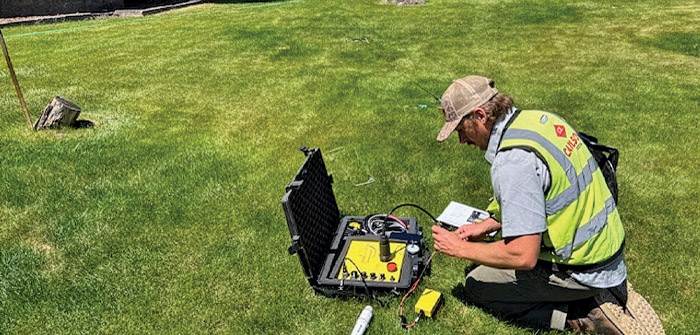
(ReMi Geophysical Survey performed at local jobsite | Photos courtesy of Carlson Testing, Inc.)
Developers, architects, and structural engineers have been designing new building structures, critical infrastructure, and retrofitting older structures to accommodate seismic forces in the Pacific Northwest for a long time due to the region’s history of earthquakes and its proximity to the Cascadia Subduction Zone. The magnitude of the seismic forces that can act on a structure during an earthquake may be amplified or diminished based on the characteristics of the ground beneath the structure. Generally, softer ground will increase the seismic forces, while harder ground can reduce them.
Structures designed to meet modern development codes will incorporate a variety of structural elements to ensure that the building remains safe to occupants if an earthquake were to occur. This design process often starts early in the project planning phase, where determination of a Seismic Site Class becomes a critical project step. An accurate Site Class directly influences seismic design coefficients, structural demands, and ultimately construction costs. Conservative assumptions — such as defaulting to Site Class D when insufficient information is available — can result in larger structural members, increased reinforcement, and higher foundation costs.
The 2025 Oregon Structural Specialty Code (OSSC) emphasizes the importance of accurate seismic site characterization. While traditional methods such as Standard Penetration Test (SPT) blow counts from drilled boreholes remain common, the Refraction Microtremor (ReMi) method offers an efficient, non-invasive alternative that can provide significant value to architects and structural engineers.
ReMi is a geophysical technique that measures naturally occurring ambient ground vibrations to develop a shear wave velocity profile and determine the average shear wave velocity of the upper 100 feet (Vs100), the primary parameter used to establish Site Class under the 2025 OSSC. Because the method requires no drilling, it can often be completed in a matter of hours with minimal disruption to the project site, making it attractive during early project planning or on sites where access is limited.
Reliable seismic site information helps minimize redesigns, improves cost estimating, and reduces the likelihood of unforeseen geotechnical issues affecting project schedules. Because ReMi can be performed quickly and economically, it provides valuable information before significant design decisions are finalized.
Carlson has been using ReMi across Central Oregon, where many project sites are underlain by bedrock which often supports a Site Class better than code defaults. ReMi can be a practical investment that delivers better data, improved structural efficiency, and greater confidence for the entire design team.