

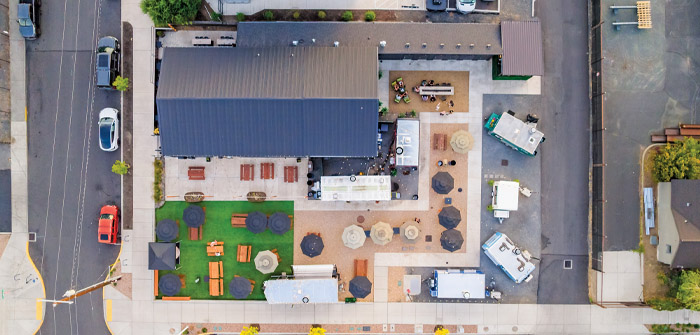
(Bend’s Morrison-Maierle team worked with the owners of Dogwood at the Pine Shed to help redesign the former Spoken Moto building, now located on NE Second Street, into a bar and food truck location | Photo by Steve Berg)
For many small and mid-sized business owners, a commercial construction project starts with a simple idea: expand into a larger space, renovate an aging building or build a new facility from the ground up. But long before permits are pulled or construction begins, there are important decisions that can significantly affect a project’s cost, timeline and long-term success.
According to Eric Webber, Regional Operations Manager for Morrison-Maierle’s Bend office, one of the biggest mistakes business owners make is waiting too long to bring engineers into the conversation.
“If you’re starting from scratch and wanting a business project designed, typically you start with an interior designer or an architect,” Webber said. After that, it’s critical to bring in the engineering team needed for the project, which will deal with any logistical issues.
“We’re a one-stop shop when it comes to needing an engineer. If you need one, then we’re likely able to provide all the services required for a commercial construction project,” said Webber, who has worked for Morrison-Maierle for 15 years and was the founding team member for the Bend office.
Morrison-Maierle’s Bend staff includes 20 engineers and provides civil, structural, mechanical, electrical, plumbing, fire protection and low-voltage engineering services. While the firm is perhaps best known for large public projects such as the ongoing expansion of the Redmond Airport terminal, its portfolio also includes the types of commercial projects many local business owners encounter, including medical offices, restaurants, retail spaces and tenant improvements.
Start with Goals, Budget and Timeline
Before engaging an engineering team, Webber recommends business owners think through three fundamental questions: What is the project trying to accomplish? What is the available budget? And when does it need to be completed?
“Schedule is really important, as well as breaking down what the overall goals are for the project,” Webber said.
Those early discussions help engineers determine the appropriate design approach while allowing owners to communicate priorities that may influence the project, whether that’s sustainability, future expansion, aesthetics or operational efficiency.
The level of engineering involvement can also vary depending on the owner’s experience. Someone building their fifteenth commercial building will likely require a different level of support than a first-time restaurant owner opening a new location.
Collaboration Prevents Costly Surprises
Although many owners primarily interact with an architect or general contractor, engineering firms spend much of the design process coordinating with every member of the project team.
Mechanical, structural, civil and electrical engineers work together to resolve conflicts before construction starts, helping prevent expensive changes in the field.
“We absolutely coordinate and collaborate with the other design services,” Webber said. “We’re doing a lot of that behind the scenes to make sure that everything is coordinated.”
Business owners remain involved in major decisions affecting functionality and appearance, while engineers focus on ensuring that building systems work together efficiently.
Older Buildings Often Require More Than a Remodel
For owners considering redevelopment projects—especially in downtown Bend—older buildings can present unexpected challenges.
Webber pointed to Morrison-Maierle’s work on the newly opened Bamboo Sushi, located in the historic O’Kane Building downtown, as an example. While many older buildings continue serving tenants for decades, renovation projects often trigger code requirements that didn’t apply previously.
“A lot of older Bend buildings don’t have any ventilation, and their water meter sizes are (often) really small,” Webber said. “If you’re doing a remodel on that type of space, you have to bring everything up to code.”
Electrical infrastructure is becoming one of the biggest challenges. As buildings transition toward electric heating systems, electric vehicle charging and other modern technologies, many older services simply weren’t designed to handle today’s electrical demands.
Addressing those issues early allows owners to budget appropriately instead of discovering costly upgrades after construction begins.
Permitting Is Easier with the Right Team
Engineering firms also play an important role in navigating the permitting process.
Beyond preparing technical drawings, engineers regularly work with local jurisdictions to clarify code interpretations before plans are submitted.
“One of the main reasons to bring a design professional on board is to try to streamline your permitting process,” Webber said.
That local experience can help projects move more efficiently through reviews with the City of Bend, City of Redmond and Deschutes County, reducing delays that often result from incomplete or unclear plans.
Don’t Wait Until the Last Minute
Whether the project involves renovating an older downtown storefront or constructing a new commercial facility, Webber encourages owners to begin conversations well before construction is scheduled to begin.
While Morrison-Maierle is helping deliver one of Central Oregon’s most visible infrastructure projects at the Redmond Airport, the same planning principles apply to much smaller commercial developments. Bringing engineers into the discussion during the earliest planning stages gives owners more flexibility, more accurate budgeting and fewer surprises later in the process.
“Bringing us in early doesn’t cost extra money,” Webber said. “If it’s like, ‘Hey, we’re interested in doing this project, we don’t know where it’s going to go,’ … we can work that into our schedule.”
Perhaps most importantly, Webber says business owners shouldn’t hesitate simply because they aren’t sure engineering services are necessary.
“It’s always okay to engage an engineer or an architect or a general contractor because they may bring things to light that you might not be aware of or think about,” he said. “We’re used to answering questions and addressing concerns about the building process. It’s something we do often and is customary in our line of work.”
For businesses planning their next expansion, redevelopment or new commercial facility, that first conversation may be an invaluable investment in success.