

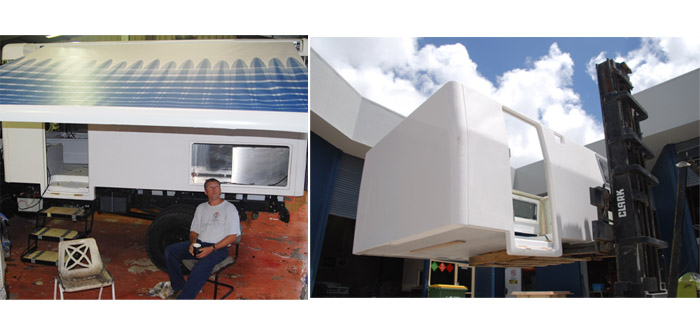
((Left) Lance Gillies building first EarthCruiser 2008 in Australia (right) first composite shell | Photos courtesy of EarthCruiser)
EarthCruiser is expanding production of its MOD composite camper platform, applying nearly two decades of expedition vehicle engineering to scale the design through a distributed builder network.
The move reflects a broader shift underway in the recreational vehicle industry. As inventory rises and buyers increasingly scrutinize build quality and long-term durability, manufacturers are being pushed to rethink how vehicles are designed and produced.
Founded by Lance Gillies and Michelle Boltz, EarthCruiser grew out of the founders’ own experience traveling in remote regions where vehicle reliability is critical.
The company developed its first fully composite expedition vehicle in 2008, using structural concepts designed for extended travel in remote environments. That engineering approach predates the recent surge of interest in “overlanding,” a segment that has increasingly become a focus for the broader RV industry.
In 2018, Gillies and Boltz entered their own vehicle in the Budapest–Bamako rally, a GPS endurance event running from Europe to West Africa along terrain that loosely follows the historic Paris–Dakar route.
The rally covers thousands of kilometres of rough roads, desert terrain, and remote travel where reliability is essential.
Gillies drove while Boltz served as co-driver and navigator.
“Engineering decisions are easy to make in a workshop,” said Gillies.
“The real test happens thousands of kilometres from the nearest support.”
The vehicle used in the rally was not a prototype. It was a standard EarthCruiser built using the same composite structural philosophy first developed by Gillies and Boltz more than a decade earlier.
That same vehicle remains in service today.
“We still use that truck regularly,” Gillies said. “Same structure, same philosophy. It continues to do exactly what it was built to do.”
Over the past two decades EarthCruiser has produced hundreds of expedition vehicles and composite camper structures using variations of the same design approach. The company is now applying that experience to a broader range of products, including the MOD composite camper platform.
Unlike traditional RV construction methods that rely on multiple panels, fasteners and seal joints, the MOD camper uses a one-piece composite structure designed to reduce potential failure points while lowering overall weight.
EarthCruiser’s current production model focuses on engineering and structural composite production while experienced builder partners complete final vehicle builds closer to customers.
The distributed approach allows EarthCruiser to scale production efficiently while maintaining a focus on structural design and engineering.
“We’ve spent years building vehicles intended to operate far from help,” Gillies said.
“Now we’re applying that experience to simpler, lighter products that more people can use.”
EarthCruiser plans to continue expanding its composite camper platforms and builder network over the coming year.