
(Graph courtesy of EDCO)
Jon Stark, CEO — Economic Development for Central Oregon
1) Reflecting on What Came True
First, I’d like to acknowledge and thank Cascade Business News for once again inviting Economic Development for Central Oregon (EDCO) to contribute our perspective to its annual Central Oregon Economic Outlook. Looking back on our 2025 forecast, many expectations held steady, including moderated inflation; continued business expansion in advanced manufacturing and technology; lower interest rates; and steady, albeit slower, population growth, at least in the tri-county area. Despite persistent uncertainty around interest rates and Oregon’s dwindling in-migration rates, Central Oregon demonstrated resilience, thanks in part to EDCO’s business development projects. Now, a year after our last forecast, oil prices have, as predicted, fallen and are expected to remain lower in 2026, giving households more capacity for other spending. At the same time, the unemployment rate continues to rise, creating a more balanced employment market in Central Oregon. Together, these factors set the stage for a cautiously optimistic 2026.
2) Overview of What’s to Come
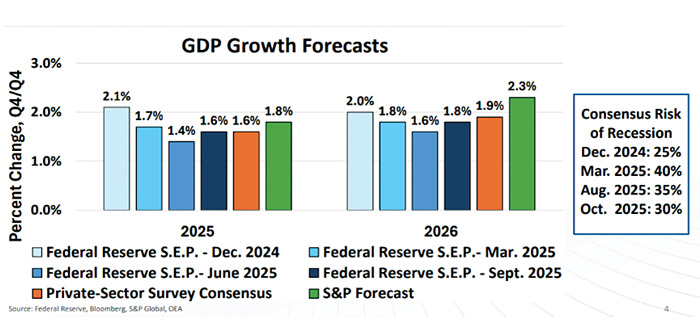
As we step into 2026, Central Oregon’s economic landscape remains shaped by a diversified industry base. EDCO’s pending projects are nearly evenly split between Lifestyle Products, High Technology and Advanced Manufacturing. While statewide economic growth has been moderate, local strength in innovation, lifestyle products and manufacturing facility development positions Central Oregon for stronger results and steady expansion. In his November revenue forecast, state economist Carl Ricodonna noted that Oregon will trail the U.S. in GDP output. According to that forecast, Oregon’s GDP is expected to grow by approximately 0.8%, compared to 2.1% for the U.S. economy over the same period. Over the past four years, Oregon has averaged roughly 1.6% GDP growth, trailing the national average of 2.7%.
This persistent gap reflects structural factors affecting statewide growth, including demographic shifts and sector-specific dynamics. While the forecast does not anticipate an outright recession, it emphasizes a period of modest, positive growth with elevated uncertainty. Given this context, we would suggest that Central Oregon’s economic outlook for 2026 is cautiously optimistic, especially if inflation pressures ease and as EDCO’s local project pipeline converts into realized investment and job creation. The Oregon Employment: Urban and Rural chart included here notes the Bend MSA (which now includes Deschutes, Crook and Jefferson Counties) has seen sustained job growth, exceeding Portland Metro and other rural counties in Oregon through February of 2025.
3. Unemployment / Employment Rate – Available Labor Force
Central Oregon’s labor market continues to show signs of rebalancing, with unemployment climbing roughly a percentage point over the past year across the tri-county region. While this may initially appear concerning, it signals that the labor market is approaching balance, which we estimate will occur at around 6% unemployment, resulting in a healthier pool of candidates for employers.
From a year-over-year perspective, employment conditions across the Bend MSA have softened modestly but remain relatively stable. According to the Oregon Employment Department (OED), total nonfarm employment declined slightly, down approximately 0.1% from September 2024 to September 2025, reflecting a broad-based cooling rather than a sharp contraction. Private-sector job losses were widespread and concentrated primarily in sectors related to leisure and hospitality, information, trade, transportation and utilities, and financial activities, all of which are more sensitive to interest rates, consumer spending and seasonal dynamics. In contrast, job gains were more narrowly focused, occurring predominantly in private education and health services, which added roughly 630 jobs year over year, along with government employment, which increased by approximately 500 jobs.
While employment growth has moderated, Central Oregon continues to rank among the state’s top two MSAs alongside Salem, a trend we expect to continue in 2026. Rising unemployment and increased job-seeker activity signal a constructive shift toward a more balanced labor market. Employers are beginning to see improved access to available talent, even as the region remains short of full equilibrium. Several employers are building new facilities and plan to increase hiring following completion. Companies like Nosler (Redmond), Amazon (Redmond), BlackStrap (Bend), Cv International (Prineville), Serán Bioscience (Bend), and Western Metrology Sales (La Pine) are strong examples of this activity. Others are occupying existing facilities, like GFP Enterprises (Sisters), BASX (now also in Sisters) and Lexington Manufacturing (Prineville). Notably, Lexington Manufacturing is hiring former Endura Products employees, signaling that the wood products industry, particularly related to housing demand, remains resilient and that Central Oregon’s skilled labor force continues to hold strong value within the manufacturing industry.
The Oregon Employment Department’s most recent 10-year employment projections, released last month, indicate that Central Oregon’s manufacturing, wholesale trade, transportation, warehousing, and utilities sectors are projected to grow on a percentage basis at two to three times the rate of comparable sectors elsewhere in the state.
At present EDCO is working with over 180 companies that are actively moving forward with plans to launch their enterprise, expand operations or relocate to Central Oregon. The strength of this project list reflects a robust opportunity for the continued growth we’re forecasting within our book of business, and further diversification of our economy. Supporting this outlook, EDCO’s project pipeline for FY 2025/26 reflects a healthy, diversified mix of industries: Lifestyle Products (34%), High Technology (32%) and Advanced Manufacturing (19%). These sectors leverage Central Oregon’s unique assets, from quality of life to growing industry clusters. EDCO’s activity among “Start” and “Grow” projects suggests strong potential for job creation and capital investment, positioning our region to outperform others around the state.
4. Venture Capital Trends
Inflation has eased, but uncertainty in the broader capital markets remains. While the stock market has posted strong gains to start the year, periods of short-term volatility have reinforced a cautious mindset among investors. Capital is still available, but investors are no longer willing to take the same level of risk. Instead, they are seeking companies with clear momentum, proven demand and the ability to deliver results quickly. There is a strong emphasis on businesses with shorter runways to results and a clear direction, as investors want to see progress and impact sooner.
The 2025 Bend Venture Conference, held in October drew 342 attendees and 74 applicant companies, with eight companies selected as winners, including two from Central Oregon. A total of $278,000 in investment was committed across six companies, with additional deals still being finalized, and an additional $25,700 in cash awards was granted to two companies.
Looking ahead to 2026, this more disciplined investment environment is expected to persist. While national funding conditions remain cautious, Central Oregon startups are well positioned by emphasizing strong fundamentals, precise execution and sustainable growth. In a selective capital market, companies that demonstrate progress and resilience are most likely to attract investment and translate innovation into long-term success.
5. Tax Implications vs. Opportunities
Beyond labor availability and capital trends, tax policy is emerging as a meaningful lever influencing where and how companies choose to invest. Recent changes under H.R. 1 to the federal depreciation schedule for manufacturing equipment have improved the near-term economics of capital investment by allowing firms to recover costs more quickly. For manufacturers evaluating expansion or relocation decisions, this accelerates cash flow, reduces effective project costs and strengthens the business case for investing in modern production capacity. When paired with Central Oregon’s skilled workforce and available industrial sites, these tax provisions position the region to capture a greater share of advanced manufacturing investment in 2026 and beyond, as long as Oregon doesn’t decouple from this tax code, which would water down its net effect. Contrarily, the State of Oregon is working on improvements to programs that encourage private-sector companies to invest. The Enterprise Zone program, which is a property tax abatement incentive, has at least three concepts pending this legislative short session. For example, extending the standard program’s discretionary exemption term to up to eight years, while also improving access and allowing for longer hiring runways to better utilize the program’s benefits. A more balanced labor market and targeted tax incentives strengthen Central Oregon’s ability to deliver durable, high-quality economic outcomes in 2026 and beyond.
6. Summary
Central Oregon enters 2026 with steady momentum and pragmatic optimism. The region benefits from a balanced labor market, easing inflation and a diverse industry mix that supports job creation and private investment, despite modest statewide growth. Employers have better access to talent, and traded-sector projects in manufacturing, technology and lifestyle industries are advancing. While investor capital is more selective, it continues to support companies with strong focus, execution and near-term potential. Recent federal depreciation changes and potential state policy improvements are also strengthening the business case for expansion and investment. However, further regulatory modernization is needed to fully realize these gains. These conditions position Central Oregon to leverage resilience, innovation and collaboration for sustainable economic growth in the coming year.
Brian Vierra — EDCO Venture Catalyst Director
In tandem with EDCO’s Local Area Directors, who represent a city, group of cities or county within Central Oregon, EDCO’s Venture Catalyst Director provides guidance and technical Support for startup businesses across Deschutes, Crook and Jefferson Counties. Currently, EDCO is working with over 100 startup companies, spanning industries from high-tech to consumer products, and projects including fundraising assistance and bringing products to market.
The 2025 Bend Venture Conference (BVC) received 74 applications from startups to present. These startups were the most mature batch of companies to ever go through BVC, with most tracking at over $1 million in revenue. EDCO also worked with ecosystem partners to put on a week of innovation and entrepreneurship activities in 2025, appropriately named High Desert Innovation Week. This week of activities leverages the work that various partners are doing throughout the entrepreneurial ecosystem and across multiple key industries.
As anticipated, the funding landscape in Central Oregon successfully rebounded in 2025 after bottoming out in the second half of 2024. While the “easy money” of the 2021 era hasn’t returned, 2025 saw a distinct acceleration in deal volume, particularly for companies that survived the 2024 “reset” by proving capital efficiency. Oregon’s statewide startup funding reached over $330 million by late 2025, buoyed by a stabilization in interest rates and a renewed focus on sectors like Biotechnology and Applied AI.
As such, EDCO is more focused than ever on providing support for entrepreneurs through connections with experts and mentors in the community, exposure through BVC and monthly PubTalk programming and introductions to financing opportunities. In addition, EDCO will lead the Central Oregon Innovation Hub (COIH), a regional partnership aligned to deliver coordinated services for innovation-driven entrepreneurs. EDCO will continue collaborating with local partners to drive diversified industry growth and increase the number of Central Oregon startups that achieve long-term success.
For more information, contact EDCO Venture Catalyst Director, Brian Vierra at brian@edcoinfo.com or 541-388-3236
Don Myll — Bend Area Director
Bend’s current pipeline of economic development projects remains strong, with the combination of recruitment of new businesses and expansion projects for existing businesses expected to generate $289 million in capital investment and create 530 jobs.
The prospects for increasing the supply of job-creating properties in Juniper Ridge are being realized as evidenced by nearly 400,000 square feet of projects recently completed, under construction or in planning. Covering a wide range of industries, this industrial development is having a positive impact on our local economy.
Bend has become a bioscience hub in the state, with our local companies growing steadily for several years. One significant driver of recent development in Juniper Ridge is Serán Bioscience’s new commercial drug manufacturing facility. Other local bioscience companies are committed to ongoing expansions as well, which together indicate continued industry growth.
With a focus on continued economic development, the City of Bend has adopted economic prosperity goals in a concerted effort to continue Bend’s growth and success. Combined with the State’s new economic development strategy to promote development across the state, these state and local policies enhance the prospects for Bend and our state.
The City of Bend has also made increasing housing supply a core strategic priority in order to support local job growth. To aid this effort, they are looking at policies and incentives aimed at streamlining development and expanding a range of housing types from multifamily to single-family and middle housing. Bend saw nearly 1,500 new homes completed in 2025, a continuation of steady increases over the last few years. In addition, various affordable housing developments and nonprofit projects are underway or funded, contributing to broader housing supply growth that supports local job growth and economic vitality.
Bend’s prospects are also supported by the Bend Central District (BCD), which is envisioned as a vibrant, walkable, mixed-use neighborhood immediately east of downtown. Guided by the City’s urban renewal goals, the BCD is designed to reconnect east–west Bend, enhance streetscapes and pedestrian access and catalyze private investment in housing, commercial, retail, and office development, along with supporting infrastructure improvements.
For more information, contact EDCO Bend Area Director, Don Myll at don@edcoinfo.com or 541-388-3236
Steve Curley — REDI Director, Redmond
Redmond will continue to see growth in 2026 as several significant projects started in 2025 will be completed in the new year. In addition, there continues to be investment in larger flex space projects as the availability of larger lease spaces remains very low. Investments are also being made in transportation infrastructure and education that will improve transportation efficiencies, as well as in new facilities to train the future manufacturing workforce. With these efforts and others, we expect to see continued economic growth in 2026.
Significant Projects
There are four significant projects currently under construction, representing 466 jobs and $91.6 million in capital investment. The most anticipated is the Amazon 80,000 sq. ft. delivery station. The most anticipated is the Amazon 80,000 sq. ft. delivery station that will serve the entire region, scheduled to be completed in the spring.
A second project of similar scale is the expansion of Nosler to consolidate its manufacturing and headquarters in Redmond. This project is scheduled to be completed in the summer. The remaining two projects highlight growth at local Redmond manufacturers Basalite and Poltex, each of which is constructing new manufacturing facilities designed to serve them well into the future.
Flex Space Growth
There are several projects in planning and construction that will expand Redmond’s flex space inventory. One of the larger projects is currently under construction on the corner of Deerhound and 19th Street across from the fairgrounds. This building will be 40,000 sq. ft., with units that can be demised to 10,000 sq. ft. each. Two others are being planned that would add another 56,000 sq. ft., bringing the total new square footage to over 100,000 sq. ft.
Transportation Infrastructure Improvements
The Eastside Arterial Project continues to move forward, with the largest impact being the new roundabout at Hwy. 126 and Ninth Street. Construction has started on the roundabout at Veterans Way and Airport Way, which will connect the two roundabouts extending Ninth Street south, improving connectivity and enhancing access to the Redmond Airport and the Fairgrounds and supporting regional business expansion.
Workforce Development Expansion
Redmond High School will invest $10 million in expanded and upgraded facilities for its CTE and manufacturing programs. This will provide more room and state-of-the-art equipment to help train the workforce of the future.
In addition, Central Oregon Community College (COCC) is investing $8 million in expanding its manufacturing and applied technology building while revitalizing the manufacturing programming to meet the needs of local employers. Response to the new programming has been positive, and across both of these projects, the goal is to generate additional workforce to meet the needs of growing advanced manufacturing companies.
Economic Initiatives
Redmond Economic Development, Inc. (REDI), a local office of EDCO, is actively fostering business investment and job creation, helping to diversify the economy. There are currently twenty-one projects in the pipeline expected to create over 2,900 jobs in the next five to ten years, with a total capital investment exceeding $761 million.
Outlook for 2026
With significant projects, transportation infrastructure improvements and workforce development expansion, Redmond is well-positioned for economic success in 2026. The city’s strategic planning and investment in key sectors ensure sustained growth, new business opportunities and a thriving job market.
For more information, contact REDI Director, Redmond, Steve Curley at steve@edcoinfo.com or 541-923-5223
Kelsey Haskett — Prineville / Crook County Area Director
Prineville enters 2026 with strong momentum and a growing reputation as one of Central Oregon’s most dynamic and resilient economic hubs. Building on the significant investments and job growth of recent years, the community continues to see sustained activity across advanced manufacturing, data infrastructure and entrepreneurial development. After several years of rapid investment, job growth and national-scale project delivery, the focus is shifting from momentum alone to intentional, infrastructure-ready and innovation-driven growth. The next chapter for Prineville is about leveraging its unique advantages, including speed, coordination and scale, while proactively removing barriers that could constrain long-term competitiveness.
Prineville has several projects in the pipeline and currently underway, totaling over $2.22 billion in capital investment that would create an estimated 200 new jobs. With multiple large-scale projects under construction or in advanced planning, Crook County remains a key driver of regional economic growth and diversification.
One of the most defining priorities for 2026 is infrastructure readiness. As demand from advanced manufacturing, data and traded-sector industries continues to accelerate, Prineville is stepping into a regional leadership role to advocate for expanded capacity and resilience. EDCO, the City of Prineville, utility providers, and major employers are working collaboratively to quantify economic impacts and advance coordinated advocacy for power infrastructure that can support large-scale commercial and industrial growth. This is a critical foundation for the next wave of investment in Prineville and across the region.
Industrial land and site readiness remain core strengths. Prineville’s streamlined permitting environment, innovative infrastructure developments and long-term land opportunities continue to attract interest from companies seeking speed-to-market and cost certainty. In 2026, efforts will be increasingly focused on targeted attraction of traded-sector and light industrial businesses, supported by a more intentional public relations and storytelling strategy that showcases Prineville’s advancements and advantages.
Entrepreneurship will also take on a more visible and structured role in the local economy. Building on previous efforts in collaboration with the Center on Rural Innovation and local partners, the Crooked River Innovation Collective (CRIC) is helping to build a more robust rural entrepreneurial ecosystem. Prineville is positioning itself as a place where rural founders can access mentorship, early-stage funding connections and regional networks without leaving their community. This initiative, aligned with EDCO’s broader innovation strategy, is designed to support early-stage companies, encourage business formation and create new pathways for local wealth generation.
Workforce remains a priority, but with a sharper lens. Rather than focusing solely on attraction, 2026 will emphasize alignment between industry needs and training pipelines. Deeper collaboration with Central Oregon Community College, Oregon State University – Cascades, K–12 partners, and employers will continue to shape career pathways, close skills gaps and support upskilling of existing workers. This approach recognizes the interconnected nature of workforce and business growth, and ultimately, the need to address them in tandem.
What truly distinguishes Prineville, moving into 2026, is the level of local alignment and public-private coordination. The community’s ability to move quickly, collaborate across jurisdictions and bring partners to the table has become a competitive asset. Whether it’s infrastructure advocacy, business recruitment, workforce initiatives, or entrepreneurship support, Prineville is increasingly seen as a place where projects get done.
Overall, 2026 is shaping up to be a year of continued investment, intentional growth and strategic focus for Prineville and Crook County. By aligning infrastructure, workforce and entrepreneurship, the community is well-positioned to build on its success while remaining true to the values that make it a unique and attractive place to live and do business.
For more information, contact EDCO Prineville / Crook County Area Director, Kelsey Haskett at kelsey@edcoinfo.com or 541-213-3169
Eric Strobel — EDCO Sisters Director
2026 will mark the availability of 50,000 square feet of light industrial space in Sisters, with three new projects scheduled for completion in the second quarter of 2026. These developments will meet the growing demand for flexible, modern spaces that cater to a variety of industries. Having available land and leasable space is essential for attracting companies like BASX, as well as providing local businesses, such as Cascade Spirits, with the opportunity to expand and create local jobs.
Company news includes an expansion for GFP Response, a premier provider of emergency mobile services, specializing in base camp solutions and emergency management. GFP has expanded into new buildings and has plans to create a storage yard for trailers and trucks being deployed to Sisters from other areas. Cascade Spirits will be conducting tenant improvements to the former Laird Superfood warehouse and plans to move in by Q4, marking a large expansion of their warehouse operations. Plans for their new Broken Top Whiskey tasting room on Cascade Avenue, next to Sno Cap restaurant, are moving forward, but will occur after the expansion is complete. BASX, based in Redmond, has expanded with a new location in Sisters, employing 40 workers who operate seven days a week across two shifts assembling surgical clean rooms.
In 2026, the Sisters Business Association (SBA) will offer local perk educational sessions, sip-and-mingle networking events and business classes. Additionally, SBA is introducing a new event called First Fridays, where member businesses will stay open late on the first Friday of each month.
COCC Community Education will bring its programming to The Hub, by Citizens4Community, in downtown Sisters for an engaging midday break where learning meets connection. Classes will take place on the second and fourth Wednesdays of each month (March-May) for presentations on topics ranging from area watersheds to the geology of Central Oregon to travel and beyond.
In 2026, the City of Sisters will advance several key initiatives to enhance livability and community well-being. The Trinity Place Affordable Housing Project will support the local workforce and housing stability by delivering 40 apartment units, anticipated to be available in spring 2027. The Adams Avenue Streetscape improvements will strengthen the downtown core by creating safer, more walkable, and visually appealing public spaces. Building on Sisters’ Dark Sky certification, the Dark Skies lighting incentive program will preserve the community’s night sky character while promoting energy-efficient and responsible lighting. The Elm Street pathway will improve connectivity and access for pedestrians and cyclists from downtown to the Peterson Ridge trail network south of the community. Rounding out these initiatives, the third year of the Civic Leadership Academy will invest in the future by equipping residents with the knowledge and skills to actively participate in local governance and community leadership.
Explore Sisters is entering its fourth year of operation as the Destination Management Organization for the greater Sisters area. Explore Sisters will continue to steward the destination brand and execute an impactful marketing strategy focused on the balance of economic prosperity and local livability. Other initiatives for them this year include leveraging Sisters’ Dark Sky Community designation, developing new print collateral, website expansion, city wayfinding, and a Leave No Trace pilot project. Explore Sisters is committed to nurturing and growing collaborative relationships in Sisters and throughout the Central Oregon region working with partners to support and uplift the community.
For more information, contact Eric Strobel, EDCO Sisters Director at eric@edcoinfo.com or 541-410-8630
Patricia Lucas — Sunriver/ La Pine Director
South Deschutes County is on the rise, and the momentum is unmistakable. From new investment in advanced manufacturing to exciting developments in health care and business support infrastructure, our community is rapidly becoming a hub for innovation, industry and opportunity. As the fastest-growing community in Central Oregon over the past five years and one of the fastest-growing in Oregon, La Pine is well-positioned for new growth, supported by positive population trends and sustained demographic momentum.
The Sunriver/La Pine Economic Development (SLED) program plays a role in shaping the landscape of the South Deschutes County economy. SLED is supported by the City of La Pine, Deschutes County and our members. We work collaboratively with the communities served, spearheading efforts to move, start and grow traded sector businesses to create a balanced and diverse economy.
Advanced Manufacturing Gains Ground
New investment is flowing into the advanced manufacturing sector, bringing job creation, innovation and long-term economic strength. This investment signals growing confidence in our region’s skilled workforce, strategic location and business-friendly environment. Companies are setting up operations here, drawn by our commitment to infrastructure, training and streamlined permitting processes. This new investment will enhance our local supply chains and diversify the economic base, signaling a bright future for industrial growth in the region.
Health Care Sector Expands
The health care sector continues to thrive, with the La Pine Community Health Center leading the way. With the expansion, expected to be completed during the second quarter of 2026, the center will offer residents in South Deschutes County and Northern Lake County greater access to essential care, including behavioral health, women’s health and specialty services. These additions not only improve community wellness but also create high-quality health care jobs and career pathways in the region.
Business Incubator Breaking Ground Soon
Supporting the next generation of entrepreneurs, a new business incubator is slated to break ground in the spring with an expected completion date of Summer 2026. This facility in the La Pine Industrial Park will offer critical resources to startups and small businesses, including affordable workspace, mentorship and access to capital networks. The incubator will be a hub for innovation, fostering the next generation of traded-sector enterprises and strengthening the small-business ecosystem.
La Pine Industrial Park: Shovel-Ready and Affordable
For developers and traded-sector businesses looking to expand or move, our community offers a wealth of shovel-ready land that is affordably priced near US 97 and workforce centers. The park is an ideal environment for companies looking to build or expand operations and is already home to several successful enterprises and continues to attract interest from across the region.
Looking Ahead
This is an exciting time to be part of our community’s economic growth. We’re building a future rooted in innovation, access and opportunity, and we invite you to join us.
If you want to be part of this thriving community, reach out to Patricia Lucas, SLED executive director at sledexecutivedirector@gmail.com or call 248-693-3049.
Brenna Fulks — Jefferson County Director
Jefferson County enters 2026 with momentum and several significant initiatives already underway. EDCO is supporting two active traded-sector projects expected to bring new jobs and investment, while a steady flow of business inquiries reflects continued interest in the county. With available industrial land, a municipal airport and a community that values balanced development, the county continues to position itself for tangible economic growth.
The revitalized EDCO Jefferson County program is moving into its second year. With a dedicated local staff member and an advisory board, this local office of EDCO continues to support local businesses and the broader community. The program also assists with select non-traded-sector efforts, reinforcing its commitment to community placemaking. These activities help build the foundation that attracts and sustains future traded-sector investment.
Much of the progress anticipated in 2026 builds on groundwork already laid. The 2024 Urban Growth Boundary expansion and two Enterprise Zone boundary expansions in 2025 created new opportunities for industrial and commercial development. Together, these changes help “set the table” for future recruitment by making more industrial properties eligible for incentives and better positioning the county to attract traded-sector investment. In 2025, the Madras Industrial Site Readiness Plan was also launched. Once completed, it will identify infrastructure needs tied to emerging industries.
Jefferson County’s population continues to grow, and Portland State University estimates the county at roughly 25,700 residents, including the Warm Springs community, which remains central to the county’s culture and economy. Agriculture continues to anchor the region, supporting jobs, contributing to supply chains and helping preserve the county’s rural character.
Across the county, Metolius, Culver and Madras are pursuing growth while honoring their unique identities. Culver is advancing projects within its urban renewal district, and all three cities are focused on strengthening public infrastructure to support future development.
2026 will also be a year of transition. Bright Wood Corporation, Central Oregon’s third-largest employer, begins a new chapter under Minnesota-based Andersen Corporation after 65 years of local ownership. EDCO recognizes the outgoing owners for their decades of leadership and stewardship and looks forward to building a strong partnership with the new ownership as the company continues its work here.
Meanwhile, recent public and private efforts to expand childcare capacity are expected to make a real difference for working families in 2026. Housing development is also progressing, including 162 homes planned in Culver over the next several years, helping ensure the region can support a growing workforce.
Central Oregon Community College’s expanded Madras campus is also set to play a larger role in developing local talent. The campus will offer programs in Nursing, Nursing Assistant, Medical Assistant, and Early Childhood Education, including bilingual instruction, and will include a third-party-operated childcare center with room for up to 100 children.
Looking ahead, EDCO enters 2026 confident in Jefferson County’s continued progress. With strategic investments underway and a community ready to support responsible growth, the county is well-positioned to turn planning and preparation into meaningful economic results.
For more information, contact EDCO Jefferson County Director, Brenna Fulks at mbrenna@edcoinfo.com or 541-306-9676