

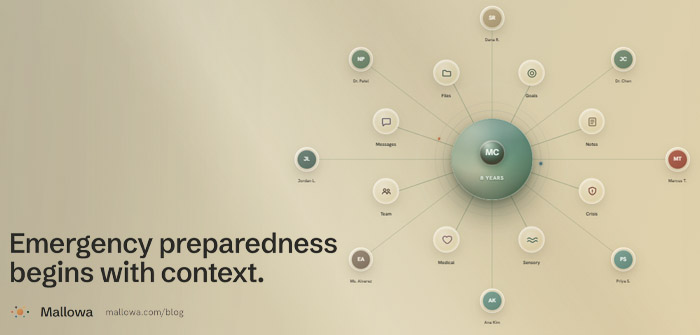
Every person receiving care carries a body of knowledge that lives almost nowhere. What a good day looks like for them, and what the first hour of a hard one looks like. Which change in routine tends to unsettle them, and what steadies them once it has. How they say they are in pain when they don’t use the word. Who to call, in what order, and what the second person on that list already knows that the first one doesn’t.
I spent four years as a direct support professional in Central Oregon, supporting children and adults with intellectual and developmental disabilities in their own homes, and that knowledge was the whole job. Not the tasks. The context. It was what let you see a difficult afternoon coming while there was still time to change its course, and it was the thing most often missing when someone new walked through the door.
Here is what I came to believe emergency preparedness actually means. The responsibility for providing that context falls, almost always, on the family or on the person themselves. It falls on them at intake, at every new appointment, with every substitute, and in the emergency, which is precisely the moment they are least able to carry it. A parent trying to explain a decade of history to a stranger in a hallway. An adult managing their own care who cannot, right then, establish context themselves. Preparedness is the work of lifting that burden off them before the moment arrives.
In Central Oregon that moment has a particular shape. The wait for an appointment is measured in months. The wait to be seen, even when it is urgent, is measured in hours. And when you are finally in front of someone, they have a few minutes and no history. Whatever context makes it into those minutes is what the person gets treated with.
So the most useful thing a household can do this week costs nothing. Write one page, and write the context first. What this person is like on an ordinary day. What a hard moment looks like as it begins, what tends to set it off, and what has helped before. How they communicate, especially when they are overstimulated or unwell. Then the things every form asks for: allergies and what a reaction looks like, current medications with doses and the date of the last change, and three people to call with their relationship written beside the number.
Print it. Put one where it will be found, one in the bag that goes everywhere, and one with whoever steps in when you can’t. If you are managing your own care, this is the same page, and it may matter more: you are the one person who cannot be asked to explain yourself in the moment it is needed.
One page will not fix the waitlist. It will make sure that when the wait ends, the person at the center of it arrives already known.
We keep a free printable version of that page at mallowa.com/resources, with no account and nothing to sign up for. If you have 20 minutes this week, they are well spent here, for someone you love or for yourself.
Skyler Kruger is the founder of Mallowa, a Bend-built care record that families and supported individuals own and share on their own terms. Before founding it he spent four years as a direct support professional in Central Oregon.