
(Photo courtesy of First Interstate Bank)
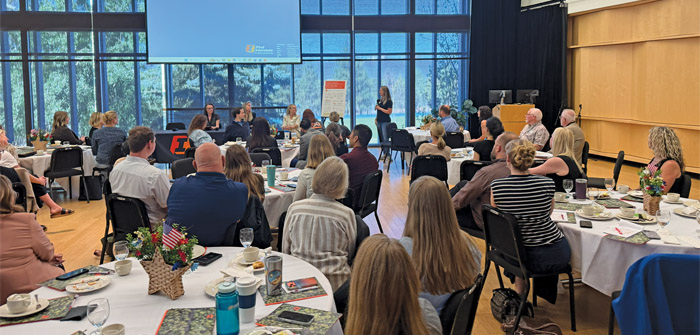
On June 17 of this year, First Interstate Bank gathered more than 80 nonprofit industry leaders representing 55 different organizations from the region at Wille Hall on Bend’s COCC campus. The Summit aimed to help local organizations navigate increasing demands, evolving community needs and the ongoing funding challenges that nonprofits are facing across the state. The Summit also featured a $500 mini-grant that was awarded via raffle system to a lucky guest and their organization.
“This event serves as a collaborative forum where nonprofit organizations can discuss current industry challenges, share best practices, and gain insight into strategies that are proving effective across the sector,” said Dawn Cofer, VP, relationship manager with First Interstate Bank. “The event provides attendees with valuable perspectives on operational and funding challenges, enabling organizations to better position themselves for long-term sustainability and future planning. By fostering peer-to-peer dialogue, the Bank supports capacity building within the nonprofit community.”
The day kicked off with coffee and breakfast as Cofer presented “First Interstate’s Commitment to Our Communities,” a presentation designed to share the Bank’s community impact scorecard. This highlighted several different community contributions from First Interstate Bank, including foundation grants, bank donations and employee matching/rewards programs, which resulted in a total of $339,837 donated in 2025 in Central Oregon alone. The same year, the Bank also collected more than 1,000 winter items for donation and volunteered more than 4,600 hours across 121 nonprofits in Central Oregon.
Travis Combe, a retirement plan advisor, with First Interstate Bank led a discussion on retirement preparedness that helped industry leaders track not only their own progress, but the progress being made for everyone in their respective organizations. As valuable as that information is, especially given the rising cost of living and the rapidly changing workforce economy, the bulk of the day’s conversations were centered around the next topic.
“The Power of Partnership: Redesigning Nonprofits for What’s Next,” was a panel presentation and discussion featuring leaders from Central Oregon Intergovernmental Council, Central Oregon Veterans Ranch, J Bar J Youth Services, Deschutes Land Trust and the Nonprofit Association of Oregon.
The main point shared is as follows: due to sweeping budget cuts and higher operating costs, competition for funding is getting fierce, and nonprofits will have to work collaboratively, putting mission over organization, in order to still achieve their goals and serve the community.
In Cofer’s words, “Across recent years of this event, the most significant challenge identified within the nonprofit sector is the widening gap between declining or constrained funding streams and increasing demand for program services. Nonprofits are facing heightened pressure as operating costs and community needs continue to rise, while traditional funding sources—including grants, donations, and government support—have not kept pace. This dynamic is requiring organizations to operate more efficiently, diversify funding strategies, and prioritize long-term sustainability planning in an increasingly competitive and resource-constrained environment.”
In an environment as described above, nonprofits are leaning more and more toward collaboration. Many organizations have already been doing this, and collaboration for them is natural.
We are all about collaboration,” said Michael Baker, CEO of the Boys & Girls Club of Central Oregon. “It is never about competition when we keep in mind what we are in the service of doing; we are here to help serve the youth that need us most. I can’t think of a more impactful way of doing that than working with collaborative partners to help all the youth in the region, collectively.”
Similarly, Polly Cohen, executive director of Healing Reins, said the following, “The Summit’s discussion around collaboration resonated strongly because it reflects how Healing Reins has operated for more than 26 years. As a PATH International Premier Accredited Center, we are part of a network of more than 800 equine-assisted services centers nationwide, allowing us to share best practices, research, and industry advancements. Locally, our work depends on strong partnerships with physicians, therapists, school districts, veterans’ organizations, disability service providers, outdoor recreation partners, and other community agencies. These relationships help us identify unmet needs, improve referrals, and ensure participants receive comprehensive support through both equine-assisted and outdoor therapeutic experiences.”
Summing up the future of nonprofits in Central Oregon, Cohen said, “The organizations that thrive in the future will be those that listen to their communities, work across sectors, and recognize that collaboration is not simply beneficial; it’s necessary.”