

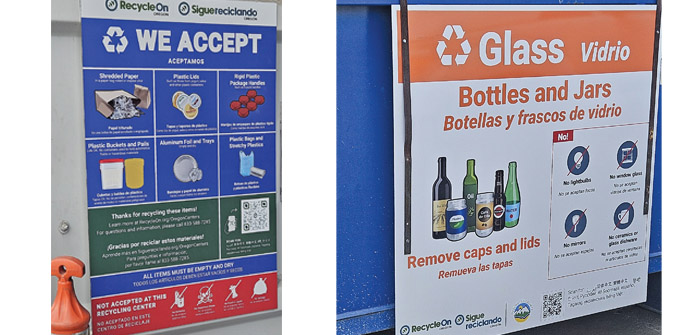
(Left) More than 140 new RecycleOn Centers will open across Oregon by the end of 2027 (right) A unified statewide recyclable list clarifies what people can recycle in their recycling bins or at drop-off transfer stations | Photos by Andrea Hine
Damaged by international market shifts (such as China’s policy enacted around 2018 that sharply restricted the import of foreign recyclables); lack of consistency across Oregon as to what could or could not be recycled; and the fact that, for decades, local municipalities and rate payers have borne nearly 100 percent of the cost of sorting, processing, and managing packaging
waste — rather than the companies producing the packaging — Oregon passed the Recycling Modernization Act (RMA) in 2021 to streamline the state’s outdated recycling system.
Launched in 2025, its goal — according to Susan Baker, Waste Diversion & Franchise Services manager in Deschutes County’s Solid Waste Department — was multifaceted: make recycling easier for the public to use; expand access to recycling services; improve facilities that sort recyclables; ensure recyclables are being processed responsibly; and help reduce contamination in the recycling system.
As she explained, under the RMA — which reinforced Oregon’s reputation for progressive environmental policies — manufacturers and brands must bear some financial responsibility for the ultimate disposal of any packaging, paper, and food service ware associated with their products. The resultant fees fund improvements (such as modernization of sorting facilities) and management of the state’s recycling program.
Among its components, RMA created a unified statewide recyclable list to clarify what can be recycled — in contrast to previous inconsistent and confusing rules in different cities and counties that led to high contamination rates and widespread public confusion. As a result, Baker said, whether people live in Beaverton or Baker City, they can now recycle the same items in their recycling bins or at drop-off transfer stations.
Circular Action Alliance (CAA)
Circular Action Alliance (CAA), a nonprofit producer-responsibility organization for paper and packaging in the U.S., was chosen by the Department of Environmental Quality (DEQ) to implement Oregon’s RMA program. CAA also works with companies in California, Colorado, Maryland, Minnesota, and Washington that have passed similar legislation.
RMA Program Enhancements
Described by Baker as “a slow-moving progression, rather than a light switch,” implementation of the RMA includes the following program enhancements in Deschutes County over the past year:
- Items added to the recycling program. Food and beverage cartons like soup, broth, and milk cartons, as well as juice boxes, and small scrap metal (under 10 pounds or 18 inches), can now be recycled. All materials must be empty and dry. Pizza boxes with no food residue also qualify.
- RecycleOn Centers added at county drop-off transfer stations. Residents can now drop off a list of “hard to recycle” items that cannot go into recycling bins at home or work, but which can be recycled when collected separately. Examples include plastic bags and plastic film; plastic lids from yogurt, salsa, cottage cheese, and other containers; aluminum foil and trays; and large plastic buckets and pails.
- Curbside recycling expanded. Residents in distant rural areas — specifically south of Sunriver; and north and east of Bend, Redmond, and Sisters — now have recycling included as part of their overall curbside collection service.
“Customers have really wanted that option for the past several years, saying that the effort required to haul recyclables to drop-off locations had kept many people from recycling at all,” Baker said. And according to a Republic Services employee, response has been “terrific.”
CAA’s Role in Ongoing Communications
“Word is getting around about the various changes in the past year that have made recycling easier, which is nice,” she noted. “And CAA plays a pivotal role with its statewide education campaigns that have resulted in a lot of local media coverage and helped reduce
overall contamination.”
These communications have included direct mail to customers of Republic Services and Cascade Disposal about recycling, and quarterly newsletters inserted in their monthly billing statements.
Where do Recycled Materials Go?
Oregon’s recycled goods are sent to certified “responsible end markets” —
either within the state, to other U.S. states, or to overseas facilities in countries including Vietnam, Malaysia, Indonesia, and Thailand — where they are processed into new products or feedstock, with strict environmental and safety standards applied.
A sincere commitment to statewide recycling, rather than professional duty alone, is apparent when talking to those involved in implementing RMA. As Baker expressed, “We want to make this happen!”