

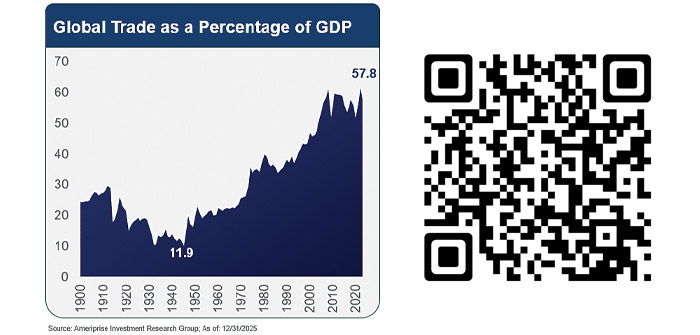
(Graph courtesy of Heritage Wealth Advisors)
Our team at Heritage Wealth Advisors recently held our Quarterly Market and Investment Update virtual event as part of our monthly educational workshop series. We’re fortunate to have a premier in-house investment department that does an incredible amount of research and drives very informed decisions about what we’re doing with our investments, which in turn drives very good outcomes for our clients.
Given recent economic conditions, we think investors should be prepared for both future volatility and a broad range of potential investment outcomes. The global economy is becoming bifurcated in a manner that is creating fractures in the financial system. What follows is our view on how the last several decades of globalization can help explain the investment outcomes of investors to this point, and how deglobalization may alter those outcomes — a small preview of the wealth of information we presented during the event.
The evolution of global trade helps to highlight our shift in expectations for the future. Looking back at the last century, we can see both the impact World War II had on global trade, and the post-war recovery the world experienced.
In the decades following WWII, international trade expanded with the U.S. leading the way — climbing from 11.9% of GDP to 57.8%, boosted by the emergence of China as a global manufacturing hub. That export of labor to lower-cost countries such as China drove down inflation, causing interest rates to fall, while expanding corporate margins and creating a highly constructive environment
for the stock market.
Global trade expansion, though, was not a free lunch. Many Americans lost high-paying union jobs due to outsourcing, with limited options to retrain in new fields. Political swing states like Ohio, Michigan, and Pennsylvania were hit the hardest, and influenced the rise in the political polarization we see today. It seems we are now moving into a period of deglobalization as a response to the unfair deal many Americans feel globalization offered.
Heightened tariffs will likely weigh on global trade and lead to an economic and investment future that differs from the past. For example, we believe:
- Decades of deficit spending amid large trade imbalances crowded out productive infrastructure investment — like roads and bridges that we are now woefully behind on updating — and increase the likelihood for higher future taxes and inflation.
- China’s rise as a geopolitical power and past transgressions of intellectual property theft have escalated into an AI arms race against the U.S., increasing market volatility while potentially widening the disparity between nations generating above- and below-average returns.
- Finally, wealth inequality, accelerated by outsourcing well-paying union jobs, has been a key driver of political polarization, intensified by aging U.S. demographics.
To reach their retirement goals, investors will likely need to focus on what will work in the future — not what’s worked in the past. If you’re interested in getting the full recap from the event, or in connecting with an advisor to learn more about our portfolio positioning strategies, use the QR code to get connected with us.