

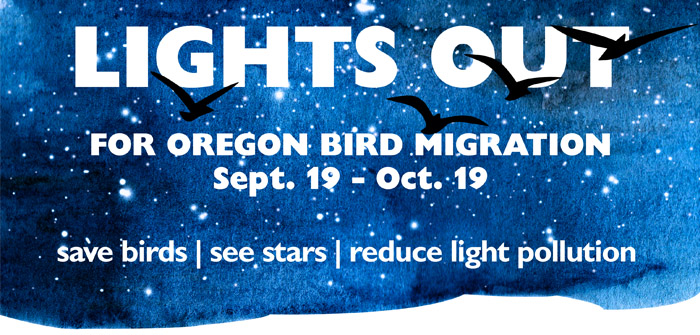
(Graphic courtesy of Bend Night Sky Alliance)
Bend Night Sky Alliance, the East Cascades Bird Alliance, Think Wild and other local groups are initiating a Lights Out Central Oregon program to help protect migratory birds traveling through the region.
Central Oregonians can help migrating birds by reducing artificial light from 11pm to 6am during the peak fall migration period, now through early November.
Central Oregon lies within the Pacific Flyway, an important migration route for birds traveling between breeding and wintering grounds. Data from the Cornell Lab of Ornithology’s BirdCast program show that tens or even hundreds of thousands of birds can cross Deschutes County in a single night during migration, with millions passing through the region over the course of the season. BirdCast uses weather surveillance radar to estimate the number, direction, speed, and altitude of birds migrating at night.
Most migratory birds travel at night, and artificial light can attract and disorient them, drawing them toward developed areas where they are at greater risk of colliding with windows and buildings. The Cornell Lab estimates that more than one billion birds die from collisions with glass each year in the United States.
Lights Out programs have successfully reduced bird collisions in communities across the country. Audubon reports that collision monitoring at one site participating in Lights Out Philly found a 70 percent decline in collisions. Long-term research at Chicago’s McCormick Place also found a strong relationship between nighttime lighting and fatal bird collisions, with researchers estimating that reducing illuminated window area to minimum levels could reduce bird mortality at the site by approximately 60 percent.
What Central Oregonians Can Do:
At night: Reduce artificial light from 11pm-6am, especially during peak migration nights.
- Turn off unnecessary lights in homes and offices.
- Turn off unnecessary outdoor lighting, or replace outdoor lights with warmer, amber-colored bulbs where lighting is needed.
- Use motion- or sensor-controlled outdoor lighting.
- Use fully shielded fixtures that direct light downward rather than into the night sky.
- Close blinds and drapes when interior lights are on.
- Keep cats indoors, particularly during peak migration nights.
- Check BirdCast to see when large numbers of birds are expected to migrate over Central Oregon.
During the day: Make windows safer for birds.
- Prioritize windows where bird strikes have happened before or where vegetation and sky are strongly reflected.
- Apply chalk or tempera paint markers, window-safe tape, decals, stickers, or other treatments to the outside of the glass.
- Space markings no more than two inches apart across the entire window to effectively break up reflections that birds may mistake for open habitat.
- Avoid relying on just one or two bird-shaped decals. Effective treatments need to create a visible pattern across the glass.
- Learn more about preventing window collisions and bird-friendly window treatments from Think Wild’s guide to preventing birds from hitting your windows.
Community members are also encouraged to spread the word. Share Lights Out information with neighbors, businesses, schools, HOAs, workplaces, and community organizations. A few simple changes across thousands of Central Oregon homes and businesses can collectively make our communities safer for migrating birds.
Local news organizations are encouraged to share BirdCast migration forecasts and maps during fall migration, particularly when the data indicate a major migration night. BirdCast’s freely available forecast and live migration tools can help communities identify the nights when reducing artificial light may have the greatest benefit. More than half of annual nocturnal migration across the contiguous United States occurs on just ten percent of migration nights, making targeted action during major migration events particularly valuable. The forecasts and maps are available at dashboard.birdcast.org/region/US-OR-017.
A Bend City Council proclamation recognizing Lights Out Central Oregon is scheduled for October 7 at 6pm. However, Central Oregon community members do not need to wait until October to act. As an outdoor-loving community, we can begin taking these simple measures now and make an especially strong effort during peak migration.
East Cascade Bird Alliance is committed to this program as a simple, proven way to help protect migrating birds. Oregon has recorded one of the highest bird species totals in the country, ranking sixth among the 50 states according to Audubon, making bird conservation particularly important in our region.
Bend Night Sky Alliance is committed to this program because reducing unnecessary artificial light benefits wildlife and human health while preserving Central Oregon’s night sky. Protecting dark skies also supports our region’s outdoor recreation and astrotourism opportunities while reducing unnecessary energy use.
Think Wild is committed to educating Central Oregon residents about the connection between artificial light, window collisions, and wildlife. During fall migration, Think Wild will conduct a public education campaign through social media, blog posts, and outreach at local events to help residents understand when birds are migrating through our region and what they can do to help. Think Wild’s wildlife hospital also treats birds injured in window collisions, making prevention an important part of reducing avoidable wildlife injuries in our community.