

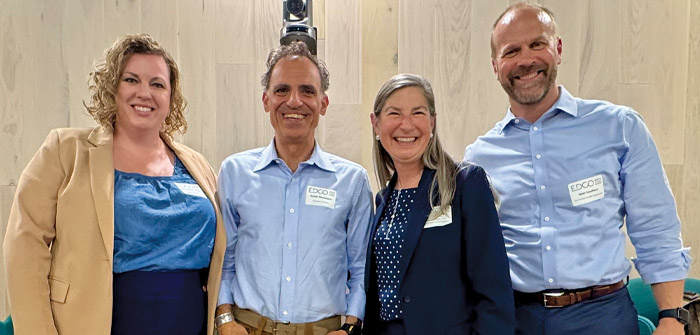
((L-R) Mary Ann Cooper, Keith Thomajan, Dr. Tracy Muday and Matt Swafford were panelists in a recent EDCO forum on the future of healthcare | Photo by Leah Etling)
Central Oregon’s healthcare system is entering one of its most consequential periods in decades, shaped by rising costs, workforce shortages, changing federal policy and growing demand for care.
Those challenges were the focus of a recent Economic Development for Central Oregon (EDCO) forum that brought together leaders from healthcare, insurance and business to examine how the region can maintain a strong healthcare system while supporting long-term economic growth.
The discussion highlighted that healthcare is a critical component of regional competitiveness. Employers increasingly evaluate the strength of a community’s healthcare system alongside housing, education and workforce availability when deciding where to invest. Access to primary care, specialists and hospital services has become an important factor in attracting businesses, recruiting employees and retaining residents and staff long-term.
Healthcare itself is also one of Central Oregon’s largest economic engines. Major providers employ thousands of people across the region (including 6,000 employees at St. Charles Health System), generate significant economic activity and provide wages well above county averages. A strong healthcare system also helps attract retirees, solo entrepreneurs and growing companies that view quality medical care as essential infrastructure for their employees and families.
“Growth and investment in quality healthcare draws businesses here,” said Matt Swafford, senior vice president and CFO of St. Charles Health System. “The balance against that is of course affordability, and I would say we all know we have not worked that out yet.”
Panelists agreed that the financial structures supporting that system have recently changed dramatically. Oregon’s long-standing expansion of Medicaid through the Oregon Health Plan has successfully reduced the number of uninsured residents. But recent federal policy changes, especially H.R. 1 containing $1 trillion in federal Medicaid cuts, are creating new financial pressures.
“We are going to really have to work to ensure that we are expanding people on commercial health insurance as much as possible,” said Mary Ann Cooper, Director of Government Affairs for Regence Blue Cross Blue Shield of Oregon. “There’s going to be even more Medicaid cuts coming and a Medicaid slowdown coming in 2029.”
Because Medicaid reimburses providers at rates well below the actual cost of delivering care, hospitals and health systems rely on commercially insured patients to help offset those losses. Maintaining robust employer-sponsored insurance coverage will become increasingly important as providers adapt to those changes.
At the same time, healthcare costs continue to rise across nearly every sector. Medical utilization has steadily increased since the pandemic. Major providers continue expanding services and rebuilding financial stability after the 2020-2022 disruption, while also addressing persistent labor shortages and higher operating costs.
Swofford shared that St. Charles has worked diligently to reduce its post-pandemic employee turnover rate, which was 20 percent at the end of the pandemic, to six percent overall today and two percent among RNs. A stable workforce is an essential piece of healthcare success, both for the hospital and the community.
Another top priority for St. Charles is addressing $100 million in deferred maintenance issues, including replacing the 50-year-old Bend hospital’s roof.
Prescription drugs and emerging medical technologies are also reshaping the financial picture. Panelist Dr. Tracy Muday said that some high-cost specialty medications and other new treatments carry enormous price tags. While weight loss drugs like GLP-1s are having positive overall impact so far, that’s not the case for all the new products on the market, she observed.
“Right now, specialty drugs, those very high-cost drugs, that go towards treating uncommon conditions … five percent of the drugs cost more than 60 percent of the pharmacy spend,” said Dr. Muday, who is the Executive Medical Director for Regence BlueCross BlueShield of Oregon.
Those costs are increasingly flowing through the healthcare system, contributing to higher premiums and greater affordability challenges for both employers and consumers.
Employers are experiencing those pressures firsthand. Comprehensive health insurance has become one of the most valuable tools for recruiting and retaining employees, particularly in a competitive labor market.
“We spend about $30,000 per employee on additional benefits beyond their base compensation. Healthcare is a core part of that investment, and so we really use that to help us win in the talent space. We see it as smart money,” said panelist Keith Thomajan, Senior Vice President and Chief of Staff for Hayden Homes.
Hayden Homes has absorbed recent annual increases in healthcare costs rather than passing them along to employees, but as costs continue to rise, that practice is not possible for many employers.
Dr. Muday shared that one of the greatest opportunities for improvement in health care efficacy is reducing the administrative burden placed on healthcare professionals. Insurance documentation, regulatory compliance and countless manual processes consume valuable clinical time that could otherwise be devoted to patient care. Emerging technologies, such as electronic prior authorization systems, improved integration between insurers and electronic health records, and artificial intelligence, offer ways to streamline those workflows while improving both efficiency and patient experience.
The discussion also broadened beyond traditional healthcare delivery to examine the social factors that influence overall health. Stable housing, quality education, economic opportunity, access to healthy food and strong social connections all play significant roles in determining long-term health outcomes.
“Your zip code matters more than your genetic code in your health,” Dr. Muday shared. “Medical care accounts for maybe 10-20 percent … biology and genetics, maybe another 10-20 percent, and the rest is education, economics and housing.”
Given rising costs, increasing affordable housing is considered essential for ensuring teachers, healthcare providers, first responders and other essential workers can continue living and working in Central Oregon.
“Our company is tenaciously committed to mid-market housing. Teachers, firefighters, cops should be able to afford a nice three-bedroom house to raise their family. We see that as a holistic part of that family’s success and the community’s success,” Hayden Homes’ Thomajan said.
Collaboration emerged as the central theme for addressing the region’s healthcare challenges. Providers, insurers, employers, educational institutions and policymakers each have distinct roles to play, but panelists stressed that no single organization can solve these issues alone. Central Oregon’s long history of cross-sector collaboration positions the region well to develop innovative solutions that balance affordability, access and quality.