

Founders often ask for the best offshore jurisdiction as if one answer fitted everyone. It does not: the right place depends on where the work happens, who must be on the ground and what you are prepared to file each year.
Every cell below comes from the registry, tax authority or law of that jurisdiction, and where a row has no verified fact, it says so.
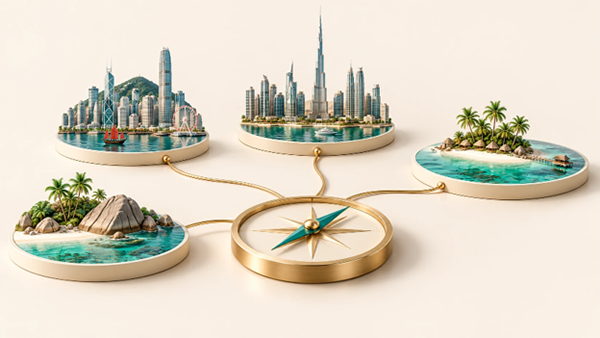
The decision table
| Seychelles | Marshall Islands | Dubai (IFZA free zone) | Hong Kong | |
| Tax basis | Territorial: income sourced in Seychelles is taxed. An economic substance test covers passive income from non-residents for covered companies | The registry describes a zero tax jurisdiction for these entities | Free zone companies are inside UAE corporate tax: 9% above a Cabinet-set threshold, 0% only on Qualifying Income of a Qualifying Free Zone Person | Territorial: profits arising in or derived from Hong Kong. Corporations pay 8.25% on the first HK$2 million and 16.5% above |
| Local requirements | At least one director, with no residence condition. Registered office and licensed registered agent in Seychelles | At least one director. A registered agent acts for non-resident domestic entities | IFZA says no physical presence is needed during incorporation. 100% foreign ownership | Non-resident directors allowed. Company secretary must live in Hong Kong, or be a firm with a Hong Kong office |
| Public record | Registrar’s register shows name, number, dates and registered office. Beneficial ownership is kept on a non-public register through the agent | Search shows name, dates, amendments and public filings. No rule to file officers’, directors’ or shareholders’ names publicly | Licence application lists the ultimate beneficial owner. What the public sees was not checked | Companies keep a Significant Controllers Register, open to law enforcement on demand |
| Yearly duties | Annual fee on each anniversary, paid through the agent. Accounting records kept. Filing accounts is optional | No annual filings listed by the registry, plus an annual economic substance report within 12 months of each anniversary | All taxable persons, free zone companies included, register for corporate tax and file a return within 9 months of the tax period end | Annual return within 42 days, audited accounts unless dormant, profits tax return, business registration renewal |
| Substance | Test for passive income of covered companies | Annual economic substance report required for non-resident domestic entities | Adequate substance in the UAE for the 0% rate | Substance requirement for passive foreign income of multinational group members |
Banking is a process, not a row
Whichever place you pick, you end up at the same step: a bank’s own checks. The Hong Kong Monetary Authority notes that banks there must carry out customer due diligence and that requirements differ from bank to bank, so registering the company and opening its account are two separate steps.
Which is the best offshore jurisdiction? Ask five questions
- Where will the work and the contracts sit? Seychelles and Hong Kong tax by source of income, so the location of the activity matters, while Dubai’s 0% rate is narrow and depends on substance.
- Who must be on the ground? Hong Kong needs a resident secretary, and Seychelles and the Marshall Islands use a registered agent. IFZA does not require presence for incorporation, but a UAE residence visa is a separate step that means travelling to Dubai for medical tests and Emirates ID biometrics.
- What will the public record show? The Marshall Islands registry says it holds no public file of officers, directors or shareholders. Seychelles keeps beneficial ownership on a non-public register through the registered agent, and Hong Kong keeps it in a company register open to law enforcement on demand.
- How much admin can you carry? Hong Kong has the fullest yearly calendar, while the Marshall Islands lists the lightest filing set alongside its annual substance report.
- Will your banks accept the structure? That is each bank’s call, in every jurisdiction.
When Dubai is the answer
Dubai tends to suit founders who want a real base in a growing market: a trade licence that also sponsors residence visas, a time zone between Europe and Asia, and access to UAE banks. If that is the trade-off you want, you can set up an IFZA company in Dubai remotely, with first-year packages starting from around AED 12,900 and visas added on top. The 0% rate still depends on qualifying income and real substance, so plan for both from day one.
Offshore company formation does not move your tax home
Choosing a place is a legal step, and it does not change where you are tax resident. Your home country’s residence and controlled-company rules still apply to you and the company, as do its reporting rules for owners of foreign companies.
Views Expressed Disclaimer: The information provided in this content is intended for general informational purposes only and should not be considered financial, investment, legal, tax, or health advice, nor relied upon as a substitute for professional guidance tailored to your personal circumstances. The opinions expressed are solely those of the author and do not necessarily represent the views of any other individual, organization, agency, employer, or company, including the publisher.