

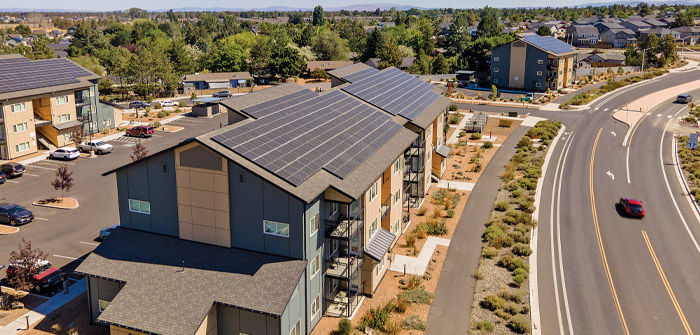
(Photo courtesy of E2 Solar )
Central Oregon’s fast-growing population is putting pressure on our region’s power grid. This is at a time when utility companies are facing higher wildfire risk and more frequent safety shutoffs. For local homes and businesses, these factors indicate that managing energy costs (and reliability) are a bigger part of the economic outlook, and rooftop solar and batteries can play a stabilizing role.
Central Oregon’s Population Boom
Central Oregon remains one of our state’s fastest-growing regions. Between 2020 and 2024, Deschutes County saw a six percent population increase and Crook County had a ten percent spike in residents, according to U.S. Census data. Bend and Redmond continue to add residents steadily, with Bend alone accounting for more than half of Deschutes County’s growth in recent annual estimates. Smaller communities such as La Pine, Sisters and Prineville are also expanding, as people and businesses look for more affordable options within commuting distance of job centers.
As in many growing areas, ongoing in-migration is impacting the demand for housing, services, and infrastructure. Managing this growth thoughtfully is key to our region’s long-term stability.
What Growth Means for the Power Grid
While growth brings economic benefits like more workers, more customers, and more investment, it also adds strain to infrastructure that is built for a smaller region. In the power sector, that strain shows up as higher peak demand, heavier use of long rural feeder lines, and rising costs to maintain the system during hotter summers and more intense winter storms.
In recent years, Pacific Power, which serves much of Central Oregon, has proposed and implemented significant rate increases to cover investments in grid infrastructure, wildfire mitigation, and new resources. The utility raised residential energy rates by 9.8 percent for 2025, following a 12.9 percent increase in 2024, a 21 percent increase in 2023, and a 15 percent increase in 2022. Further rate increases are likely to remain a trend over the next several years.
Wildfire, Safety Shutoffs, and Reliability
As demand grows, wildfire risk is also impacting how utilities operate in Central Oregon. Pacific Power and other utilities now use Public Safety Power Shutoffs (PSPS) and “enhanced safety settings” that can automatically shut off power when conditions suggest lines may pose a fire risk, especially during hot, dry, and windy weather.
These measures are designed to prevent catastrophic fires, but they also mean more frequent and sometimes longer outages for customers, even on clear days when no active fire is visible. In recent seasons, thousands of Central Oregon residents have received alerts about planned or weather-triggered outages, and local news reports document concerns about both communication and the balance between safety and reliability. For businesses dependent on refrigeration, data connectivity, or time-sensitive operations, this presents a new layer of risk.
Is the Utility Ready for Continued Growth?
From a planning standpoint, Oregon’s regulated utilities are actively investing in transmission, distribution, and wildfire-hardening measures, and those investments are subject to review by the Oregon Public Utility Commission. Pacific Power highlights hundreds of millions of dollars in planned spending to strengthen its system, modernize equipment, and improve wildfire resilience while continuing to integrate more renewable generation.
Readiness is also a question of cost and our community’s tolerance for outages. Rate proposals, wildfire safety programs, and PSPS protocols all indicate that our grid will likely be safer and more modern over time, but also more expensive to operate and more willing to shut off power during high-risk periods. Those factors have economic implications on our region — one that markets itself on quality of life, outdoor recreation, and a growing knowledge-economy workforce.
The Role of Rooftop Solar and Batteries
In these times of growth, rooftop solar and battery storage are increasingly discussed as investments that can support resilience, both for individual homes and businesses, but also for our entire region. When paired with batteries, rooftop solar can keep critical loads running during outages, which reduces the impact of PSPS events and automatic safety shutoffs.
At scale, rooftop solar and storage can also help flatten peak demand, reduce stress on rural feeders, and provide localized backup capacity. This complements the utility’s investments in transmission and wildfire mitigation. For Central Oregon’s economic outlook, that suggests a future of more diversified energy: one where the traditional grid remains essential, but where additional reliability and flexibility are provided by customers who choose to invest in their own generation of power.