

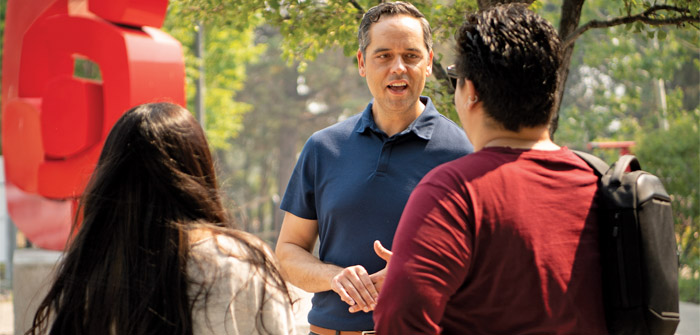
(COCC President Greg Pereira speaking with students | Photo by Rosie Day, Central Oregon Community College)
On Tuesday, May 5, COCC held its State of The College Address for its Bend campus. Delivered by COCC President Dr. Greg Pereira, the address aimed to cover primary topics, such as the state of the college today, community and economic impact, challenges and areas of opportunity, managing/tracking growth between multiple campuses, as well as the strategic direction that will determine the future of COCC.
Held at Wille Hall on COCC’s Bend campus, the address began with Pereira being introduced, and clarifying the intent of the day’s talks: to show how COCC lives up to their mission of empowering students and engaging with community through high-quality, accessible and equitable lifelong education.
“It can be difficult to serve students across five campuses and 10,000 square miles, but that is our mission and it’s what we do,” said Pereira.
Taking a look at some data, Pereira shared the news that COCC’s student population had grown in two specific ways: first, COCC students have gotten more diverse, with more than 16 percent of the student body coming from a Latino/a or Hispanic background. Additionally, COCC has a higher-than-average student age, sitting at 25.3 years old.
“When you think about economic development, redevelopment of the workforce and expanding opportunities, it makes a lot of sense that we have a lot of individuals re-careering at COCC,” Pereira said.
Looking at achieving their mission, Pereira noted that COCC stands uniquely among other community colleges, as it is the only community college that serves Central Oregon, over 10,000 square miles. In other regions and states, multiple community colleges cover similar spans of land, which takes the pressure off of each one to provide every possible service and educational opportunity. For COCC, there is no other community college to serve the community, which has helped push COCC to be a jack of all trades, when it comes to providing educational opportunities.
In terms of providing opportunity geared towards student success, Pereira highlighted how 51 percent of the student population received financial aid in the 2024-25 school year. This amounts to more than $22 million spent during that school year to help students achieve their educational goals, when they otherwise may not be able to.
Another standout stat for the college is the percent of students who are enrolled in lifelong learning programs, such as the Small Business Development Center (SBDC) and the Center for Business and Education. Approximately half of the students who attend COCC enroll in these non-credit courses or others, with the goal of taking home real skills that translate into success.
In 2025, COCC was awarded 38 new grants totaling nearly $8 million in funding for a variety of projects and expansions, including a $2.2 million Department of Education FIPSE grant that will help the Redmond campus meet the needs of a growing workforce and evolving industries.
As a result of their wide reach and constantly pushing towards their mission statement, COCC generates $349.2 million in annual economic impact, with one out of every 41 jobs in Central Oregon tied to COCC in some way. Of that economic impact, COCC alumni contribute about 74 percent, or $257.8 million annually.
The address also covered challenges, mostly surrounding budgeting. Most community colleges in the state and across the nation are cutting programs and funding, and Pereira was met with the difficult question of what that would look like for Central Oregon.
“We put forth a petition to protect higher education in our region with more than 1,400 signatures; more than any other community college in the state,” he said.
While support from the general public as well as our elected officials is there, COCC still has some difficulties to contend with, including deferred maintenance (after 76 years in operation), infrastructure needs, dealing with the national decline in enrollment in higher education and the rising cost of living in Central Oregon.
Despite these challenges, Pereira put a strong foot forward and stated, “The key takeaway from today’s state of the college is that COCC is an absolutely incredible institution, and despite challenges that come up, we always find a way forward, and we’re doing incredible work in this community.”