

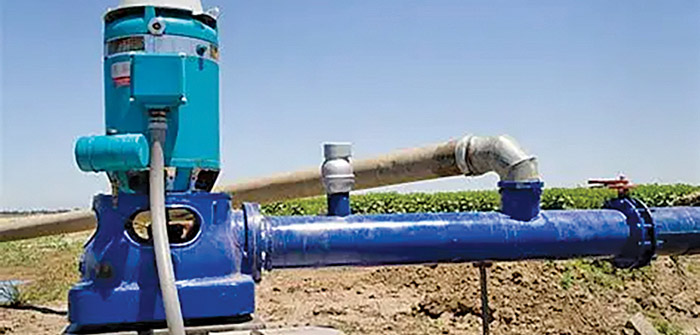
(Stettler Supply has found that improvements in technology have made water management easier | Photo courtesy of Stettler Supply Company)
“Water is life,” said Chris Carpenter. “Just as the human body can’t survive more than a few days without it, water is essential for growing cops and raising livestock” – with agriculture being the main industry in Jefferson County, and generating an estimated $63 million to $74 million in direct annual commodity sales, as well as hundreds of millions of dollars in broader Central Oregon economic impact.
Carpenter, Central Oregon manager for Stettler Supply Company, grew up in Madras among the farming and ranching communities, and sees firsthand the impact of the area’s persistent dry conditions, and the increasing importance of irrigation resources and support.
These conditions (94% of Jefferson County is currently experiencing severe drought, according to the Oregon Water Resources Dept.) and minimal streamflow have led to reduced water allotments from the North Unit Irrigation District (NUID) for the 2026 growing season. The significant drop in numbers from previous years provides farmers with just over half (57%) of their normal water supply.
Carpenter emphasized that other areas in Central Oregon are “just as challenged” by the circumstances facing Jefferson County. For example, Three Sisters Irrigation District’s senior water users (i.e., those with the oldest priority dates) are seeing a 50% allocation cut for the 2026 season).
“Producers have some tough decisions to make,” Carpenter said. “For example, local producers dependent on 1,000 acres – and only able to utilize 300 of them – will have to make up another 700 acres in order to survive. And they are doing this by leasing land from other property owners – perhaps ones based in Crook County or as far away as the Valley – which results in having noncontiguous parcels of land, all of which need water.
These circumstances require innovation and water management in irrigation, Carpenter said, “which is a really big focus for us as we work in this region. You could say that ‘it’s our niche.’”
“Improvements in technology have made water management easier,” he added, “as has growing awareness of the importance of good stewardship of land” – defined as “managing land in a way that balances human needs with long-term ecological health, ensuring that it remains productive and resilient for future generations.”
Another factor is lack of labor, Carpenter said, “with fewer and fewer people willing to do the work that’s entailed. So farmers have to adjust with, for example, remote monitoring and controls.”
He elaborated: “We educate our customers about new products such as pump systems that link to a central irrigation controller (like a smart timer), which dictates exactly when and for how long the pump and valves will run – taking into account fluctuating water needs based on factors such as outside temperatures and evaporation rates. Innovations like this allow a farmer to control hundreds of acres of noncontiguous parcels that can be anywhere from a few hundred feet to tens of miles apart.
Responding to the need for irrigation support, as voiced by people in the area, Stettler Supply opened a new location in Madras this March to better serve local producers. As Carpenter explained: “Every farm is different. Our goal is to find specific solutions that address each customer’s specific needs. This is true for all our producing friends,” Stettler said, “whether large (with thousands of acres) or small (with as few as 5-10 acres).”
Since opening in 1948, Stettler has been offering “holistic, all-encompassing irrigation solutions (including equipment installation and repair services) to Oregon farmers,” according to the company.
Carpenter defined holistic in this context: “As consultants, we’re like medical professionals who consider the whole person and focus on finding the root cause of illnesses rather than just treating symptoms. Stettler doesn’t put band aids on a single pain point, but rather looks at the customer’s whole operation and where we can best be of use.”
“The opportunity to be of service to our growers and support their operations – not just in Jefferson County but the entire Tri-County area as we look to expand our operations – is very exciting,” Carpenter said. “There’s a lot that can be done in terms of system infrastructure upgrades, and bringing new technology into the market. Stettler’s objective as a company is to align with our producers by helping them become more knowledgeable, and make it easier for them to do their job.”