
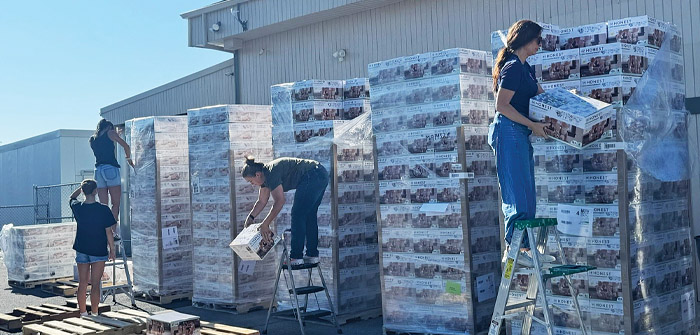
(Acquiring a 5,000-square-foot warehouse proved to be a major breakthrough for the nonprofit | Photo courtesy of Every Child Central Oregon)
While issues such as climate change, water pollution, hunger and economic instability that affect millions of people globally can seem insurmountable, an area nonprofit has been mobilizing communities to tackle one specific concern: supporting families in Central Oregon’s foster care system — one diaper at a time.
“I realized that the foster care system in this country has a lot of areas for improvement ranging from insufficient funding to overwhelmed caseworkers and a lack of mental health services — and that many people would like to do something to help,” said Melissa Lovemark, founder of Every Child Central Oregon, who has first-hand experience as a foster parent. “The majority simply don’t know what they can do, and I wanted to give them an easy on-ramp.”
“Diaper need, as I realized after taking time to dive into the data, is a growing problem,” she said. “A clean diaper means a happy baby or toddler, yet a 2023 study by the National Diaper Bank Network (NDBN) revealed that one in two U.S. families with young children cannot afford enough diapers to keep their infant or child clean, dry and healthy. Clean diapers are a basic necessity.”
Without clean diapers, Lovemark continued, babies are exposed to potential health risks such as painful rashes and urinary tract infections, and have more trips to the doctor; mothers are at risk for increased maternal depression; and parents may miss work or school because they can’t afford the diapers required to leave their children in child care.
A pilot study in 2024 provided Head Start families with a one-month supply of diapers, and “the results were remarkable,” according to Lovemark. “The diapers helped the ability of parents to go to work, and as a result, gave them hundreds of dollars back into their budget. The free supply also led to a reduction of stress: as financial security increased, families could afford to take their kids to child care. The bottom line is that $11 went back into the economy for every $1 in diaper aid provided,” she said.
Jazlyn Lepez, warehouse & volunteer coordinator for Every Child Central Oregon, shared her firsthand experiences. “It’s been very impactful just to see how much difference a pack of diapers makes. I’ve had people literally tearing up at the generosity of the community.”
Initially operating out of her garage, Lovemark subsequently expanded into two small storage units, and then to six units in the Tri-County area — “which involved a lot of driving around,” she said.
The next step was acquiring a 5,000-square-foot warehouse through grant funding and donors “who really believed in us.” (She singled out NeighborImpact for its partnership).” Lovemark admitted that “It was a risk, and I was terrified, but it proved to be a major breakthrough. I hadn’t realized how just moving things in and out of a considerably larger space could make the process so much more efficient. Yet despite its size, the warehouse already feels tight, given the growing demand for what we offer.”
She noted that in addition to diapers, Every Child Central Oregon also provides “other tangible items that kids require — everything from car seats to clothes, hygiene items, shoes and specialty items like toys. We’ll do one-off special requests as well,” Lovemark said, adding that “We’re not just trying to give the bare minimum. We want to be extremely generous.”
As the nonprofit “kept being reminded of the need for more diapers, early this year we became a member of a national diaper bank — Marked for Love — and are now able to reach further, buy in bulk and at an extreme discount and tap into larger corporate donations — which gives us a quicker impact. We have developed a reputation of reliability and trust, and companies know we have supplies to meet the most basic necessities of foster families before child welfare is involved.”
In addition, Lovemark said, as the nonprofit “has become more established, we’ve expanded our network of partner organizations, which are passing on their needs. Agencies, nonprofits and social services organizations are lining up, and we now have over 10 community partners.”
On the large donor side, she included Hayden Homes, 1st Interstate Bank, WHH Foundation, PacificSource, Guild Mortgage, the Deschutes Children’s Foundation and KTVZ 21. “We have so many wonderful partners, and are filled with gratitude beyond words.”
In her organization’s work to support foster children in Deschutes, Jefferson and Crook counties, as well as Warm Springs, Lovemark is all too aware of the ever-growing need for its services. “In 2024, we had a 300 percent increase in requests just out of our warehouse. And this year, we’re already up another 20 percent. We’re currently meeting about 95-98 percent of requests that are sent in,” she said, “but don’t see the needs slowing down anytime soon.”
Lovemark urged “people interested in joining our efforts to go to our website and sign up to help. There are always opportunities, and we will be launching new ones, while continuing to rely upon the love, generosity and dedication of our community partners, volunteers, donors and the incredible ECCO staff.”
“Supporting members of our community who need it the most is my heart and my passion,” Lovemark said. “We’re humbled by what we’ve accomplished as an organization, and deeply grateful for everyone who has joined us on this journey.”