

(Graphic courtesy of Heritage Wealth Advisors)
Our wealth management practice recently held a tax planning workshop that covers the leading strategies that we have seen make an impact in our clients’ lives — especially the top proactive techniques to [take]action on prior to Tax Day. Tax reduction is one of the many ways our team helps clients get more out of their financial resources, and it can result in an impact that can be life-changing.
At Heritage Wealth Advisors, our goal with proactive tax planning is to motivate you to take a relatively small amount of time now in creating a forward-looking plan, to create significantly more freedom for yourself in the coming years. Read on to learn about the proactive strategies that have driven the biggest positive outcomes for our clients, helping them keep more of their hard-earned money. Because it’s not about how much income or assets one has, that is most important — but rather how much of those they can keep after taxes.
The Importance of Income Diversification
While America operates within a progressive tax system, over the past several decades, we’ve seen a huge shift where billionaires are now paying a lower tax rate than the middle class. When you consider federal, state and local taxes, those ultra-wealthy households pay a total rate of about 23%, versus 24% for the working class.¹
At the center of what these wealthy families take advantage of is income diversification. Each type of income source is taxed differently in the tax code, with the most common type being income that comes from a job (W2, 1099, Schedule C income). But it’s also the most expensive — it has the highest tax brackets applied to it in the entire tax code. We’re talking upwards of 50% when accounting for federal, state, Social Security, and Medicare taxes.
Ultra-wealthy families often hire highly paid tax consultants to navigate the code, and many of them take advantage of the fact that there are other types/sources of income that are taxed at lower rates. This allows them to structure their tax returns so the bulk of their income comes from other sources, like investments (stocks, bonds, real estate, business interests) — all of which typically enjoy a lower tax rate than income from a job. This planning construct is fundamental for someone who wants to meaningfully reduce their taxes — and the good news is that many of the techniques they use are available to most of our clients as well.
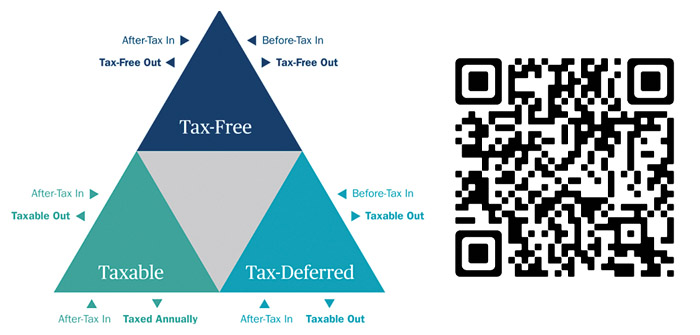
Tax Control Triangle
Another crucial tax diversification concept that many wealthy families use relates to whether their income streams are inside a tax shelter or not. We frame this by using the Tax Control Triangle, which gives us a visual for the ways in which investments can be taxed.
The key to this framework is to identify your optimal diversification across these triangles, with the ultimate goal of reducing the average tax rate you pay on your overall income. If your financial advisor and/or CPA hasn’t yet run this analysis for you, let us know and our team can do that in short order.
Now, we bring this from critical constructs and frameworks to a more tactical level. Below is a preview of some of the entry-level strategies we cover in this workshop.
Fund Tax Shelters
The first tax reduction strategy relates to funding tax shelters. While this may seem obvious, many people haven’t taken full advantage of the shelters available to them, and others miss out on certain shelters entirely. We help clients evaluate which shelter they’re eligible for, and how to maximize the available shelters, across all the following: 401(k)s; Roth 401(k)s; after-tax 401(k)s IRAs; Solo(k)s; deferred compensation plans; SEP and SIMPLE IRAs; and more.
One set of shelters we highlight allows substantially higher-than-typical tax deductions: defined benefit plans and cash balance plans. These are retirement plans (available to some business owners) that in many cases can allow for several hundred thousand dollars per year to be sheltered from tax, versus IRAs and 401Ks which typically limit funding to $7,500 to $23,500 per year.
Upstream or Downstream Gifting
Many of our clients incorporate family gifting strategies in their financial plans. They often don’t want their kids and grandkids to wait to inherit money — they want to start now so they can see their relatives enjoy the money, versus have all those benefits occur after they’re gone, or when the recipients have less of a need for it.
Fortunately, there can be significant tax savings from gifting strategies. For example, if you have highly appreciated stock that would trigger a 23.8% tax rate if you sold it, it might make sense to gift shares to a child (downstream gifting) or a parent (upstream gifting) if they’re in a lower tax bracket, and have them sell the shares. In some cases, this can result in the tax rate going down to 15%, or even 0%.
Discover More Tax Reduction Strategies
At Heritage Wealth Advisors, we’re motivated by helping people take control over how much they pay rather than just “letting taxes happen.” If you’d like to learn more about ways we can make an impact on your financial goals with strategic tax reduction, use the QR code to access the full workshop recap, which covers all of the most powerful techniques our clients have seen success with.
Source:
¹cbsnews.com/news/americas-richest-400-families-pay-a-lower-tax-rate-than-the-middle-class
Disclaimer:
The information contained in this document is not intended to provide specific recommendations to you, nor is it to be used as the primary basis for any investment decisions you might make.
Ameriprise Financial cannot guarantee future financial results.