
(Photo by Cheryl McIntosh | Quanta Collectiv)
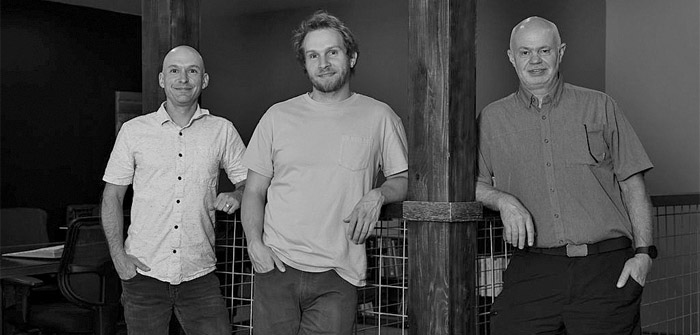
Tekneek Architecture was founded in 2005 by Larry Wright. As the founder and principal architect, Wright has spent 20 years in the business, leaving his mark on the Redmond community and others. Tekneed moved from Bend to Redmond in 2019 so that they could better focus on community-oriented projects and help bolster the growing city.
“Our projects were mostly residential to start with,” said Wright. “Then the Great Recession hit and it was around 2009 that I decided to diversify into more commercial projects.”
When the business moved to Redmond, the city was heavily pushing for downtown revitalization projects. Tekneek became involved with a number of projects with the city, and they have continued down that path ever since. “The move out to Redmond was the best decision we’ve ever made,” said Wright. “And it’s very much helped us define who we are at the core of the business.”
More focused on downtown revitalization these days, Wright is very focused on the health of his community, and how the projects taken on by Tekneek can add to that.
“We love historic architecture and we love to keep that alive,” he said. “We really want to encourage walkability within the community, so we like to work with older infrastructure that was still designed with walkability in mind.”
Prior to mass transit and lobbying from the automotive industry, cities and towns were designed with more walkability in mind, focusing on mixed-use neighborhoods as opposed to suburbia.
“We figured, why not play to our local advantages and make use of these walkable layouts? Doing so in the early stages is much simpler, easier and typically less expensive, as opposed to taking a very car-centric layout and trying to turn that into something that is mixed-use and walkable,” said Wright.
In conjunction with that development philosophy, Tekneek is involved in a number of commercial projects in the area, mostly focusing on amenities like food truck lots and tap houses near residential areas.
“You’ve got a downtown core that has a walkable radius, and a sea of residential developments that are way outside of the walkable radius,” he said. “We’ve got a handful of projects, and are looking to take on more, that create commercial spaces within those residential zones so that people can live nearby things they want and need; food and drink amenities, grocery stores, local businesses and more.”
Wright looks at Bend’s Northwest Crossing as an example of a community built for walkability. He says that while most communities he deals with were not designed in the way Northwest Crossing was, there are still many ways to mesh these communities together, increase their walkability and help bolster the health of the community, as a whole.
Why the focus on food truck lots and taphouses? Simply put, if you want people to show up, you need to provide food and drink. That is step number one, especially in Central Oregon, with the proven popularity and success of these types of amenities.
And why does Wright and Tekneek focus on these projects? Wright says that he loves to see his community succeed.
“We get a lot of satisfaction in seeing these developments succeed and in seeing our community grow in a healthy way,” he said. “In this style of growth, it’s local businesses, mom and pop shops, that get to find success and become time-honored parts of the community. We want to help them do what they do, and support local.”
Tekneek has worked all across the community, and has helped revitalize multiple areas within Redmond, both in the downtown district and beyond. They have done extensive work with the Redmond Proficiency Academy (RPA), as well as the Dry Canyon Art Center, the Blacksmith Public House, Junction Roastery and more.
They also worked on the historic Roberts & Lynch Building, where Redefined Wellness has moved into. “This building has so much history and charm,” said Redefined Wellness’s owner Katie McCarthy. “As I learned more about it, I found out it was originally home to one of Redmond’s first merchant stores, selling everything from general goods to potatoes — and one of the original owners even helped develop what’s now Roberts Field Airport. Architecturally, I love everything about it — the tall ceilings, the big windows, the classic white brick, even the old potato cellar and massive original boiler in the basement. There’s just something special about being in a place that’s seen so much of Redmond’s story.”
A Redmond resident of eight years, McCarthy has nothing but the best to say about the architecture firm that has added so much beauty and life to her community. “There’s so much energy here — new businesses, creative professionals, and people who really care about the community. Tekneek has done such an incredible job bringing new life into these spaces downtown.”