
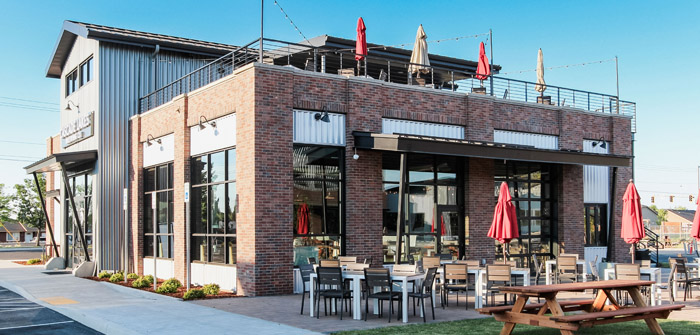
(Cascade Lakes Brewing at Reed South | Photos courtesy of STEELE Associates Architects)
History has taught us the woes of rigid single-use planning zones and less desirable single-use developments and site design which in turn led to a built environment lacking in vitality, flexibility, and sustainability.
The “New Urbanism” movement of the 1980’s fostered huge improvements in planning and zoning which in turn resulted in communities and building with enhanced livability, variety, and walkability.
Thankfully, local jurisdictions have embraced mixed-use planning principles and zoning which have given architects the freedom to design creative, flexible projects for their clients and developers. Speaking of developers, our community is fortunate to have civic-minded ones like Empire Construction & Development, Taylor Brooks, Brooks Resources, Taylor Development, and William Smith Properties who all have long histories of meaningful developments and community service in Central Oregon.
STEELE is proud to have designed Central Oregon mixed-use developments like District 2, Reed South, NoCo at Juniper Ridge, Brinson South, and Interchange which are fine examples of the benefits of mixed-use site/campus design that include benefits such as sustainability, efficiency, reduced automobile dependency, walkability, sense of place, enhanced quality of life, economic growth, and job creation.
Not all great mixed-use needs to be new construction and I am certain great things will happen through urban renovation and revitalization in the Bend Central District and other similar locations. The Old Mill District is an outstanding example of a blend of mixed-use renewal and new development with a historically sensitive aesthetic. It is wonderful when mixed-use developments create their own vibe and identity, particularly when it ties to their specific site or local historical context.
When mixed-use multi-building sites and campuses are located adjacent to housing, schools, parks, and other uses it creates a synergistic effect enjoyed by the neighborhood and community. Locals can walk or bike to or from school, work and play while experiencing safe and beautiful streets and paths which provide access to a wide variety of uses and buildings such as coffee shops, restaurants, bakeries, and offices and other uses.
Mixed-use developments can also add convenience, new life, and vibrancy to existing neighborhoods. The City of Bend’s Convenience Commercial Zone is a prime example of this. Planners created this zone spaced approximately one mile apart to serve nearby residential areas with small to medium businesses and services, designed as compact centers (max five acres) rather than strips, to promote pedestrian-friendly development. This zone allows frequent shopping needs for residents, positioned adjacent to residential zones, with development standards aiming for reduced automobile trips, walkability, and convenience for nearby residents. Reed South is such a development that brought a variety of uses, such as restaurants, a pub, brewery, a market, a gas station, offices, and pocket parks and plazas to an existing neighborhood.
While many welcome and understand the benefits of mixed-use developments in their neighborhoods some don’t, and the best way to avoid it if you don’t want it is to do your due diligence when buying or renting a dwelling and asking your realtor if the dwelling is in or adjacent to a zone that allows or promotes mixed-use development.
I’ve focused more on mixed-use site and campus design so far and would like to remind readers that sustainable long-term mixed-use and adaptability applies to individual buildings too.
One must design use adaptability into the building from the onset so that decades from now when the neighborhood, use and market has changed the building can be easily modified for its new purpose. Often when you see buildings, which are not old, demolished to make way for new ones it is because they were not readily adaptable and the cost to remodel was too great. Care should be exercised with the design of clear heights, structural grids, widths, access to natural light, and vertical cores and exit locations to allow for numerous future uses and layouts. If one does not understand these and many other design considerations, you may end up with inefficient unadaptable buildings.
As we face the challenges of rapid growth in Central Oregon, creative, sustainable mixed-use design will be a valuable tool to make certain we enhance our region’s economy, livability and built environment.
Scott Steele is the president and founder of STEELE Associates Architects in Bend. His 38-years of leadership in sustainable design and master planning has earned recognition in articles, and awards including the Environmental Center’s 2023 Enduring Sustainability Award.