
(Photo courtesy of E2 Solar)
If you’ve driven West into Bend on Highway 20, North to Redmond, or near Prineville and Powell Butte, you’ve likely noticed that utility‑scale solar farms are now part of Central Oregon’s high desert landscape. Long rows of panels stretch across former fields and shrub‑steppe, a visible sign of the clean‑energy transition.
However, this scenery also raises questions: How much land should utility-scale solar projects occupy? Is covering open land with panels the only way to go solar, or is there a better option for business owners that lies closer to home?
The Land Use Concern with Ground‑Mount Solar
Utility‑scale, ground‑mounted arrays can deliver a lot of power, but they do it by converting rangeland, farms, or wildlife habitat into industrial energy sites. Research on energy sprawl has predicted that by 2040, energy development in the U.S. could impact an area larger than Texas, with solar being a growing piece of that footprint.
Oregon state rulemaking has wrestled with how to encourage new solar while still protecting valuable farmland and habitat in Central Oregon. Wildlife experts have long cautioned that poorly sited projects can disrupt important habitats and affect species ranging from pollinators to birds and bats, which are already under pressure from climate change and development.
This isn’t to suggest that ground‑mount solar is inherently bad. Thoughtfully designed projects on disturbed or low‑value sites, with native vegetation and wildlife‑friendly fencing, can even offer climate benefits. But as demand for energy increases in our region, it matters where the next megawatts come from, especially when there’s plenty of unused roof space available.
Rooftop Solar Offers Clean Power With No New Footprint
Advocates have estimated that hundreds of thousands of solar‑equipped rooftops could supply a significant share of Oregon’s electricity, which would cut emissions equivalent to taking hundreds of thousands of cars off the road. Because rooftop systems generate power right where it’s used, they can also reduce line losses and the need for some new transmission, which further lowers the total environmental impact.
Rooftop solar lets Central Oregon diversify its energy sources without impacting the unique landscapes, farms, and habitat that define our region. By building solar on existing roofs, we make better use of space we’ve already paved, built, and wired. Panels on commercial roofs do not require grading the ground, removing vegetation or fencing off habitat. It’s a win-win: businesses can cut carbon and operating costs while keeping more of our natural and working lands intact.
A Better Fit for Communities and Businesses
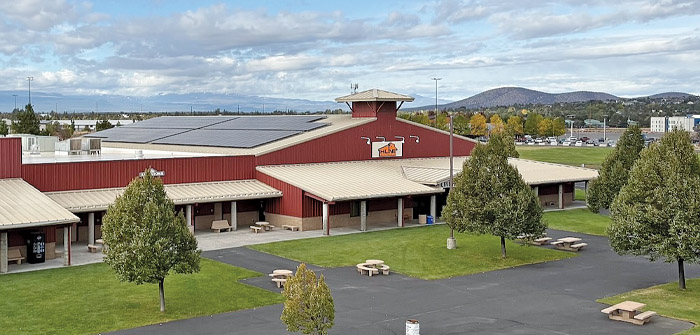
Rooftop solar also tends to align well with local values. Rather than changing the view along the highway or fencing off fields, a warehouse in Redmond or a retail center in Bend can power its operations from its own rooftop. E2 Solar recently installed a 796-panel system at Deschutes County Fairgrounds and Expo Center, demonstrating how local industry can lead the way — achieving both climate and bill‑saving benefits while strengthening local resilience and using existing infrastructure.
For commercial building owners who go solar, the resulting impacts on the environment and their bottom line are significant. Rooftop solar systems provide energy stability despite price fluctuations and potential disruptions. Additionally, these systems can improve a building’s value and demonstrate to customers a commitment to sustainability, all while reducing demand, without harming the surrounding community and ecosystems.
In many cases, flat and structurally sound commercial roofs are ideal for solar. These spaces offer clear spans, simple wiring paths, and enough area for solar to decrease on‑site energy consumption (and utility charges).
A Smarter Long Game for Solar in Central Oregon
As our region continues to grow, Central Oregon will likely need both rooftop and some well‑sited ground‑mount solar to reach long‑term climate and energy goals. The important questions we should be asking are: Which options will we prioritize first? What narrative do we want our communities to tell? Our region can be a place where clean energy spreads across fields and precious habitat, or where our schools, warehouses, offices, and stores transform their rooftops into part of the solution.
For Central Oregon’s commercial buildings, the most environmentally friendly place for solar is often where it’s been hiding in plain sight all along: right over our heads. When businesses put solar on their rooftops, they help meet clean‑energy targets without pushing the energy transition deeper into farms, sagebrush, and wildlife corridors that make this region so special.