
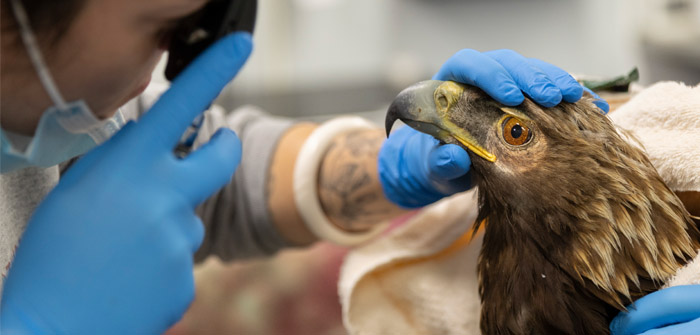
(Photo by Sue Dougherty)
A juvenile golden eagle rescued near Summer Lake in late June returned to the wild last week after more than six weeks of rehabilitation at Think Wild’s wildlife hospital in Bend.
Oregon Department of Fish and Wildlife (ODFW) personnel rescued the eagle along a roadway near Summer Lake on June 26 after finding the bird unable to fly. The bird’s intake examination at Think Wild revealed nearly all of the primary flight feathers on the right wing were missing, and the eagle had sustained a wound over their right shoulder blade. Despite the significant feather damage, examination and radiographs found no fractures or dislocations – a promising sign!
Think Wild’s veterinary and rehabilitation team treated the eagle’s wounds and provided supportive care before moving the bird into an outdoor flight enclosure. As the injuries healed, staff began assessing flight ability. Although the eagle showed gradual improvement, the missing and damaged primary feathers continued to prevent normal, sustained flight.
On July 31, the Think Wild team performed a specialized procedure called imping, which replaces damaged flight feathers with intact donor feathers. During the procedure, three damaged feathers on the eagle’s right wing were replaced with donor eagle feathers, secured into the existing feather shafts using lightweight carbon graphite rods and glue. Unlike waiting for a natural molt and feather regrowth, imping can restore the structure of the wing much sooner, allowing an otherwise healthy bird to regain flight and return to the wild. These donor feathers will fall out naturally during the next molt as new feathers grow in.
“Following the imping procedure, we saw marked improvement in lift and wing symmetry. Once the eagle demonstrated sustained, controlled flight, the bird had regained the flight ability necessary for release,” said Dr. Laura Acevedo, Think Wild veterinarian.
After passing a final flight assessment and veterinary examination, the eagle was cleared for release. On August 11, Think Wild staff returned the bird to the Summer Lake area, close to where ODFW originally found them, and released the eagle back into the wild. After leaving the transport crate, the eagle took a short initial flight, landed and perched on a post, stretched and preened each wing, then flew off and out of sight.
“This successful release is a testament to the dedication and expertise of our wildlife rehabilitation team,” said Sally Compton, Think Wild’s executive director. “Their specialized care, persistence, and attention throughout this eagle’s recovery made it possible to return this magnificent bird back to the wild where they belong.”
The successful release is especially meaningful given the challenges eagles face both in the wild and in rehabilitation. Golden eagles depend on strong, efficient flight to hunt, navigate large territories and survive. Found throughout Oregon’s open landscapes, particularly east of the Cascades, they prey primarily on rabbits, hares, ground squirrels and other small mammals and will also scavenge carrion.
Golden eagles and other raptors face a number of human-related threats, including habitat loss and fragmentation, vehicle strikes, collisions with infrastructure and exposure to lead. Eagles can ingest fragments of lead ammunition when scavenging carcasses or gut piles left in the field, while discarded fishing line and tackle can cause entanglement, injury and poisoning. Reducing these preventable hazards and protecting large, connected areas of habitat are important to supporting healthy eagle populations.
Think Wild has cared for six injured eagles so far in 2026, including two bald eagles who died from lead toxicity and associated complications, while another died from severe trauma after being struck by a vehicle. Just last week, Think Wild admitted another bald eagle after the bird became entangled in fishing line and was euthanized due to the extent of the bird’s injuries and severely emaciated condition. The golden eagle released August 11 is only the second eagle treated at Think Wild this year to recover sufficiently for release, underscoring both the severity of injuries these birds face and the intensive care often required to return them to the wild.
Successful outcomes like this one also depend on collaboration among wildlife agencies, rescuers, veterinary professionals and rehabilitators. Think Wild is grateful to ODFW for rescuing the golden eagle and transporting the bird to Think Wild for care, giving the rehabilitation team the opportunity to help them return to the skies over Summer Lake.
About Think Wild:
Think Wild is a 501(c)3 nonprofit organization located in Bend, Oregon. Our mission is to inspire the high desert community to care for and protect native wildlife through education, conservation, rescue, and rehabilitation. We provide veterinary treatment and care at the wildlife hospital, staffed by expert wildlife rehabilitation staff, animal husbandry volunteers, and our staff veterinarian. We also provide wildlife habitat installations, native plantings, and wildlife education programming for youth and the community, and can help with conflicts with wildlife. Wildlife injuries can be reported to our Wildlife Hotline at 541-241-8680, which is monitored seven days a week from 8am-6pm.
thinkwildco.org • Instagram/Facebook @thinkwildco