

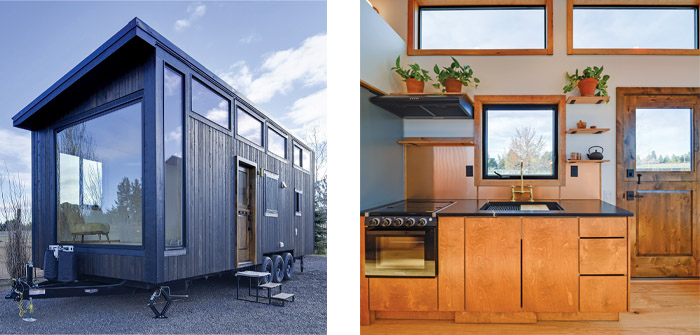
(Shown is the most recent model designed and built by Spindrift Homes called “Black Butte” | Photos courtesy of Spindrift Homes)
With 10,000 tiny homes in the United States, there’s no denying that this movement toward smaller living spaces which began in the late 1990s — is gaining momentum.
In fact, the market for tiny homes is projected to grow from $1.42 billion in 2026 to $1.79 billion by 2031 with North America leading the way due to strong demand for affordable housing solutions, followed by the Asia-Pacific region that will be driven by increasing urbanization and space constraints.
In the U.S., California, Florida, Texas, Oregon and Colorado boast the highest concentration of tiny homes, while other states with significant tiny home populations include Arizona, Georgia, Indiana, Mississippi and Washington.
So what exactly is a tiny home, who is drawn to this lifestyle, what does a tiny home cost, and what are the market’s primary considerations and constraints?
Defining Tiny Homes & Their Demographics
Tiny homes — small, efficient living spaces typically ranging from 100 to 400 square feet can take many forms, from mobile houses on wheels to repurposed shipping containers to permanent structures built on foundations. They reflect an intentional lifestyle choice to maximize functionality while minimizing excess space with an emphasis on simplicity and making a smaller carbon footprint.
Tiny homes continue to attract a mix of age groups, from older adults (around 39% are age 50+), many of whom are retirees downsizing for simpler living, to young adults seeking financial freedom. Those between 40 and 50 make up 18%, adults 30 40 comprise 21%, and under-30 homeowners also account for 21%.
In addition to providing an affordable, sustainable living option, tiny houses are also being explored as alternatives to nursing homes, temporary shelters for disaster zones, and solutions for homelessness. (For example, Oasis Village in Redmond, featuring 15 tiny homes with access to social services, is designed to assist homeless individuals in their journey toward stable housing.)
Tiny Home Costs
Whether people purchase a pre-built model or construct their own, the total cost of a tiny home can be a fraction of a traditional full-size property. (Average construction costs for a tiny home range from $30,000 to $60,000. Compare this to the typical home value in the U.S., which was approximately $356,000 to $366,000 as of early 2026, according to the Zillow Home Value Index.)
In addition, maintenance costs are lower (depending on the quality of construction materials), property taxes are often reduced and homeowners avoid large mortgages.
However, there can be additional expenses. If the tiny home is on wheels, purchasing a suitable truck, hitch and trailer drives up costs, as does securing land for a permanent or semi-permanent spot, especially in areas with high demand or strict zoning restrictions.
Environmental Impact
Tiny homes contribute to sustainability through reduced resource use. Many designs incorporate eco-friendly materials such as reclaimed wood, compact solar panels and energy-efficient appliances. In addition, smaller spaces consume less heating, cooling and electricity, lowering environmental footprints. For example, a 250-square-foot home uses 50% less energy than a standard home of 2,500 square feet. Some tiny homeowners even go off-grid, further minimizing ecological impacts.
Legal and Zoning Considerations
Zoning laws and building codes can complicate tiny home ownership. Many jurisdictions restrict where tiny homes can be placed, particularly movable ones. For instance, areas might only allow permanent structures or enforce minimum size requirements, making tiny living options limited.
However, RV parks, tiny home communities, or off-grid locations often offer more flexibility, and an increasing number of states are expanding legal pathways for both mobile and permanent setups.
In Portland and Eugene, Oregon, for example, tiny homes built on foundations can be treated as ADUs, simplifying the permitting process.
Perspective of Bend-Based Tiny Home Builder
“The market is definitely ramping up,” said Bijan, owner of Bend-based Spindrift Homes, who has been building custom tiny houses in Deschutes County for nine years since moving from Northern California. “People want them, and we’re booked out for a year.”