
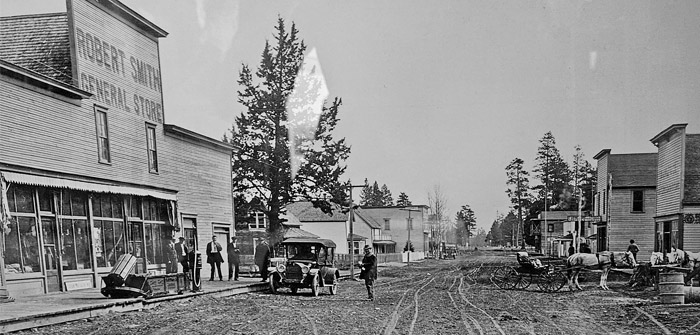
(The Sisters aesthetic was not an artificial construct, but one that hearkens back to the town’s heritage and history, as shown by this early photo of Main Street | Photo courtesy of the Three Sisters Historical Society & Museum)
“More than half of our town’s economic base is tourism, with 2024 spending estimated at more than $50 million,” said Scott Humpert, executive director of Explore Sisters, which is tasked with sustaining Sisters’ quality of livability by attracting visitors “who value the small-town atmosphere and surrounding nature that local citizens prize.” As he’s fond of saying, “it’s not the quantity, but the quality of tourists that counts.”
Counting primarily on the June — September summer season to help fill the city’s coffers, but also desirous of attracting visitors during the rest of the year, Humpert explained that Sisters has become “more of a weekend destination, with the average visit lasting two-and-a-half to three days.”
As a rule of thumb, he added, “overnight visitors have three times the economic impact of day trippers, or those passing through, filling up on gas, and getting an ice cream cone. The former category spends about $300 per person on lodging and dining, with an affinity for hiking, fishing, and mountain biking that goes beyond the necessities, such as purchasing guided experiences.”
A self-admitted “cone licker” when visiting Sisters as a child with his family, Humpert previously served in a capacity similar to his current position for ten plus years in Lincoln City. “The product we have makes it easy to promote Sisters,” he said. “It’s not a hard sell due to its small-town feel, cohesiveness, accessibility to recreational options, and great people. From the start, I found the community to be very welcoming.”
He also emphasized that “much of what Explore Sisters does is based on partnerships with local and regional groups, as opposed to operating independently — there is a lot of overlap in our promotional efforts.”
Tracing the evolution of the town’s western theme, Humpert said that it began to emerge in the 1970s, spurred by the developers of Black Butte Ranch who decided they needed a place for prospective residents and guests of the nascent resort a place to shop and dine, and believed that a unique identity would help attract visitors.
As he detailed: “Slowly but surely, the downtown core started to transform with a consistent look and feel — built brick by brick over time (and ensured through various local ordinances). This aesthetic was not an artificial construct, but one that hearkens back to the town’s heritage and history — an example being the Sisters Rodeo, now in its 85th year.”
“Sisters has grown thoughtfully,” Humpert said, “and care has been taken in the planning of the community, which regularly tops the list of ’great small towns in Oregon’ (like Jacksonville and Hood River). Yet in wanting to maintain our livability and sustainability, sometimes we tend to forget that the amenities we residents enjoy wouldn’t be what they are without tourism.”