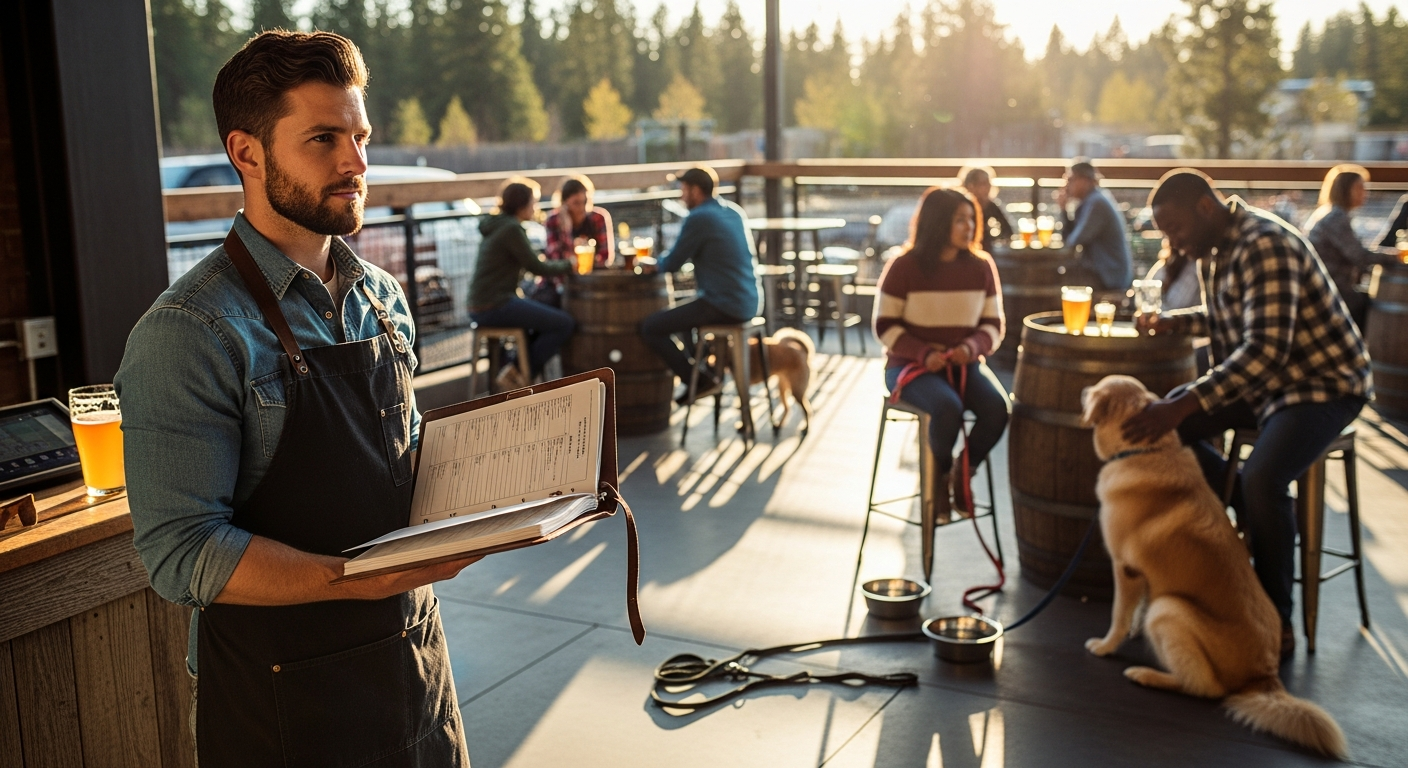


Image generated by Gemini
Bend’s dog-friendly patios, breweries, and cafés are a huge part of what makes the city’s hospitality scene so appealing. But when a dog injures someone on commercial property, the legal and financial fallout can hit business owners a lot harder than they’d expect.
This welcoming, pet-forward culture attracts customers and helps build strong local brands. It also creates a real risk that many hospitality operators don’t fully appreciate until an incident occurs. Statewide insurance data paints a clear picture: according to the Northwest Insurance Council, Oregon home insurers paid $15.5 million to settle 244 dog-bite and related-injury claims in 2024, with an average claim cost of $63,611. The central issue for operators is straightforward. When a dog injures a customer, child, employee, or delivery worker on business property, liability can extend well beyond the dog owner to the business itself. If you run a dog-friendly establishment, you need to understand how premises liability works in Bend before something goes wrong, not after.
Why Dog-Friendly Policies Create Real Premises Liability Risk
A dog-friendly atmosphere can expand your duty of care
Businesses that invite the public onto their commercial property owe a legal duty to keep the premises reasonably safe for patrons. If you actively market your brewery or café as dog-friendly (and let’s be honest, half the taprooms in Bend do), that policy can affect the legal standard of foreseeability. Foreseeability is a key issue in negligence and premises claims. If a judge or jury determines that animal conflicts were foreseeable because dogs are expected on site, your business may face a higher standard of care than one that doesn’t welcome pets.
Because you’re inviting animals onto the property, owners and managers should establish clear safety rules and enforcement protocols. You can’t simply welcome animals and then ignore how they interact with patrons, servers, and other dogs. That kind of passive approach can create a basis for civil liability. Think of it this way: if you opened a play area for kids, you wouldn’t skip the safety rails. Dogs require a similar level of operational planning.
The biggest exposure isn’t always the bite itself
Liability claims involve much more than puncture wounds. Sound surprising? As a business owner, you may face exposure from knockdowns, leash-entanglement falls, facial injuries to children, infection risks, emotional trauma, and disputes involving animal separation. Anyone who’s watched a 90-pound Lab dart across a crowded patio knows how quickly things can go sideways, even without teeth being involved.
Local public safety context shows that animal-related risk remains active in Oregon. Deschutes County Public Health recently warned residents after a bat tested positive for rabies in Sisters, highlighting how quickly animal incidents can escalate into public-health concerns. A separate report noted that a dog in Deschutes County came into direct contact with a rabid bat, prompting public caution around pets and exposure risk. While that doesn’t mean dog bites in Bend automatically involve rabies, it shows that businesses managing public spaces and animals should plan for serious and unforeseen health consequences beyond the initial incident.
How Oregon Dog Bite Liability Works on Commercial Property
Oregon uses a split framework, not a one-size-fits-all system
Understanding Oregon dog bite liability requires looking at specific statutory damages. Under ORS 31.360, an Oregon dog owner is strictly liable for a victim’s economic damages caused by a dog bite or attack. Economic damages are legally defined as measurable out-of-pocket losses, including emergency medical bills, future reconstructive treatment costs, lost wages, and rehabilitation expenses. Under these statutory rules, victims are generally exempt from proving that the owner knew the dog was vicious to recover objective economic losses. The dog’s owner is simply liable for the immediate financial burdens arising from the attack.
Non-economic damages often require a negligence-based showing
When seeking compensation for intangible losses like physical pain, mental anguish, and emotional trauma, a different legal standard comes into play. Claimants often must prove negligence or show that the owner knew (or should have known) about the dog’s dangerous tendencies. Because of this requirement, Oregon retains a version of the “one-bite rule” for non-economic damages, even though strict liability applies to economic damages. That distinction matters quite a bit in practice, because plaintiffs may try to prove negligence specifically to pursue the much larger non-economic damage categories.
A business can face a separate negligence or premises liability claim
The dog owner is rarely the only target in a commercial injury lawsuit. A business may be accused of failing to take reasonable safety steps to protect patrons. If you allowed unleashed dogs in violation of local rules, ignored a visibly aggressive animal, failed to separate dogs from crowded waiting lines, lacked a written pet policy, or failed to train staff on handling complaints, you increase your exposure to commercial property owner liability in a dog bite case.
The legal theory directed against the business is usually premises liability or standard negligence, separate from the owner liability established under ORS 31.360. In other words, even if the dog’s owner bears primary responsibility, your business can still end up as a co-defendant if the property wasn’t managed safely. Not exactly a comforting thought if you’re running a bustling patio on a Saturday afternoon.
| Economic damages after bite | Strict liability may apply under ORS 31.360 | Not strict liability; exposure depends on negligence or premises liability |
| Pain and suffering claim | Often requires proof of negligence or knowledge of dangerous tendencies | Usually requires proof the business failed to act reasonably |
| Main legal question | Did the dog cause injury? | Was the risk foreseeable, and was the property managed safely? |
| Typical evidence | Bite report, medical bills, witness statements | Pet policy, incident reports, staff actions, surveillance, ordinance compliance |
| Insurance issues | Homeowners or renters policy may respond | Commercial general liability policy may respond, subject to exclusions |
Bend Leash and Control Rules Can Shape Liability
Local ordinances help define reasonable care
Oregon often relies on city and county rules rather than a single statewide leash law. For businesses, Bend dog bite laws and local control ordinances can serve as evidence in a civil claim. If your business ignores local dog restraint rules on your property, that failure may give injured plaintiffs evidence to support a negligence claim against your establishment. Courts may treat a business’s failure to enforce local animal control laws as evidence that it didn’t maintain a reasonably safe environment. And yes, there’s a catch: “I didn’t know about the rule” generally isn’t a defense.
What business owners should watch for in practice
You need to monitor whether dogs must be physically restrained and whether off-leash behavior is permitted anywhere on your property. Watch for crowded patios that create choke points where dogs interact closely with servers, young children, and other animals. You should also make sure entry signage clearly states behavioral requirements and that staff enforce those rules consistently, not just when they feel like it.
Here’s something many operators overlook: lawfully present workers, such as delivery drivers, vendors, and contractors, may bring injury claims if an animal attacks them on your site. The USPS reported that more than 5,200 postal employees nationwide suffered dog attacks last year, and Portland ranked among the top 30 U.S. cities for dog attacks on mail carriers. Delivery workers remain a vulnerable and recurring class of victims in dog-related claims, underscoring the importance of adhering to local leash and control requirements to protect against liability.
Some of the most common operational failures that increase your exposure include:
- Allowing dogs on site without requiring a leash or close physical control
- Ignoring prior complaints about a specific dog or owner (even informal ones mentioned to a bartender)
- Failing to create distance between dogs and children’s seating or waiting areas
- Leaving staff without clear authority to intervene or document unsafe behavior
Insurance Coverage Is Often Where These Claims Turn Expensive
Homeowners coverage and commercial coverage aren’t the same
Many business owners mistakenly assume the dog owner’s personal homeowners or renters policy automatically handles all injury costs. That’s rarely true when a serious incident occurs on a commercial site. A commercial property owner may still face a dog bite claim involving business property even if the dog owner has valid personal insurance, because plaintiffs often look to commercial policy limits (which tend to be much higher). Understanding the mechanics of dog bite insurance coverage in Oregon is important to helping shield your business assets.
Common insurance gaps and exclusions
Your commercial general liability policy may cover a lawsuit, but it’s often subject to specific exclusions. You should review your policy for breed exclusions, prior-bite exclusions, total animal liability exclusions, and business pursuits exclusions. You might also find exclusions tied to special events, food vendors, or third-party operators sharing your space.
Notice failures can be just as damaging. Not reporting an incident to your carrier immediately, or disputes over whether a dog was tied to business operations, can lead to a denied claim. Ask any hospitality operator who’s been through the process, and they’ll tell you the same thing: the coverage gap you didn’t know about is the one that costs you.
Why claim value rises fast
Dog bite settlements can rise rapidly due to the physical damage that canine attacks can cause. As noted earlier, the Northwest Insurance Council reported that Oregon insurers paid $15.5 million for 244 claims in 2024, with an average claim cost of $63,611. Nationally, the risk is widespread; more than 4.5 million people in the U.S. are bitten by dogs each year, and children remain the most common victims.
Claims often become more expensive when reconstructive surgery is required, facial injuries occur, scarring becomes permanent, or psychological trauma affects a child long-term. Picture a four-year-old who gets bitten on the face while sitting at a patio table; the immediate medical costs alone can be staggering, and the long-term damages (future surgeries, emotional counseling, visible scarring) push those claims into a completely different bracket. Serious child dog bite cases can involve substantial settlements, particularly where advanced reconstructive care is involved.
How Dog Bite Claims Are Evaluated When a Business May Share Liability
Investigators usually look at both the dog owner and the property
When evaluating Oregon premises liability dog bite claims, insurance adjusters and legal investigators typically consider multiple factors simultaneously. They review internal incident reports, surveillance footage, eyewitness statements, and any documented prior complaints regarding the animal. They also check leash and control compliance, determine whether the injured person was lawfully present, and analyze the premises’ layout to identify dangerous choke points.
Staff response before and after the incident, medical documentation, and insurance correspondence may all affect the final value of the claim. Documenting these incidents correctly provides objective evidence and can be critical if litigation follows. So what does this actually mean for you? If you don’t have a formal incident report process in place right now, you’re already behind.
Child injuries often change the stakes
Children are disproportionately affected by dog bites, which can change the trajectory of a premises liability claim. Facial injuries are more common in children because of their relative height to the dog’s mouth. Cases involving children often raise larger damages questions because plaintiffs may seek compensation for future care, permanent scarring, emotional trauma, and long-term developmental impacts. On business property, maintaining a child-focused area or a family-oriented environment may increase the legal scrutiny of the business’s safety precautions and separation policies.
Liability differs from state to state
When a child gets hurt, the legal analysis tends to be more layered than most business owners expect. The claim might involve the dog owner’s statutory liability, a separate premises liability theory against the business, and a careful review of which insurance policy actually applies to the location. If you’re a parent trying to understand your rights in Oregon if a dog bites your kid, Telaré Law provides a helpful overview covering how dog bite injury claims are evaluated, including compensation, child-specific injuries, and the practical differences between Oregon and Washington liability rules.
That state-by-state distinction matters more than you might think. Washington applies a stricter dog bite liability framework than Oregon in many situations, while Oregon claims often hinge on the distinction between economic damages, negligence, and premises liability. The same physical incident can be analyzed very differently depending on where it happened and who controlled the property. For families and business owners near the border, understanding your state’s specific rules before filing or responding to a claim is essential.
Statute of limitations issues can differ for adults and minors
The timeline for filing a lawsuit depends heavily on the victim’s age. In Oregon, personal injury claims are generally subject to a two-year limitation period under ORS 12.110. For minors, state tolling rules can extend these filing deadlines, though not indefinitely. Under ORS 12.160, a minor child’s claim may be extended for up to five years, but not beyond the child’s 19th birthday.
Despite these tolling provisions, prompt action and investigation are still important because physical evidence fades, surveillance footage may be deleted, and witness memories weaken over time. If you’re a business owner, you should treat every incident as if it might result in a claim years later, because in the case of a minor, it absolutely can.
What Bend Business Owners Can Do Now to Reduce Exposure
Written rules matter more than dog-friendly branding
You’ve seen how liability works, how insurance gaps arise, and how child injuries raise the stakes. So what can you actually do about it? Start by turning your general dog-friendly branding into a written safety policy. Create a formal dog policy and clearly define leash and physical control requirements for all patrons. Reserve the right to remove unsafe or disruptive animals from your property immediately, and ensure that this authority is clearly communicated to front-of-house staff.
Document all animal-related incidents and train staff on escalation procedures so they know when to intervene, not just when to look the other way. Review your patio layout and choke points to help ensure safe passage for both people and animals, and coordinate these rules with commercial landlords where needed. A laminated policy card at the host stand is a small investment that could save you a very expensive headache.
Review your insurance before an incident happens
Don’t wait for an attack to discover your policy excludes animal incidents. Ask your insurance broker directly whether animal-related claims are excluded from your commercial general liability policy. Confirm your event and patio coverage if you regularly host large crowds alongside pets. Review the indemnity provisions for vendors, food trucks, or tenants operating on your site to help ensure their insurance protects you as well. And understand your reporting requirements after an incident so you don’t accidentally jeopardize coverage through late notice.
Treat complaints as early warnings
A prior near-miss or customer complaint can serve as evidence of foreseeability. You should log animal complaints and document management responses every single time, even if it feels like overkill. Consistent enforcement of written rules matters more than informal verbal policies that staff ignore or forget about. If a business disregards repeated complaints about a specific dog or an aggressive owner, it increases the risk of a negligence claim if that dog later injures someone. You’ve probably seen the same regular and their rowdy dog at a local spot. Now imagine the liability exposure if that dog finally bites someone and there’s no documentation on file.
A Safer Dog-Friendly Business Starts With Clear Rules
If you welcome dogs onto your property, treat that decision like any other operational risk. Allowing dogs can be great for business; just look at how many breweries in Bend built their brand partly on being pet-friendly. But it only works if the policy is actively managed and enforced. Oregon liability can involve both dog-owner strict liability for economic damages and separate negligence or premises claims against your business.
Compliance with local ordinances, careful insurance review, and documented safety procedures can reduce costly legal disputes. Implementing explicit protocols, providing thorough employee training, and conducting targeted insurance evaluations collectively safeguard your clientele while insulating your business from financial risk. That’s the kind of operational discipline that separates a well-run dog-friendly business from one that’s just hoping nothing goes wrong.