
(Graphic courtesy of Express Employment Professionals)
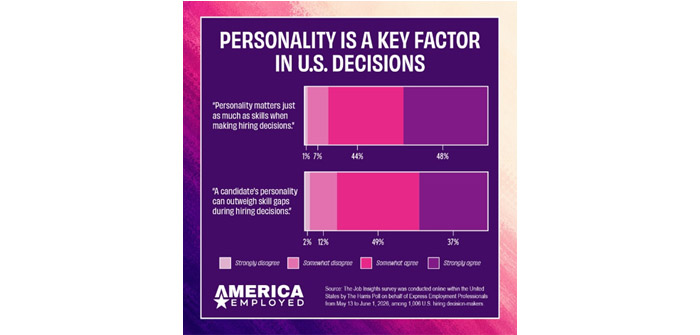
Personality may be the new hiring advantage, with 91 percent of U.S. hiring managers saying it matters as much as skills, and 86 percent saying it can outweigh a candidate’s skills gap, according to a recent Express Employment Professionals-Harris Poll survey.
Its influence extends beyond the hiring decision, with 78 percent of hiring managers and 72 percent of job seekers saying personality is at least very important to thriving at a company. That includes 29 percent of hiring managers and 20 percent of job seekers who consider it absolutely essential to long-term success.
First Impressions Carry Lasting Weight
Employers often rely on moments outside prepared interview questions to assess whether a candidate’s personality fits their company culture. Informal interactions, including small talk before or after an interview, email tone and how candidates interact with administrative staff, are the most common methods, cited by 61 percent of hiring managers.
Those early exchanges can be decisive, as 87 percent of hiring managers say they can tell from the first conversation whether a candidate will succeed at their company, including 38 percent who strongly agree. That pressure is not lost on job seekers, with 61 percent worrying about how their personality comes across during an interview.
Nearly all job seekers (94 percent) say companies have evaluated their personality during the hiring process, most commonly through:
- Informal interactions: 47 percent
- Situational questions: 46 percent
- Behavioral interview questions: 45 percent
- Reference checks: 43 percent
- Personality assessments: 37 percent
Employers and Candidates Agree on What Matters
Regardless of how personality is assessed, hiring managers and job seekers largely agree on the traits employers value most:
- Reliability: 66 percent of hiring managers and 65 percent of job seekers
- Honesty: 63 percent of hiring managers and 58 percent of job seekers
- Adaptability: 55 percent of hiring managers and 51 percent of job seekers
- Flexibility: 54 percent of both groups
- Self-motivation: 54 percent of hiring managers and 46 percent of job seekers
Job seekers also report possessing these traits at similar rates, led by honesty and reliability at 63 percent, flexibility and adaptability at 54 percent each and self-motivation at 49 percent each.
However, perceptions vary by generation. Gen X and baby boomers are more likely than Gen Z and millennials to see themselves as having these traits. Baby boomers are also more likely to believe companies value each trait on the list except flexibility.
Hiring managers place similar emphasis on the workplace behaviors behind these traits. Six in 10 consider work ethic absolutely essential, up significantly from 54 percent in spring of 2025, while 59 percent say the same of dependability and 57 percent of willingness to learn.
Personality Can Shape a Career After the Hire
Those traits continue to carry weight once an employee is on the job, as 94 percent of hiring managers and 91 percent of job seekers say personality shapes how performance is perceived.
Personality may also affect how quickly employees move forward in their careers. Nearly all hiring managers (99 percent) believe a positive or approachable personality can directly accelerate career advancement, a view shared by 90 percent of job seekers.
Survey Methodology
The Job Insights survey was conducted online within the United States by The Harris Poll on behalf of Express Employment Professionals from May 13 to June 1, 2026, among 1,006 U.S. hiring decision-makers.
The Job Seeker Report was conducted online within the United States by The Harris Poll on behalf of Express Employment Professionals from May 19 to June 8, 2026, among 1,000 adults ages 18 and older who are employed but looking for a new job or not employed and looking for work.