
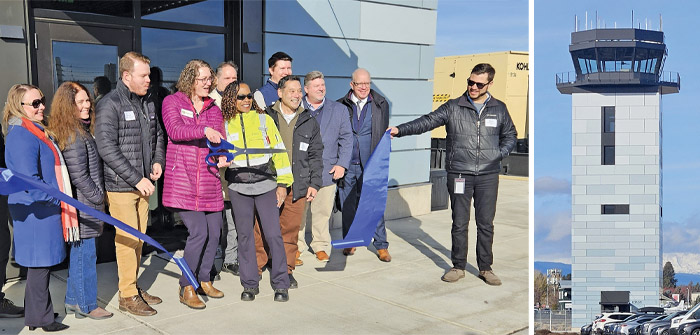
((Left) Dignitaries attending the ceremony included Bend Mayor Melanie Kebler (in bright pink jacket) who stands next to Airport Director Tracy Williams (Right) At 115 feet in height, the control tower is Bend’s tallest building | Photos by Andrea Hine)
“A lot of people don’t realize that Redmond isn’t the area’s only airport,” said Mayor Melanie Kebler, speaking at the grand opening and ribbon-cutting ceremony for the Bend Municipal Airport’s new air traffic control tower. “Yet it’s one of the busiest in the state, with 140,000+ takeoffs and landings every year — and the only airport among the five largest in Oregon that lacked a tower.”
Calling the $15 million project “a reminder of what can be produced when federal and local governments work together,” another speaker commended “the airport and all its partners. This significant investment in the future required a tremendous amount of cooperation and collaboration; it really was a group effort.” (Collaborating entities included the City of Bend, the FAA, the State of Oregon, and Deschutes County, among others.)
As Airport Director Tracy Williams emphasized in her remarks, having a control tower (the first to be built in the state since 2015) will organize the flow of traffic by providing “safe separation of aircraft by sequencing takeoffs and landings, and facilitate safer, more efficient aircraft operations.”
The Bend Airport previously operated in “uncontrolled airport airspace,” requiring pilots to coordinate directly with each other. This created what air traffic specialists call an “extremely difficult operating environment.”
Moving from construction to completion in just over two years — with financing coming from a combination of federal and state grants and airport revenue — the new control tower boasts amenities such as 360-degree views of the surrounding area, a 200kW standby generator for power continuity, weather monitoring equipment, and seismic/storm hardening to allow it to operate in virtually any scenario.
It is also equipped with a fire suppression system (similar to high-rise apartments) designed to detect, control, and extinguish fires automatically or manually before they escalate, and a pressurized stairwell to prevent smoke if fire occurs.
Airport Engineer Neilan Salerno of Morrison-Maierle, the project’s lead engineering and design firm, pointed out other features such as angled windows and motorized window shades that will allow the air traffic controllers to minimize glare that could “really distract their field of view.”
Having spent much of the last few months on site, providing construction management and coordinating testing of such vital components as an underground drywell system, Salerno commended Airport Manager Tracy Williams for her vision and fundraising tenacity. “She knows the aviation industry very well, and was adamant in creating a comfortable and modern workspace for the controllers,” Salerno said. “She was always looking out for them.”