
(Photos courtesy of School of Ranch)
School of Ranch is a nonprofit organization that teaches community members heritage skills while fostering a sense of community. Founded in 2022 by Mark Gross, the creation of the School of Ranch was inspired by the founder’s own struggles when it came to owning and managing land in Central Oregon.
“I was a city boy who moved here about five years ago when I bought a ten-acre property,” said Gross. “I needed to deal with some of the juniper trees on the property, so I bought a chainsaw without ever having used one before. I ran to YouTube but didn’t learn much.”
Gross decided to branch out and put an ad on Craigslist to see if he could get some in-person help. Sure enough, that’s when Gross met Kaleb Watson. Watson showed up and taught Gross how to handle a chainsaw and get his job done. Along the way, Gross mentioned a shift in his own perspective.
“At first I thought we would have nothing in common, but we got along great,” he said. “It inspired me to start something like this, where people can learn these outdoorsmen/heritage skills and connect with people who they might not interact with otherwise.”
This is the inspiration for the School of Ranch. According to their website, “School of Ranch hires skilled community members to teach heritage skills to newcomers and curious locals. Our mission is to educate, to keep heritage skills alive and vital and to help people discover common ground regardless of politics, age, background or beliefs.”
The skills that built Oregon are still needed today in many situations. Gross describes many Oregonians as “near the grid, but not quite off,” referring to how many people in Central Oregon want to be less reliant on certain systems but not fully disconnected from society.
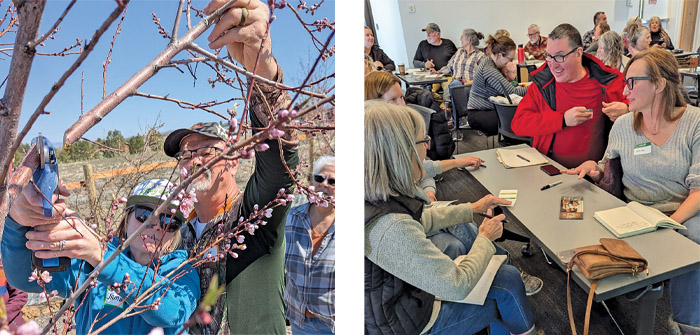
The skills and workshops offered by the School of Ranch include chainsaws and other power tools, trailer towing basics, handyman basics, motor/engine maintenance, tractor use, welding, carpentry, irrigation basics, how to start up with solar power and much more. In fact, these are just the “practical skills” offered. Outside of this category, there are artisan skills like candle and soap making as well as traditional food arts like pickling, canning, fermenting, cheese making and more.
The School of Ranch can teach you how to care for all sorts of livestock, how to manage any type of farm or garden and how to keep bees. All along the way, another goal of the nonprofit is to foster community and build relationships based on common goals and shared knowledge.
“At the beginning of a workshop, I say Americans always have more in common than we think. We can agree on most things but disagree on how to get it done,” said Gross. “By creating environments where people can talk about low level and non-controversial things, it builds the basis of a relationship that can handle more conversation on that. Once we build a baseline of respect and understanding, it makes difficult conversations easier.”
Continuing, he said, “In today’s climate, we’re very divided, but we can get people together on common goals and they get along. You’d be amazed how often I hear ‘I didn’t know you were my neighbor,’ which really sums up our mission of connection. Through teaching skills, we can bring people together and foster a real sense of community. Without politicians or the media, we really just have our neighbors. It’s so incredibly important to see our fellow people as something more than a stranger.”
The existence of the School of Ranch is testament to its success and the necessity of having a place to learn heritage skills. As a nonprofit, Gross says it is run more like a business than a charity. “We still have customers, marketing, a business model and we strive to outperform competition,” he said. “AI makes it possible for everyone to apply for every grant, leading to intense competition in a market like Central Oregon, which is already saturated with nonprofits. There is no magic way to get funding, so I set things up to run like a business. If the community did not value us and the work we do, we would not be here.”
In an increasingly virtual world, the School of Ranch actively pushes the other way; Gross has no interest in recording workshops, posting YouTube videos or holding Zoom conferences. Everything he does is in person, face to face.
“We hold potlucks because I believe it is very important, in terms of building relationships and fostering community, to break bread that you baked together,” he said. “Anything that isn’t face to face just defeats the purpose of building genuine human connection.”
Another important detail is the forgoing of the usual lecture structure. In many organizations that hold any sort of class or seminar, the usual setup involves one speaker at the front providing general information and 30 or so attendees who wish to have their specific questions answered. Every situation is unique and not always connected to someone else’s situation.
At the School of Ranch, Gross encourages the use of AI and other software to personalize lessons and help each attendee leave with an actionable plan that is specifically catered to their unique situation. By teaching people how to utilize these AI tools, Gross aims to help people become self-sufficient enough to solve their own problems by taking what they learned and being able to build off of it, in addition to learning the hands-on skills required to do the actual work.
Looking ahead, Gross sees growth and an expansion of services. Now, with so many codified processes in place, he feels confident in opening new chapters across Oregon (and the U.S.), knowing that his process can be replicated to help other communities.
“It is important to have institutions and places where we are told positive things, that the future is ours and that others share those hopes and dreams,” said Gross. “We’re creating common ground to build a future together. People have things in common and we help bring that out. We help create those bonds so later in any situation, they can see others as peers and friends as opposed to strangers.”